Best fly size for Connecticut trout streams in spring
One of the trickiest parts of fly fishing Connecticut's beautiful trout streams in the spring is dialing in the right fly size. The water conditions can be wildly unpredictable, swinging from cold, high flows to clearer, lower levels, and with that, the size of the insects trout are keying in on shifts dramatically. This guide will walk you through how to navigate these changes, helping you select the best fly sizes to ensure a successful day on the water, no matter what spring throws at you.
Understanding Spring Conditions and Trout Behavior
Spring in Connecticut is a season of transition, and our trout, whether they're wild browns in the Farmington River or recently stocked rainbows in the Salmon River, are highly attuned to these environmental cues. Understanding these patterns is the first step in choosing the right fly size.
The Early Spring Thaw and High Water
When spring first bursts onto the scene, especially in March and early April, you're often contending with melting snow and spring rains. This usually means colder water temperatures and increased flow in rivers like the Housatonic and the West Branch of the Farmington. The water might even be a bit off-color due to runoff, making it harder for trout to see small, subtle presentations.
During these conditions, trout tend to be less active and are often holding in slower, deeper pockets, behind obstacles, or along softer current seams. Their metabolism is still relatively slow, and they're conserving energy. This means they're looking for an easy, substantial meal that doesn't require much effort to chase down. When the water is high and swift, food items are swept along quickly, and trout have less time to react. This is often when bigger, more impressionistic flies shine. Think larger nymphs or even small streamers that imitate baitfish or larger aquatic invertebrates dislodged by the current. A big, juicy meal that contrasts well against murky water is often more appealing than a tiny, hard-to-spot bug.
Mid-Spring Hatches and Increased Activity
As spring progresses into late April and May, water temperatures gradually rise, and with that comes a significant increase in insect activity. This is when the classic "matching the hatch" becomes crucial. You'll start to see more consistent hatches of various mayflies, caddisflies, and stoneflies. Trout become much more active, often moving into shallower feeding lanes and even rising to the surface to intercept emerging insects.
During these periods, fly size becomes incredibly important, often even more so than the exact pattern or color. Trout can become incredibly selective, keying in on a very specific size of insect emerging from the water. If you're seeing trout rising, but they're refusing your offerings, the first thing to check is your fly size. It's not uncommon for fish to ignore a fly that's a size too large or too small, even if the color and profile are perfect. This selectivity is particularly noticeable in heavily fished streams like the certified trout management areas on the Farmington River. Observing the actual insects on the water – their size, shape, and color – is paramount.
Factors Influencing Fly Size Beyond Hatch Match
While matching the hatch is a cornerstone of spring fly fishing, it's not the only consideration for fly size. Water clarity, for instance, plays a huge role. In stained or cloudy water, a slightly larger fly can create a better silhouette and be more easily detected by trout. Conversely, in crystal clear, low water conditions, particularly in smaller streams or during a dry spell, trout can be incredibly spooky and wary, requiring smaller, more delicate presentations.
The behavior of the fish themselves also matters. Are they actively feeding on the surface, casually sipping emergers, or aggressively attacking subsurface prey? If they're being aggressive, you might get away with a slightly larger, more attention-grabbing fly. If they're hesitant, a smaller, more natural-looking fly is usually the better bet. Even the species of trout can influence your choice; wild brown trout in a backcountry stream might be less selective than educated rainbows in a highly trafficked stretch. This dynamic interplay of conditions and behavior demands a flexible approach to fly size.
Matching the Hatch: Common Spring Insects and Their Sizes
Connecticut's trout streams host a diverse array of aquatic insects, and spring sees many of them come to life. Knowing which bugs are active when, and their typical sizes, will give you a massive advantage.
Early Season Midges and Stoneflies
When early spring rolls around, typically in March and early April, the water is still quite chilly. The insect activity is usually subtle, but there are two key players: midges and stoneflies.
Midges are tiny, persistent insects that hatch year-round, but they become particularly important in colder water when other hatches are scarce. They're often so small you might not even notice them unless you're looking closely. Trout will still feed on them, sometimes with very subtle sips or dimples on the surface. For midges, we're talking about extremely small hook sizes, usually from #20 all the way down to #26 or #28. Patterns like tiny Zebra Midges, Griffith's Gnats, or even minuscule black or olive biot midges are incredibly effective. You might need to use very fine tippet, like 6x or 7x, to present these properly.
Stoneflies, on the other hand, are the behemoths of the early spring bug world. While actual stonefly hatches might be sparse and localized, their nymphs are always present in good numbers, especially in well-oxygenated, rocky rivers like the West Branch of the Farmington or the Housatonic. These nymphs are robust, active swimmers, and trout will eagerly feed on them subsurface. Early season stonefly nymphs can range in size from #8 down to #14, with many being in the #10 to #12 range. Patterns like a black or brown stonefly nymph, Pat's Rubber Legs, or a Girdle Bug are excellent choices. They provide a large profile that's easy for trout to spot and represent a significant caloric intake. Don't be afraid to go with a bigger stonefly pattern when the water is high and off-color; it can be just the ticket to entice a sluggish trout.
Caddisflies and Mayflies as Spring Progresses
As April moves into May and the water warms, the diversity and intensity of hatches explode. This is prime time for many of our most important mayfly and caddisfly species.
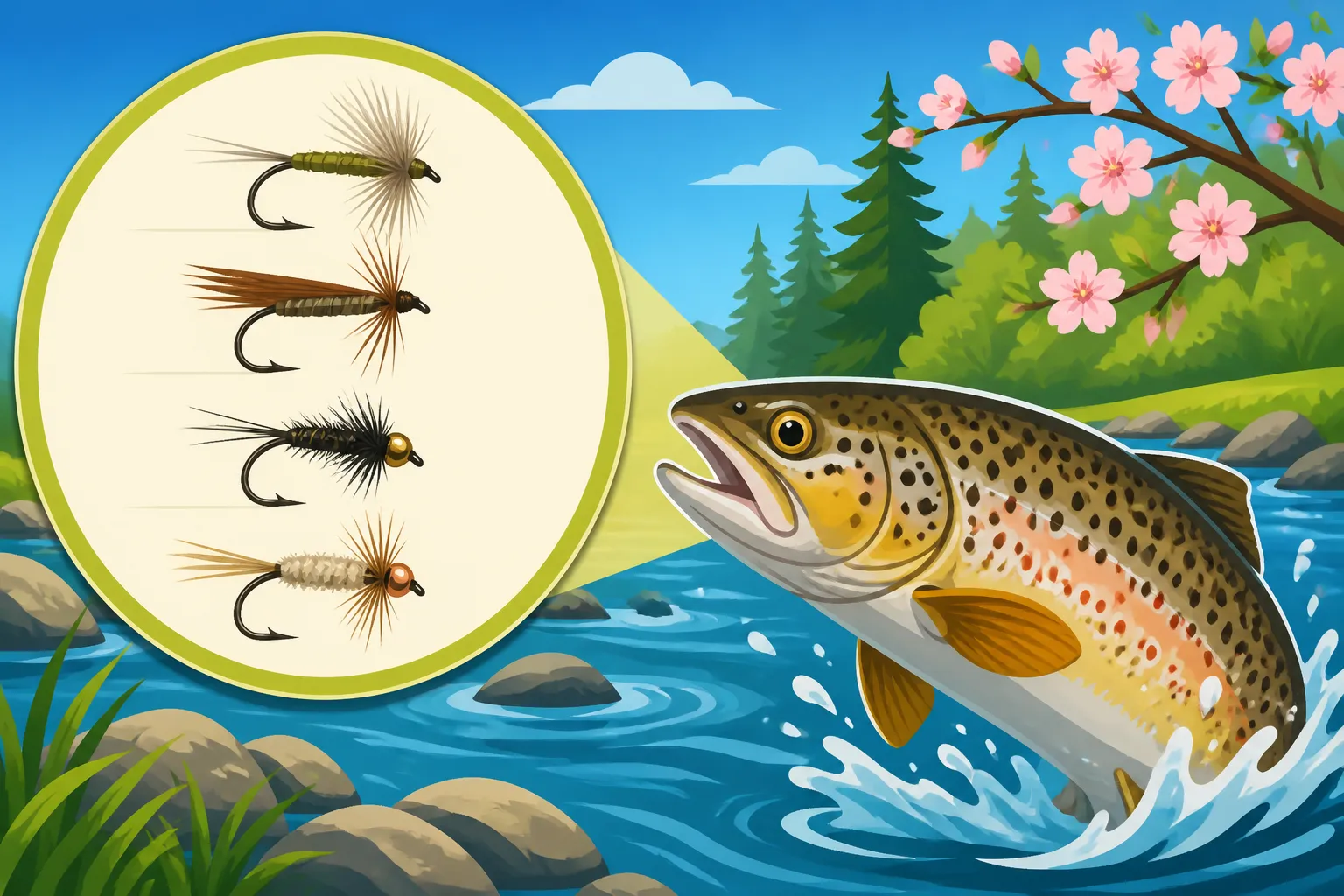
Caddisflies are often the first major "hatch" to get trout actively feeding on the surface. You'll see their adults skittering across the water, often in chaotic fashion, which can drive trout into a frenzy. Caddis hatches can be prolific, especially on rivers with good populations, and they vary in size. Early spring caddis can be a bit smaller, around #16 to #18, but as the season progresses, you'll find them in #12 to #14 ranges, and even some larger ones up to #10. Popular patterns include Elk Hair Caddis, Goddard Caddis, and various pupa patterns fished subsurface. The pupa are often more important than the adults, as trout key in on them during their ascent to the surface. For subsurface presentations, a weighted caddis pupa in sizes #14 to #18 can be incredibly effective.
Mayflies are the elegant insects that provide those classic, delicate rises. In spring, we see a succession of different species. Early on, you might encounter Blue-Winged Olives (BWOs), which are small, typically in the #18 to #22 range. These can hatch on overcast or rainy days, and trout can become very selective to their tiny profile. As May progresses, larger mayflies appear, such as Hendrickson's, Sulphurs, and March Browns. Hendrickson's are typically #12 to #14, Sulphurs are often #14 to #16, and March Browns are hearty #10 to #12. Having dry flies, emergers, and nymph patterns for each of these in their respective sizes is essential. The nymph stage of these mayflies (e.g., Pheasant Tail, Hare's Ear) in sizes corresponding to their adult forms is often the most consistent producer, especially if fish aren't actively rising. Don't forget the emerger patterns; sometimes trout will only take the fly as it struggles to break through the surface film.
Terrestrials and Attractors for Opportunistic Trout
While matching the aquatic insect hatches is often the most effective strategy, spring also offers opportunities for fishing terrestrials and attractor patterns. These can be particularly useful when there's no visible hatch, or when you're targeting less selective, opportunistic trout.
Terrestrials, like ants, beetles, and small worms, can be washed into the stream by spring rains, especially after a heavy downpour. While they become more prominent in summer, a small black ant pattern in #16 or #18, or a realistic small beetle in a similar size, can sometimes fool a trout looking for an easy meal. Worm patterns, such as a San Juan Worm or Squirmy Wormy, in sizes #10 to #14, are incredibly effective in high or off-color water, mimicking the natural worms washed in from the banks. These are less about "matching" a specific bug and more about presenting a juicy, protein-rich morsel.
Attractor patterns are designed not to imitate any specific insect, but rather to trigger a trout's predatory or aggressive instincts. These often have bright colors, flashy materials, or an exaggerated profile. In spring, especially during those early, colder days or when the fish aren't keyed into a specific hatch, attractor nymphs can be invaluable. Patterns like a Prince Nymph, Copper John, or even a brightly colored Hot Spot Nymph in sizes #12 to #16 can elicit strikes. For dry flies, a Royal Wulff or a Stimulator in sizes #12 to #16 can work well as an indicator or an impressionistic dry fly, especially in faster, broken water where a perfect imitation isn't as critical. These can be particularly good for prospecting new water or covering a lot of ground quickly.
Practical Tips for Selecting and Presenting Spring Flies
Having the right flies is one thing, but knowing how to select and present them effectively based on size and conditions is what truly makes a difference.
The "Go-To" Spring Fly Sizes for Connecticut
If you were to boil it down to a handful of "go-to" fly sizes for spring in Connecticut, focusing on versatility and common hatches, I'd suggest concentrating on the #12 to #18 range for nymphs and dry flies, and occasionally dipping into #8 to #10 for larger stonefly nymphs or small streamers, and #20 to #24 for tiny midges.
For nymphs, a good starting point would be a Hare's Ear or Pheasant Tail nymph in #14 and #16. These patterns are highly versatile and can imitate a wide variety of mayfly and caddisfly nymphs. For stoneflies, have a Pat's Rubber Legs or a similar heavy stonefly imitation in #10 and #12. These are crucial for getting down deep in fast currents. For dry flies, an Elk Hair Caddis in #14 and #16 is a must, along with a few BWO or Sulphur imitations in #16 and #18. These cover the most common hatches you'll encounter. And don't forget those tiny midge patterns in #20 or #22 for those subtle, cold-water feeders. You can often find excellent assortments of these essential sizes and patterns on Amazon, making it easy to stock up your fly box.
Adjusting Size for Water Clarity and Flow
The size of your fly isn't just about matching the natural insect; it's also about how visible it is to the trout under prevailing conditions. This is where subtle adjustments can make a huge impact.
When the water is high and murky, which is common in early spring, a larger fly often performs better. A bigger profile in sizes like #8 or #10 creates a more noticeable silhouette, making it easier for trout to detect your offering through the reduced visibility. Think of it as shouting louder when the background noise is high. This is true for both nymphs and streamers. A larger, dark-colored stonefly nymph or even a small Wooly Bugger can be incredibly effective in these conditions. When trying to decide, ask yourself if the fish can even see your fly, and if not, go up a size or two. These are the times when having a Connecticut Trout and Salmon Stamp, Explained will allow you to explore more waters, giving you more opportunities to test different fly sizes.
Conversely, as the water clears and drops, especially during a sunny, calm day in late spring, trout become much more discerning. This is when smaller flies, often in the #18 to #22 range, become essential. In these gin-clear conditions, a trout has ample time to inspect your fly, and any unnatural aspect, including an oversized imitation, can lead to a refusal. This is particularly true in special regulation waters like the Connecticut Farmington River Trophy Trout Stream Rules where fish see a lot of angler pressure. Here, you'll also need to consider dropping your tippet size to 6x or 7x to ensure a more natural drift and presentation. Remember, in clear water, stealth and realism are key, and smaller flies contribute significantly to both.
Carry a Range: Your Spring Fly Box Essentials
The biggest mistake you can make in spring is going out with a limited selection of fly sizes. As we've discussed, conditions and hatches can change rapidly, sometimes within the same hour. Your spring fly box should be a testament to versatility, stocked with a wide range of sizes for your most important patterns.
For each key pattern – whether it's a Pheasant Tail nymph, an Elk Hair Caddis, or a BWO dry fly – aim to have at least three different sizes. For instance, if you're fishing a BWO, you might want it in #18, #20, and #22. For a Hare's Ear nymph, maybe #14, #16, and #18. This allows you to make quick adjustments on the water without having to tie on a completely different pattern. Think of your fly box as a toolkit, ready for any scenario. Having a good, organized fly box helps immensely. Many anglers purchase specialized boxes for their nymphs, dry flies, and streamers, and you can find great options for these on Amazon.
Beyond just size, having a few different weights for your nymphs can also be incredibly helpful. Some nymphs come unweighted, some with a single bead, and others with a tungsten bead for getting down fast. This effectively gives you another dimension of "size" in terms of how quickly your fly sinks. A lighter nymph might be perfect for shallow, slow water, while a heavily weighted one is essential for those deep, fast runs. Regularly checking your local conditions, perhaps through the Connecticut Interactive Trout Stocking Map, Explained or reading up on local fishing reports, can help you anticipate which sizes might be most relevant for your next outing.
Here's a quick summary of essential spring fly sizes for common patterns:
| Insect Type | Typical Natural Size | Recommended Fly Sizes (Nymphs) | Recommended Fly Sizes (Dry Flies/Emergers) | Notes |
|---|---|---|---|---|
| Midges | Very Small (#20-28) | #20 – #28 | #20 – #28 | Essential for cold water, subtle takes. Fine tippet needed. |
| Stoneflies | Large (#8-16) | #8 – #14 | – (Rarely Hatch on Surface) | Great for early spring, high water, strong profile. |
| Blue-Winged Olives | Small (#18-22) | #18 – #22 | #18 – #22 | Common in early/mid-spring, especially on cloudy days. |
| Hendrickson Mayflies | Medium (#12-14) | #12 – #14 | #12 – #14 | Key mid-spring hatch, important on many rivers. |
| Sulphur Mayflies | Medium (#14-18) | #14 – #18 | #14 – #18 | Later spring, often afternoon hatches. |
| Caddisflies | Small to Medium (#12-18) | #12 – #18 (Pupa) | #12 – #18 (Adults/Emergers) | Prolific, often chaotic hatches. Pupa patterns are crucial. |
| Attractors/Worms | Varies (Impressionistic) | #10 – #16 (Nymphs/Worms) | #12 – #16 (Dry) | Good for prospecting, off-color water, or when no hatch is present. |
Remember that observing the water for natural insects or signs of feeding trout should always be your first step. Often, the trout will tell you exactly what size they prefer. Don't be afraid to experiment, especially when fish are being picky. Sometimes, a slight deviation in size can be the difference between a frustrating day and a memorable one. Learning to read the water and understand Spring Trout Fishing Techniques for Connecticut Streams will make all the difference. For more detailed information, I highly recommend checking out the Connecticut Fishing Regulations Explained for species-specific rules and tips. Many anglers also swear by specific Fly Patterns for Connecticut Trout Streams that are known producers for particular species and waters in our state. You can often find these specialized flies, or materials to tie your own, on websites like Amazon.
Disclaimer
Please note that fishing regulations and conditions in Connecticut can change. Always consult the official Connecticut Department of Energy and Environmental Protection (DEEP) website or the current Connecticut Angler's Guide for the most up-to-date information before heading out on the water. This guide is for informational purposes only and does not supersede state regulations.