Best black sea bass reefs on Long Island Sound
Finding those honey holes for black sea bass on Long Island Sound can feel like hunting for buried treasure. It's frustrating when you spend hours bouncing from spot to spot, only to pull up empty. You know these feisty bottom dwellers are out there, congregating around structure, but pinpointing which reefs are holding fish and how to effectively target them is the real challenge. This guide is here to cut through the guesswork, helping you understand black sea bass habitat, identify prime reefs across the Sound, and equip you with the knowledge to make your next trip a success.
Understanding Black Sea Bass Habitat in Long Island Sound
Black sea bass are true creatures of structure, and Long Island Sound offers an incredible array of underwater real estate that they absolutely adore. If you want to consistently find these hard-fighting fish, you need to think like a sea bass and understand what draws them to certain areas.
The Allure of Reefs and Rocky Bottoms
Imagine a vast, sandy desert—that's what much of the Long Island Sound bottom looks like. Now, picture an oasis with rocky outcrops, ledges, and jagged rubble piles. That's a black sea bass paradise! These natural and artificial structures provide everything a sea bass needs: ambush points for prey, protection from larger predators, and a rich environment for invertebrates like crabs, shrimp, and worms—their primary food sources. Think of a barnacle-encrusted rock pile, a sunken boulder field, or even an old clam bed with scattered shells; these are the kinds of spots where black sea bass thrive. They'll wedge themselves into crevices, dart out from behind rocks, and generally hang tight to any irregularity on the seabed. This is why knowing the best black sea bass reefs on Long Island Sound is critical. The more complex and varied the structure, the better chance it holds a robust population of these tasty fish.
Seasonal Movements and Depth Preferences
Black sea bass aren't static residents; they're quite migratory and their preferences change with the seasons and water temperature. In the early spring, as the water begins to warm, they move from deeper, offshore wintering grounds into shallower areas of the Sound, often congregating around inshore reefs and rocky areas to feed and eventually spawn. You might find them in depths of 20-50 feet during this time. As summer progresses and water temperatures peak, they can be found across a wider range of depths, sometimes moving deeper during the warmest parts of the day or if fishing pressure is high. During the fall, as waters cool again, they feed aggressively, fattening up before heading back to deeper, more stable offshore waters for the winter.
Understanding these seasonal shifts in their Black Sea Bass Habits in Connecticut Waters is key. For example, a reef that's red-hot in May might be nearly barren in August, while a deeper, offshore wreck could become productive. Paying attention to these movements means you're always fishing where the fish are, not just where they were. Generally, you'll find them holding anywhere from 20 to 100 feet of water throughout the open season, but their exact depth will often correlate with the prevailing water temperature and the availability of their favorite foods.
Locating Prime Black Sea Bass Reefs on Long Island Sound
Finding productive black sea bass reefs isn't always about secret spots; it's about knowing how to read the Sound and utilize the tools at your disposal. Long Island Sound is vast, but certain regions consistently produce excellent black sea bass fishing.
Eastern Sound Hotspots
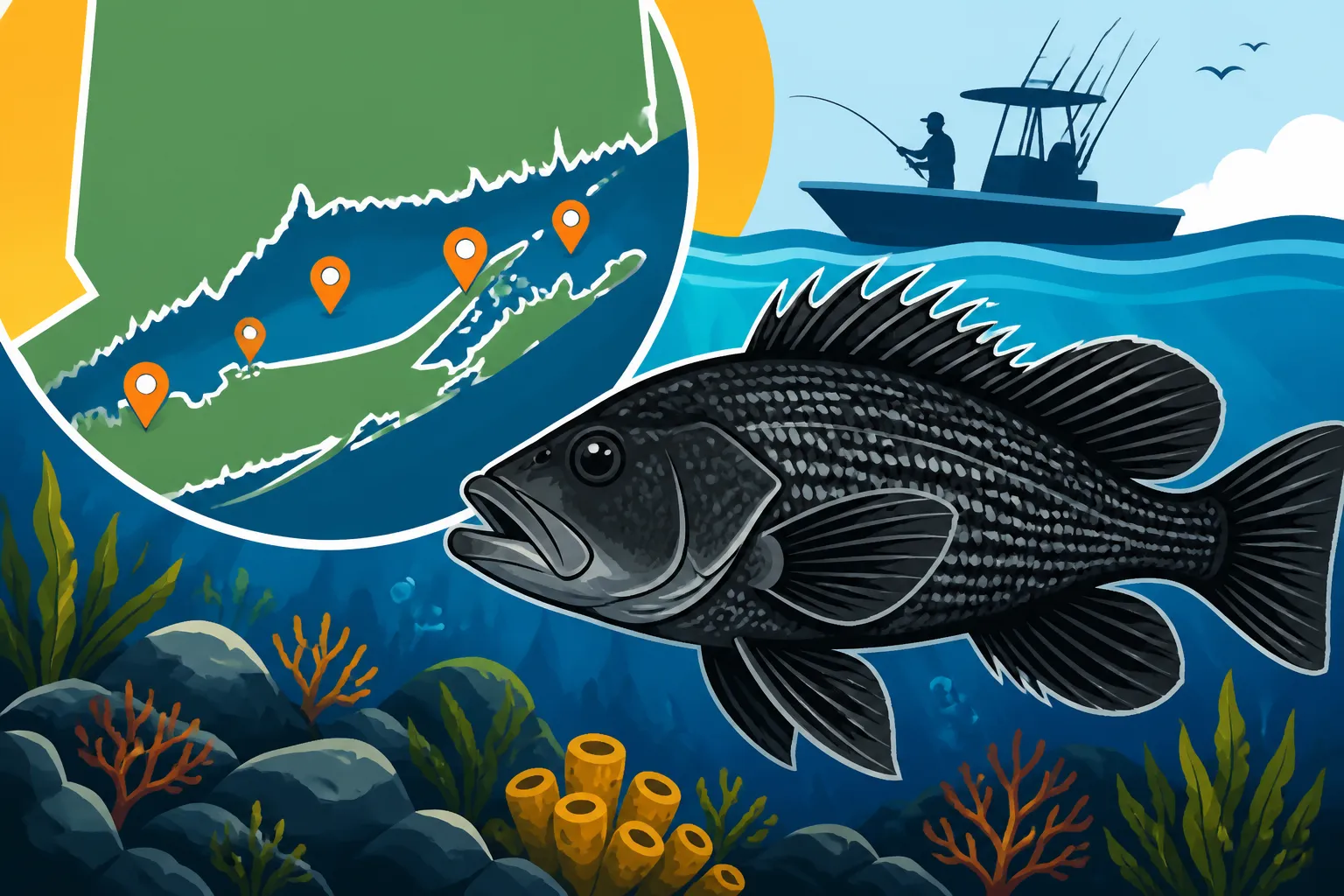
The Eastern end of Long Island Sound, particularly areas off New London, Stonington, and the mouth of the Connecticut River, are renowned for their robust black sea bass populations. This region benefits from stronger currents and a greater abundance of complex rocky structures, including natural reefs and numerous wrecks.
- Black Point Reef (Niantic/East Lyme): A widely known natural reef system, Black Point is a large, diverse area with many humps, ledges, and rocky bottom that holds fish throughout the season. It's particularly popular with charters departing from Niantic, like those you might find on FishingBooker. It offers a variety of depths, making it productive whether the fish are shallow or deep.
- Bartlett's Reef (Waterford): This extensive reef complex, stretching for miles, is a prime black sea bass destination. Its broken, rocky bottom and proximity to deeper channels make it an ideal ambush point. Anglers often drift jigs and baits over its various contours.
- The Race and Fishers Island: While these areas are more famous for striped bass, the rocky bottom and strong currents around The Race and near Fishers Island also hold significant numbers of black sea bass, especially during peak season. These areas can be challenging to fish due to the strong currents, but the rewards can be substantial.
- Wrecks off Stonington: There are numerous unnamed and historic wrecks scattered off the coast of Stonington and further east. These artificial reefs act as magnets for black sea bass and other bottom fish. Many local anglers keep these spots close to the vest, but a good fishfinder and a keen eye can reveal new territory. Charters out of Stonington Connecticut often have specific coordinates for these productive structures.
Central and Western Sound Structures
While the Eastern Sound might get a lot of press, the Central and Western portions also offer excellent black sea bass opportunities, particularly around natural rock formations and artificial structures closer to shore.
- Falkner Island Area (Guilford): The rocky ledges and broken bottom surrounding Falkner Island are well-known for holding black sea bass. It's a popular spot for both recreational anglers and charters. The depth changes around the island create good current breaks where fish like to hide.
- Branford Reef (Branford): Another prominent natural reef, Branford Reef offers varied structure and depths. It's easily accessible from ports like Branford and Guilford and can be very productive, especially in the early and late season.
- Bridgeport/Stratford Wrecks: Closer to the Western Sound, there are scattered wrecks and artificial reefs off Bridgeport and Stratford. These can be excellent spots, though they may require more searching. These man-made structures provide critical habitat in areas that might otherwise be less productive.
- Greens Ledge (Norwalk): This famous structure off Norwalk is primarily known for its striped bass fishing, but the rocky, broken bottom surrounding it also attracts black sea bass. It's a great option for anglers in the far Western Sound.
Using Marine Charts and Sonar
To truly unlock the best black sea bass reefs on Long Island Sound, you need to become adept at using marine charts and your boat's sonar. These tools are your eyes underwater.
- Marine Charts (Paper & Electronic): Start with good quality marine charts, whether physical charts from NOAA or digital charts on your GPS plotter. Look for areas marked with "Rk" (rock), "Lg" (ledge), "Wk" (wreck), or areas with closely spaced depth contours indicating steep drops or humps. Any sudden change in depth, especially near deeper channels or current seams, is worth investigating. Pay attention to notations indicating "hard bottom" or "broken bottom." These are telltale signs of black sea bass habitat.
- Side Scan and Down Scan Sonar: Once on the water, your sonar becomes your best friend. A high-quality fishfinder with side scan and down scan capabilities can reveal incredible detail. Look for "marks" (fish arches or solid blobs) directly on or just above the structure. Side scan will show you structure to the sides of your boat, helping you identify isolated rock piles or the full extent of a wreck. Down scan provides a photographic-like view directly beneath the boat, making it easier to distinguish fish from the bottom structure. Focus on identifying distinct changes in bottom hardness and contour. When you mark fish, drop a buoy or save a GPS waypoint so you can return to that precise location. Remember that what black sea bass eat around wrecks and reefs dictates where they'll be, so looking for baitfish activity in conjunction with structure is a huge advantage.
Essential Gear and Techniques for Reef Fishing Black Sea Bass
Successfully targeting black sea bass on the reefs requires the right setup and a few key techniques. These fish are strong for their size, and they live in unforgiving, snag-prone environments, so your gear needs to be up to the task.
Rods, Reels, and Terminal Tackle
When it comes to tackle, durability and sensitivity are paramount. You'll be feeling subtle bites and then muscling fish away from sharp rocks.
- Rods: A medium-heavy to heavy conventional or spinning rod, typically 6'6" to 7'6" in length, is ideal. You want a rod with a sensitive tip to detect those light bites but enough backbone to pull a strong sea bass away from snags. Many anglers prefer conventional outfits for bottom fishing as they offer more direct control over the line and weight. Rods designed for fluke or even light cod fishing often work perfectly.
- Reels: Pair your rod with a reel that has a smooth, strong drag system. For conventional setups, a reel like an Avet SXJ, Daiwa Saltist, or a Penn Squall is excellent. For spinning, look for a 4000-6000 size reel from brands like Shimano (e.g., Stradic, Spheros) or Penn (e.g., Battle, Spinfisher) that can handle braided line and has good cranking power.
- Line: Braided line is highly recommended. Its zero stretch means superior sensitivity for feeling bites and detecting structure, and its thinner diameter for a given breaking strength helps cut through current. A 20-40 lb test braid is generally sufficient. You'll want to use a fluorocarbon leader, typically 20-40 lb test, about 3-6 feet long. Fluorocarbon is less visible underwater and more abrasion-resistant than mono, which is crucial around rocky bottom. Connect your braid to your leader with a strong knot like an FG knot or a double uni knot.
- Terminal Tackle:
- Hooks: Stick with sharp, strong octopus or circle hooks in sizes 1/0 to 4/0, depending on your bait and target size. Circle hooks are excellent for black sea bass as they promote jaw hooking, reducing gut hooks and improving release survival.
- Sinkers: Bank sinkers or torpedo sinkers in weights from 2 to 8 ounces are common. The exact weight will depend heavily on current and depth. You need just enough weight to hold bottom.
- Rigs: A simple high-low rig is extremely effective. Tie two dropper loops or snell two snelled hooks a foot or so apart, with a loop at the bottom for your sinker. Another popular option is a single hook snelled directly to the leader, with the sinker on a dropper loop below, or a sliding sinker rig with a small swivel. Using a FishingBooker charter is a great way to see what local captains prefer for their terminal tackle setups.
Baits, Lures, and Jigging Strategies
Black sea bass are opportunistic feeders, so having a variety of offerings is always a good idea.
- Natural Baits:
- Squid: This is often considered the universal black sea bass bait. Strips of fresh squid (cut into thin, appealing pieces) are incredibly effective.
- Clams: Fresh shucked clams, particularly surf clams, are another top choice. Their strong scent attracts fish.
- Crabs: Small green crabs, hermit crabs, or even pieces of larger blue crabs are irresistible to sea bass, especially the larger ones. Fiddler crabs can also work in certain areas.
- Mackerel/Bunker: Small pieces of fresh mackerel or menhaden (bunker) can also be productive.
- Artificial Lures & Jigs:
- Jigs: Diamond jigs, epoxy jigs, and specialized sea bass jigs (often referred to as "squid jigs" or "bottom jigs") are incredibly effective. Sizes from 1/2 to 4 ounces are common. Tip your jigs with a piece of squid for added attraction. The technique is to drop the jig to the bottom, then lift and drop it, creating an enticing "puff" of sand or mud to attract attention.
- Soft Plastics: Bucktail jigs dressed with soft plastic curly tail grubs or Gulp! swimming mullets can also work wonders, especially in lighter current. Chartreuse, white, and pink are often productive colors.
- Teasers: Adding a small teaser fly or a bare hook above your main bait or jig can sometimes double your catch. The teaser can imitate a smaller baitfish or shrimp.
Understanding the Tide and Current
Black sea bass are highly influenced by current. They use it to their advantage, positioning themselves on the lee side of structure, waiting for prey to be swept by.
- Feeding Windows: The incoming and outgoing tides are typically the most productive times to fish, as moving water dislodges bait and makes it easier for sea bass to ambush their food. Slack tide can often be slower, though sometimes the fish will become more active as the current begins to pick up again.
- Positioning: When drifting, pay close attention to how the current moves your boat over the reef. Try to drift parallel to the structure, allowing your bait or jig to sweep naturally over key holding areas. Adjust your drift speed by using a sea anchor or by making short engine bursts to slow down. If anchoring, try to position yourself slightly up-current from the structure so your baits naturally present downstream. Being able to read the current and position your boat correctly is a skill that comes with practice, and it's something many of the best fishing charters in Connecticut excel at. For specific information on how tidal movements affect different species, you can also look into resources like the Best Time of Year to Fish in Connecticut.
Navigating Regulations and Conservation for Black Sea Bass
It’s crucial to understand and adhere to the regulations surrounding black sea bass fishing in Connecticut. These rules are in place to ensure a healthy and sustainable fishery for years to come. Fishing responsibly means knowing your limits and actively participating in conservation.
Current Connecticut Black Sea Bass Regulations
Regulations for black sea bass can change annually, so it's vital to stay up-to-date. These rules typically cover season dates, minimum size limits, and daily possession limits.
- Season Dates: Black sea bass season generally runs from mid-May through mid-December in Connecticut waters, often with a mid-summer closure or reduced bag limit to protect spawning fish. Always check the official Connecticut Department of Energy and Environmental Protection (DEEP) website or the current Connecticut Fishing Guide for the precise dates for the year you are fishing. For example, you can find specific dates in the Connecticut Black Sea Bass Regulations for 2026 article.
- Minimum Size Limit: There is usually a strict minimum length limit to ensure fish have a chance to mature and reproduce. If you catch a black sea bass that is shorter than the legal minimum, it must be immediately released unharmed.
- Daily Possession Limit: A daily limit specifies how many black sea bass an individual angler can keep per day. This limit is often subject to change and may vary depending on the season.
- Gear Restrictions: While less common for black sea bass, sometimes specific gear restrictions (like circle hook requirements for certain species) might apply. Always consult the official regulations.
It's your responsibility as an angler to know these rules. Fines for violations can be steep, and more importantly, overfishing can severely impact the black sea bass population. If you’re ever unsure, err on the side of caution or consult the Connecticut Saltwater Fishing Regulations by Species.
Practicing Sustainable Angling
Beyond just following the rules, truly responsible anglers go a step further to ensure the longevity of the fishery.
- Careful Handling and Release: If you're releasing a short fish, or practicing catch-and-release, handle the fish as little as possible. Wet your hands before touching it, support its body, and remove the hook quickly. If the fish is "vented" (shows signs of barotrauma from being brought up from deep water, like a bulging eye or distended stomach), use a descending device or vent tool to safely return it to depth. This significantly increases its chances of survival.
- Respecting Your Limits: Even if you could technically catch more, consider taking only what you need for a meal. Black sea bass are delicious, but moderation helps ensure there are plenty for others and for future generations.
- Trash No Fish: Never discard unwanted fish overboard if it's not legal or ethical to do so. Properly dispose of all waste, including fishing line and bait containers, to protect the marine environment.
- Support Conservation Efforts: Consider purchasing a Connecticut fishing license even if you don't strictly need one (e.g., if you're on a licensed charter that covers you, though it's always good to confirm). The funds generated from license sales directly support fisheries management and conservation programs by the Connecticut DEEP. Also, consider joining and supporting organizations dedicated to marine conservation. If you ever book a charter, such as through FishingBooker, many captains are passionate conservationists and can share valuable insights into sustainable practices.
By understanding where to find them, what gear to use, and how to fish them responsibly, you'll be well on your way to enjoying some of the best black sea bass fishing Long Island Sound has to offer.
| Location Category | Specific Reef/Structure | Key Features | Prime Seasons | Notes |
|---|---|---|---|---|
| Eastern Sound | Black Point Reef | Diverse humps, ledges, rocky bottom; varied depths | Spring-Fall | Popular with Niantic charters; great structure diversity |
| Bartlett's Reef | Extensive, broken rocky bottom; near deeper channels | Spring-Fall | Good for drifting jigs and baits; holds large numbers | |
| Wrecks off Stonington | Numerous unnamed and historical wrecks; artificial habitat | Summer-Fall | Often requires local knowledge or charter; magnet for fish | |
| Central/Western Sound | Falkner Island Area | Rocky ledges, broken bottom around island; depth changes | Spring-Fall | Good current breaks; accessible from Guilford/Branford |
| Branford Reef | Prominent natural reef; varied structure and depths | Spring-Fall | Easily accessible; productive early and late season | |
| Bridgeport/Stratford Wrecks | Scattered artificial reefs; critical habitat in less rocky areas | Summer-Fall | Can be found with good sonar; holds good numbers |
Disclaimer
The information provided in this guide is for general informational purposes only and is subject to change. Fishing regulations, season dates, and limits are determined by the Connecticut Department of Energy and Environmental Protection (DEEP) and can be modified at any time. Always consult the official Connecticut DEEP website or the most current Connecticut Fishing Guide before planning your trip to ensure compliance with all applicable laws and regulations. Fishing involves inherent risks, and adherence to safe boating practices and personal safety measures is always recommended.