Best kayak fishing technique for river smallmouth
There's a unique frustration that comes with targeting river smallmouth from a kayak. You're out there on the water, silently gliding, the perfect vantage point, yet sometimes those bronzebacks seem to vanish, or you just can't seem to present your lure correctly with the current swirling around you. It's a dance between paddle, rod, and river flow, and it can be tricky to master. This guide is all about helping you understand the best kayak fishing techniques for river smallmouth in Connecticut, turning those frustrating moments into triumphant catches.
Understanding River Smallmouth Behavior from a Kayak Angler's Perspective
River smallmouth bass are a different beast than their lake-dwelling cousins. They're wired for current, built for ambush, and incredibly powerful for their size. When you're in a kayak, you're experiencing their world much more intimately than from a larger boat, which is both an advantage and a challenge. You're closer to the water, more susceptible to the current, but also able to access skinny water and navigate intricate structures that larger vessels can only dream of. The key to consistent success lies in truly understanding how these fish operate within the river environment.
Current and Habitat Preferences
Smallmouth bass in rivers are masters of energy conservation. They won't fight the current constantly; instead, they'll position themselves just outside the main flow, in a "current break," waiting for food to drift by. Think of it like a buffet line for fish – they want to expend minimal effort for maximum reward. From a kayak, identifying these subtle current breaks is paramount. This could be an eddy behind a large boulder, the slack water created by a downed tree, or the calmer seam where a fast riffle meets a deeper pool. These fish will hug structure tightly, using it for both cover and an ambush point. Understanding How to fish a river for smallmouth bass is crucial for pinpointing these hotspots. You might see a seemingly uniform stretch of river, but a keen eye will spot variations in flow, depth, and bottom composition – each a potential smallmouth hideout. Your kayak's low profile and quiet approach allow you to sneak into these spots without spooking the fish.
They also show a clear preference for rocky bottoms, gravel, and submerged wood. These areas provide excellent cover, insect life, and crawfish habitat – all prime smallmouth forage. When paddling along, keep an eye on your fish finder if you have one, but also simply look at the clarity of the water and the riverbed. A stretch of river that looks "fishy" to you likely has the right ingredients for smallmouth. As seasons change, so do their preferred current speeds and depths, making adaptation a vital skill for any kayak angler.
Seasonal Movements and Feeding Patterns
Smallmouth movements in Connecticut rivers are highly seasonal, dictated by water temperature, spawning cycles, and forage availability. Knowing where they should be at any given time of year significantly boosts your chances from a kayak.
In spring, as water temperatures climb into the 50s Fahrenheit, smallmouth begin to shake off their winter lethargy and move towards shallower, sun-warmed areas. This is often pre-spawn, and they can be incredibly aggressive, actively feeding to build energy for spawning. Look for them in the slower sections of pools, near gravel beds, and around submerged woody debris where they might stage before moving onto spawning flats. Post-spawn, they might be a bit lethargic, but soon after, they’ll be back on the feed.
Summer brings consistent warm water, and smallmouth become highly active. Early mornings and late evenings often provide the best topwater action in shallower rapids and current seams. During the bright, hot midday hours, they'll often retreat to deeper pools, under shade, or into the fastest, most oxygenated current breaks. This is where your kayak's ability to reach tricky spots pays off, letting you precisely drop a lure into a shaded pocket or a deep eddy.
As fall approaches and water temperatures begin to drop, smallmouth enter a "gorging" phase, feeding heavily in preparation for winter. They can be found in a variety of depths, often transitioning between deeper pools and shallower feeding flats, following baitfish and crawfish. This can be one of the most productive times of the year, with fish often schooling up. While winter kayak fishing for smallmouth isn't as common due to colder temps and more sluggish fish, understanding that they'll seek the deepest, most stable pools helps complete the picture of their annual cycle.
Essential Kayak Setup and Gear for River Smallmouth
Getting your kayak properly outfitted for river smallmouth fishing makes a huge difference in your comfort, safety, and ultimately, your success. It’s not just about having a boat; it’s about having the right tools for the job. You're going to encounter current, obstacles, and the need for quick, precise maneuvers, so your setup needs to be dialed in.
Choosing the Right Kayak and Accessories
When it comes to kayaks for river smallmouth, stability and maneuverability are often at odds, but a good balance is key. Sit-on-top kayaks are generally favored for their stability, ease of re-entry if you happen to capsize (which, let's be honest, can happen in a river!), and open deck space for gear. Brands like Old Town, Hobie, and Perception offer excellent fishing-specific models. Pedal-drive kayaks, while pricier, offer hands-free propulsion, which is a game-changer for maintaining position in current while actively fishing. However, a good paddle kayak offers more nimble navigation in tighter, shallower stretches.
Your paddle is your primary propulsion, so don't skimp. A lightweight, carbon-fiber paddle can save you a lot of fatigue, especially if you're covering significant river mileage. Consider a longer paddle (240-260cm) if you have a wide, stable fishing kayak. An anchor system is absolutely vital. A small drag chain anchor (3-5 lbs) works well for slowing your drift in current. Alternatively, a stakeout pole can be fantastic for anchoring in shallower areas with a soft bottom, allowing you to quickly secure yourself and make precise casts. Don't forget rod holders; flush-mount holders keep rods out of the way while paddling, and adjustable RAM or Scotty mounts let you set a rod up for trolling or to hold a second rod ready for action. You can find a huge selection of these accessories on Amazon, often with great deals.
Rods, Reels, and Line Choices
Having the right tackle will help you detect subtle bites and handle powerful river smallmouth. For rods, a medium-light to medium power, fast action spinning rod (6'6" to 7'2") is a fantastic all-around choice. This provides enough backbone to fight fish in current but enough sensitivity for lighter lures and detecting those delicate taps. If you're consistently throwing heavier baits or targeting larger fish in heavy current, a medium-heavy rod might be warranted.
For reels, a 2000-3000 series spinning reel is ideal, offering a good balance of line capacity and retrieve speed. If you prefer baitcasting, a medium-heavy rod paired with a low-profile baitcasting reel works great for throwing crankbaits and jigs.
Line choice is critical. I typically spool my reels with 8-15 lb braided line for its incredible sensitivity and strength-to-diameter ratio. However, braid is highly visible and has no stretch, so it's essential to use a fluorocarbon leader (8-12 lb test). Fluorocarbon is nearly invisible underwater, provides abrasion resistance against rocks and wood, and offers a bit of stretch for shock absorption. Attach your leader to your braid with a strong knot like an FG knot or an Albright knot. Investing in good quality line from brands like PowerPro or Seaguar, readily available on Amazon, can make a real difference.
Top Kayak Fishing Techniques for River Smallmouth in Connecticut
Now that your kayak and gear are dialed in, let's talk about the techniques that really shine for river smallmouth when you're paddling the currents of Connecticut. These aren't just about casting; they're about working with the river.
The Art of Drifting and Current Control
One of the greatest advantages of kayak fishing for river smallmouth is the ability to execute controlled drifts. Instead of fighting the current, you learn to embrace it, using it to present your lures naturally and cover water effectively. The core idea is to drift slower than the current, or at least at the same speed, allowing your lure to precede you into prime holding areas.
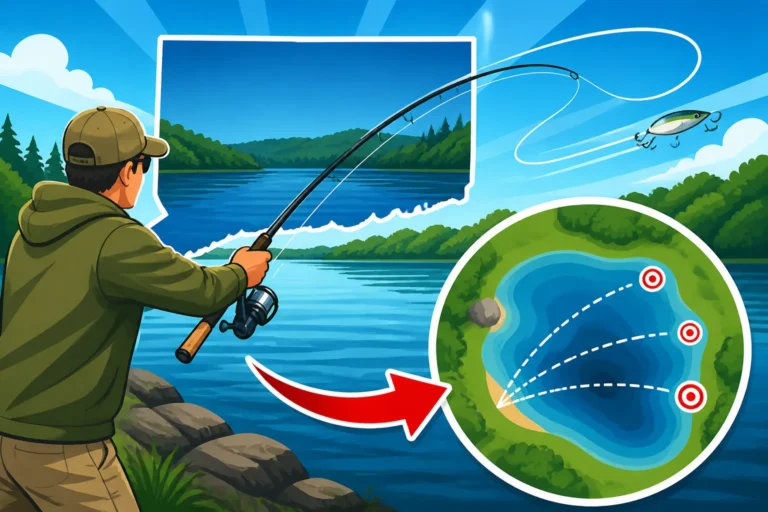
To do this effectively, learn to "ferry" your kayak across the current by angling it slightly upstream while paddling just enough to slow your downstream progress. If you have a pedal drive, this becomes significantly easier as you can keep your hands free to fish while your feet do the work. The goal is to cast upstream and ahead of your kayak, allowing your lure time to sink and drift naturally down through a suspected holding spot. As your lure drifts downstream, retrieve it just fast enough to keep a tight line and maintain contact with the bottom or the desired depth. This technique is fantastic for covering long stretches of river, effectively probing every eddy, seam, and current break. Mastering Kayak Fishing Techniques for Connecticut Rivers is all about learning this precise control.
Don't be afraid to use your anchor or stakeout pole to hold your position in a particularly promising area. This lets you thoroughly pick apart a key piece of structure, make multiple casts from different angles, and really explore the feeding zone without constantly having to paddle against the current. It's often more effective to slow down and meticulously fish a good spot than to rush through many average ones.
Lure Presentations for Active and Finicky Fish
River smallmouth can be both incredibly aggressive and surprisingly finicky, sometimes on the same day. Having a versatile arsenal of lures and knowing how to present them effectively from a kayak is key.
For moving baits, crankbaits are phenomenal. Shallow-running crankbaits (like Rapala DT series or Strike King KVD 1.5) are excellent for bouncing off rocky bottoms in shallower runs, while deeper divers can probe pools. Cast these upstream and retrieve them to get a natural drift and wobble. Spinnerbaits and chatterbaits are also deadly, especially when fish are aggressive or water clarity is reduced. Their flash and vibration attract attention, and you can swim them through current seams or over submerged grass. Small swimbaits, like those from Keitech or Z-Man, rigged on a weighted swimbait hook or a jig head, are incredibly versatile. You can slow-roll them, twitch them, or let them drift with the current. For specific recommendations, check out Best smallmouth bass lures for the Housatonic in summer.
When fish are a bit more lethargic, or you're targeting deeper holes, bottom contact baits are your best friend. Tube jigs are iconic for river smallmouth. Rig them on an internal jig head and work them with short hops and drags along the bottom. Football jigs with craw trailers are also very effective, especially when smallmouth are keying on crayfish. The Ned Rig, often using Z-Man Finesse TRD baits, has become a smallmouth phenomenon. Its buoyant material stands up off the bottom, creating a subtle, irresistible presentation. With any bottom bait, the kayak's low angle allows for excellent feel and immediate hooksets.
And let's not forget topwater. Few things are more exciting than a smallmouth exploding on a topwater lure. Poppers, walk-the-dog baits (like Heddon Super Spook Jr.), and prop baits are fantastic during low light conditions (dawn/dusk) or overcast days in summer. Cast them near current breaks, over submerged rocks, or alongside logjams, letting them sit for a moment before working them. A quality pair of polarized sunglasses, also easy to find on Amazon, will help you spot these topwater attacks and see fish darting in the clear river water.
Targeting Structure from Your Kayak
River smallmouth are almost always associated with some form of structure. Your kayak's ability to silently approach and precisely cast to these features gives you a significant edge.
Wood structure is a major draw. Fallen trees, logjams, and submerged branches create fantastic current breaks and ambush points. Approach these carefully, staying far enough away not to spook fish, but close enough for accurate casts. Pitch jigs, Texas-rigged soft plastics, or small spinnerbaits into the tightest pockets of wood. Be prepared for a strong fight, as smallmouth will try to dive back into the cover.
Rocky areas are classic smallmouth territory. Large boulders, rock piles, gravel bars, and ledges all hold fish. Smallmouth will sit on the downstream side of boulders, out of the main current, waiting for food. Use crankbaits that deflect off rocks, or jigs that you can hop and drag along the bottom. Changes in depth, where a shallow flat drops into a deeper pool, are also prime ambush points. Pay attention to your fish finder or simply the changing color of the water to identify these transition zones. Use your kayak to position yourself for the perfect cast, allowing your lure to drift naturally over the drop-off or along a seam.
Safety and River Navigation for Kayak Anglers
While the thrill of river fishing is undeniable, safety must always be your top priority. Rivers can be unpredictable, and a kayak, while nimble, is still a small craft. Being prepared means you can focus on fishing with peace of mind.
Reading the River and Identifying Hazards
Before you even launch, take the time to read the river. This means more than just looking at the surface. Online resources like USGS water flow gauges provide crucial real-time information on river levels and flow rates. A river that's too high and fast, or too low and bony, can make for a dangerous or unfishable trip. Scout your intended section using satellite maps (Google Earth is great for this) to identify rapids, potential portage spots, and major obstacles.
On the water, pay constant attention to the current. Eddies are your friends, offering respite from the main flow and often holding fish. Riffles are shallow, fast-moving sections, while pools are deeper, slower areas. Understand the difference. Crucially, learn to identify hazards:
- Strainers: Partially submerged trees or debris that allow water to pass through but can trap a kayak (and you) against them. These are extremely dangerous.
- Sweepers: Entire trees or branches overhanging the water, which can knock you out of your kayak or snag your gear.
- Dams: Obvious dangers that require portaging. Be aware of low-head dams, which are particularly insidious as they can create a recirculating current that's nearly impossible to escape.
Never turn your back on the current, and always have an escape plan if you encounter an unexpected obstacle.
Essential Safety Gear and Practices
Some safety gear is non-negotiable for river kayaking. First and foremost, wear your personal flotation device (PFD) at all times. It might feel a bit restrictive, but it could save your life. Remember, Life Jacket Requirements for Connecticut Boaters specify when and where PFDs must be worn, and for many, especially children, it's mandatory. In Connecticut, When Connecticut boaters must wear life jackets year-round during colder months (typically October to May) is also a rule, regardless of age, due to the dangers of cold water immersion. Don't take chances.
Beyond your PFD, carry a whistle to signal for help. A throw rope is invaluable for rescuing a buddy or recovering a capsized kayak. A rescue knife attached to your PFD is essential for cutting yourself free from entangled lines or ropes. Keep your phone in a waterproof case or consider a satellite communicator for areas with no cell service. It’s also wise to fish with a buddy, especially on unfamiliar or challenging stretches of river. This "buddy system" ensures someone is there to help if you run into trouble.
Top Connecticut Rivers for Kayak Smallmouth Fishing
Connecticut boasts some fantastic rivers for smallmouth bass, offering diverse experiences for kayak anglers. Each river has its own character, current, and structure, making exploration a rewarding endeavor.
The Housatonic River's Smallmouth Prowess
When you talk about river smallmouth in Connecticut, the Housatonic River inevitably comes up. It's truly a gem, known for its consistent smallmouth action and the potential for true trophy bronzebacks. The "Housy" offers a variety of water, from swift rapids and rocky stretches in its upper reaches to wider, deeper sections downstream. Access points are numerous, and many stretches are perfect for float trips in a kayak, allowing you to cover significant water.
From Bulls Bridge Recreation Area down to the Stevenson Dam, you'll find excellent smallmouth habitat. Look for them holding in the eddies behind large boulders, along the rip-rap banks, and in the seams of current where faster water meets slower. During the summer, the fish often stack up in the oxygenated fast water. Drifting jigs, soft plastics, and crankbaits through these areas is highly effective. The Housatonic can be a challenging river, especially during higher flows, so always check conditions before heading out. For a comprehensive overview, check out our Housatonic River Fishing Guide and specifically, Best kayak fishing on the Housatonic River.
Other Productive Connecticut Smallmouth Rivers
While the Housatonic often gets the most fanfare, other rivers across Connecticut offer fantastic kayak smallmouth fishing opportunities for those willing to explore.
The Naugatuck River has seen a remarkable ecological recovery over the past few decades and now supports a healthy population of smallmouth bass, particularly in its middle and lower stretches. While it's also known for its trout stockings, anglers often encounter feisty smallmouth in the same runs and pools. Look for smallmouth in the classic current breaks, around bridge pilings, and any submerged debris. The river runs through several towns, offering relatively easy access in many spots. Our guide on Naugatuck River Trout Fishing Spots also covers areas where smallmouth thrive.
The Farmington River, famed for its trout, also holds surprisingly good smallmouth bass in its lower sections, downstream of the major trout management areas. Once the water warms up, smallmouth move into these sections, offering a different angling experience. You'll find them in the deeper pools and slower runs, especially where the river widens and has more rocky structure. This can be a great option if you're looking to target both species on a single trip, transitioning from trout tactics upstream to smallmouth tactics downstream.
Finally, don't overlook urban rivers like the Quinnipiac River. While often overlooked, certain stretches, particularly around bedrock and bridge structure, can hold good numbers of smallmouth bass. It’s a great option for a quick after-work trip. For more specific access and tips on this overlooked gem, explore our article on Quinnipiac River smallmouth bass access. Remember that these smaller rivers might have less defined features, making your observation skills even more critical.
No matter which river you choose, always check the Connecticut Fishing Regulations Explained before you go, as rules can vary by water body and species. And consider that the Best Time of Year to Fish in Connecticut for smallmouth usually aligns with warmer water temperatures, making late spring through early fall prime time.
Kayak Smallmouth Lure Comparison for Connecticut Rivers
| Lure Type | Best Conditions | Target Depth | Retrieval Style | Notes |
|---|---|---|---|---|
| Tube Jig | Rocky bottoms, current breaks, varied clarity | All Depths | Hop, drag, dead drift | Mimics crawfish/baitfish; excellent feel and natural action. |
| Ned Rig | Clearer water, finicky fish, moderate current | Shallow-Mid | Drag, slight hops, subtle shakes | Buoyant plastic stands up; incredibly subtle and effective. |
| Shallow Crankbait | Riffles, rocky runs, aggressive fish | 2-6 feet | Cast upstream, retrieve with current, deflect off structure | Great for covering water; vibration and wobble draw strikes. |
| Spinnerbait/Chatterbait | Stained water, current seams, around wood | Shallow-Mid | Steady retrieve, slow roll, twitch | Flash and vibration excellent in less clear water. |
| Small Swimbait | Around baitfish schools, current seams, clear water | All Depths | Slow roll, twitch, jig on bottom | Versatile, mimics baitfish naturally. |
| Topwater Popper/Walker | Low light, calm water, aggressive fish | Surface | Pop, walk, pause | Exciting strikes, best for active fish and covering flats. |
Disclaimer
The information provided in this guide is for general informational purposes only. Fishing regulations, conditions, and best practices can change. Always consult the latest Connecticut Department of Energy and Environmental Protection (DEEP) fishing regulations before heading out. Ensure you prioritize safety on the water and adhere to all local, state, and federal laws.