Connecticut fishing rules on Army Corps of Engineers reservoirs
Standing on the shoreline of a flood control reservoir, rod in hand, trying to figure out whether federal park rangers or state conservation officers enforce the local rules can feel downright confusing. Many Connecticut anglers get caught off guard by the dual layer of jurisdiction governing United States Army Corps of Engineers (USACE) project lands. This guide breaks down exactly how federal management overlays with state regulations, detailing horsepower limits, licensing needs, and vessel restrictions across Connecticut’s primary USACE reservoirs so you can fish legally and stress-free.
Understanding USACE Authority vs. Connecticut DEEP Regulations
Navigating the waters on federal flood control property requires balancing two distinct regulatory bodies: the U.S. Army Corps of Engineers and the Connecticut Department of Energy and Environmental Protection (DEEP). While the federal government owns and maintains the dam infrastructure, surrounding parklands, and water basins, the state of Connecticut manages the living aquatic resources inside those bodies of water. Understanding where one agency’s rulebook ends and the other begins prevents costly citations and keeps your trip on track.
Federal Property Rules vs. State Inland Fishing Licenses
When you set foot on an Army Corps reservoir in Connecticut, Title 36 of the Code of Federal Regulations governs your conduct on the land and water surface. However, when it comes to taking fish from the water, state law reigns supreme. You must hold a valid inland permit, which you can easily understand by reviewing Connecticut Inland vs Marine vs All-Waters License, Explained. Federal rangers do not issue separate fishing licenses, nor do they sell state permits at lake gates, meaning you must secure your credentials online or through an authorized vendor before arriving at the recreation area.
Federal authority focuses primarily on public safety, property preservation, and environmental stewardship. For instance, USACE Title 36 regulations prohibit damaging shorelines, cutting live timber for campfires, leaving trash behind, or entering marked restricted zones near intake structures and dam spillways. State environmental police officers and federal park rangers maintain co-jurisdiction on these lands. That means an officer from either agency can inspect your catch to verify compliance with Connecticut daily creel limits, legal length minimums, and seasonal restrictions.
Boating Restrictions, Horsepower Limits, and Non-Motorized Craft
Boating on an Army Corps reservoir requires strict adherence to both state navigation laws and federal pool-specific mandates. Because these lakes primary exist for flood risk management, water levels fluctuate significantly throughout the year. As a result, speed limits and propulsion rules are heavily restricted to reduce shoreline erosion and protect shallow water habitats.
Before launching any vessel, anglers must familiarize themselves with Connecticut Boating Laws for Anglers. Many federal reservoirs in the state enforce maximum horsepower limits or restrict powerboats entirely to electric trolling motors. On smaller flood control pools, internal combustion engines are completely prohibited to maintain water quality and preserve a tranquil environment for non-motorized recreation. If you plan to paddle a kayak, canoe, or belly boat, you should check whether your vessel requires registration by consulting the Connecticut non-motorized boat registration exemption guidelines.
Key Army Corps of Engineers Reservoirs in Connecticut and Specific Fishing Rules
The Army Corps of Engineers manages several vital reservoir systems across eastern and western Connecticut. While all federal lands share baseline Title 36 protections, each individual reservoir feature operates under customized operational rules based on lake size, surrounding municipal watersheds, and regional flood management requirements.
Mansfield Hollow Lake and West Thompson Lake
Located in Windham and Tolland counties, Mansfield Hollow Lake represents one of eastern Connecticut’s premier multi-use fisheries. Created by the damming of the Fenton, Mount Hope, and Natchaug rivers, this sprawling 500-acre lake offers exceptional warmwater fishing for largemouth bass, northern pike, and panfish. For a deep dive into angling strategies on this body of water, refer to our comprehensive Mansfield Hollow Lake Fishing Guide.
Boating on Mansfield Hollow Lake is subject to strict speed and motor restrictions. Gasoline engines are limited to low horsepower thresholds—typically 8 horsepower—and a lake-wide 8 mile-per-hour speed limit is strictly enforced by both state and federal personnel. Swimming is explicitly prohibited throughout Mansfield Hollow Lake due to sudden drop-offs and underwater hazards, though fishing from kayaks, canoes, and small motorboats is widely popular.
Further northeast in Windham County, West Thompson Lake on the Quinebaug River offers a similar fishing landscape. Encompassing roughly 200 acres of impounded water, West Thompson Lake is an ideal destination for shoreline panfishing, kayak angling, and spring trout fishing. Motorboat operations are limited to slow, no-wake speeds. Public boat launches provided by the Army Corps offer gravel ramps and accessible fishing docks, but anglers must always remain aware of fluctuating water depths caused by dam releases upstream.
Colebrook River Lake and Naugatuck River Basin Reservoirs
In the western hills, Colebrook River Lake spans the Connecticut and Massachusetts border along the West Branch of the Farmington River. This deep, coldwater reservoir provides excellent opportunities for trout, smallmouth bass, and holdover species. Because Colebrook River Lake serves as a multi-state flood control asset and downstream flow management system, water levels can drop drastically during late summer and early autumn. Boaters launching here must exercise extreme caution regarding submerged rock hazards and shifting shoals.
Further down in the Naugatuck River Basin, the Army Corps operates a network of smaller flood control dams including Hop Brook Lake in Naugatuck, Black Rock Lake in Thomaston, and Northfield Brook Lake in Litchfield.
* Hop Brook Lake: Offers a popular designated swimming beach and recreation area, but boaters are restricted strictly to electric trolling motors or paddle craft. Gasoline outboard motors are strictly forbidden on the water.
* Black Rock Lake and Northfield Brook Lake: Focus primarily on light-tackle shoreline angling and carryover trout stocking. Internal combustion engines are prohibited here as well, making them quiet refuges for bank fishermen and float tube anglers.
* Thomaston Dam: While widely recognized for its off-road vehicle trails along the reservoir basin, the river corridor behind Thomaston Dam provides seasonal fishing access. However, water levels are strictly maintained as a dry bed reservoir during normal conditions, filling only during flood events.
| Reservoir Name | Location | Water Size (Approx.) | Primary Fish Species | Boating & Propulsion Limits |
|---|---|---|---|---|
| Mansfield Hollow Lake | Mansfield / Windham | 500 Acres | Northern Pike, Largemouth Bass, Crappie | Max 8 HP gas motors, 8 mph speed limit |
| West Thompson Lake | Thompson | 200 Acres | Largemouth Bass, Channel Catfish, Panfish | Slow, No-Wake speed limit lake-wide |
| Colebrook River Lake | Colebrook | 800+ Acres | Brown Trout, Rainbow Trout, Smallmouth Bass | Open to powerboats; severe drawdowns common |
| Hop Brook Lake | Naugatuck | 20 Acres | Trout, Largemouth Bass, Sunfish | Electric motors and non-motorized craft only |
| Black Rock Lake | Thomaston | 20 Acres | Stocked Trout, Panfish | Non-motorized and electric trolling motors only |
Essential Fishing Gear, Access Rules, and Seasonal Considerations
Planning a successful fishing trip to a USACE reservoir requires more than just picking out the right lures. The unique structural environment of flood control impoundments—featuring steep banks, submerged timber, and rapid water elevation shifts—demands specific gear preparation and strict adherence to seasonal site rules.
Permitted Fishing Methods, Ice Fishing, and Shoreline Access
Standard hook-and-line angling is permitted across all open waters of Connecticut Army Corps reservoirs, provided you adhere to state gear limitations. You may fish with up to three lines simultaneously in open water, which is standard across Connecticut inland waters. When rigging your gear, stocking up on specialized terminal tackle, braid, and soft plastics online through Amazon is a convenient way to prepare your tackle box before heading out into the field.
Shoreline access is generally open to the public along federal park boundaries, but anglers must pay close attention to posted property markers. Entering fenced engineering yards, climbing on concrete dam spillways, or fishing from intake towers is strictly prohibited under federal law and enforced with hefty fines.
Winter brings exceptional hard-water fishing opportunities to reservoirs like Mansfield Hollow and West Thompson. However, ice fishing on Army Corps projects carries inherent risks due to subtle currents and water level drawdowns managed by dam operators. When water levels drop beneath a thick sheet of ice, air pockets can form, making the ice structurally unstable near the shoreline and dam outflows. Before venturing out onto the hard water, review Connecticut Trout Management Area Regulations and regional ice safety guidelines to ensure you are fishing legal, safe locations.
Park Operations, Daily Access Fees, and Safety Gear Essentials
Unlike standard state park management, Army Corps recreation areas operate under federal day-use guidelines. Many USACE sites charge seasonal day-use parking fees or accept federal recreation passes, such as the America the Beautiful Interagency Pass. Gates at federal parks are typically locked at sunset, and overnight parking or camping outside designated campgrounds is strictly forbidden. If you get stuck behind a locked park gate after hours, local police or federal rangers will have to be dispatched to let you out, often accompanied by a parking violation fine.
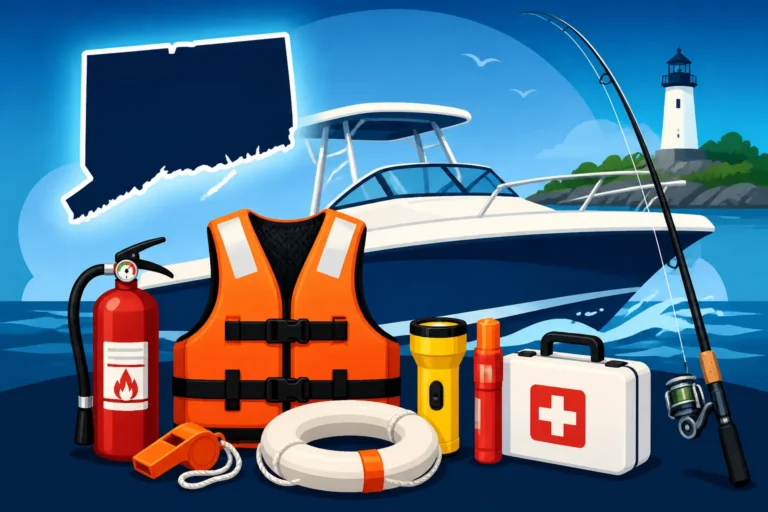
Safety equipment requirements on federal waters are uncompromisingly enforced. All vessels must carry appropriate safety gear matched to the size of the craft. Before hitting the water, anglers should cross-check their onboard gear with the Connecticut required boat safety equipment checklist.
It is easy to order USCG-approved throw cushions, signal whistles, and dry bags on Amazon to keep your vessel compliant without breaking the bank. Furthermore, life jacket compliance is heavily monitored on federal impoundments. You must follow the operator requirements outlined in Connecticut safe boating certificate age requirement and adhere to vessel life preserver mandates detailed in Life Jacket Requirements for Connecticut Boaters. During cold weather months, remember that Connecticut state law mandates wearing a life jacket continuously on small craft, as detailed in the Connecticut Cold Water Life Jacket Rule (October to May).
Navigating Permits, Special Use Rules, and Environmental Protections
Because Army Corps reservoirs attract diverse user groups—from bass fishing clubs and kayak trail associations to casual family picnickers—federal park managers utilize strict permitting procedures to balance recreational use with natural resource conservation.
Tournament Regulations and Group Fishing Permits
If you plan to host an organized fishing tournament, club outing, or derby on a USACE reservoir in Connecticut, securing state approval is only half the battle. CT DEEP requires tournament permits for competitive angling events to monitor fish stress and parking capacity. However, because the event takes place on federal land, you must also secure a Special Use Permit directly from the local USACE Project Office.
Special Use Permits ensure that your event does not conflict with scheduled dam maintenance, local public events, or water control operations. Federal permits typically require event organizers to provide proof of liability insurance, arrange for trash removal, and manage participant parking so that public boat ramps remain accessible to non-tournament anglers. Contacting the specific reservoir office several months in advance is essential when planning competitive events.
Wildlife Conservation and Invasive Species Controls
Flood control reservoirs act as vital natural corridors for Connecticut wildlife, housing bald eagles, waterfowl, migratory fish, and sensitive wetland flora. Anglers play a critical role in preserving these delicate ecosystems by respecting seasonal wildlife closures. Certain coves, islands, or shoreline zones may be posted off-limits to foot traffic and boating during spring nesting seasons for protected bird species.
Invasive aquatic species present a major threat to reservoir health and flood control operations. Invasive plants like hydrilla, Eurasian watermilfoil, and water chestnut can clog water intake grates and destroy native fish habitat. Anglers launching boats or kayaks at USACE ramps must inspect, drain, and clean their equipment before entering and after leaving the water.
Simple prevention steps include:
1. Clean: Remove all visible mud, plants, and aquatic debris from your boat hull, trailer, anchor, and fishing tackle.
2. Drain: Pull the drain plug and empty all water from livewells, bilge spaces, and bait buckets before driving away from the boat ramp.
3. Dry: Allow your boat, kayak, and gear to dry completely in the sun for at least five days before launching into a different body of water.
To make gear cleaning easier at the ramp, many kayak anglers carry portable battery-powered washdown pumps ordered off Amazon to spray down their hulls right after landing. By combining vigilant gear maintenance with respect for both federal Title 36 rules and state fishing regulations, you can enjoy world-class fishing while preserving Connecticut’s flood control reservoirs for generations of anglers to come.
Disclaimer
This article is for general informational purposes only and does not constitute professional advice. Laws, prices and regulations vary by location and change over time. Consult a qualified professional for guidance on your specific situation.