Connecticut required boat safety equipment checklist
Heading out on the beautiful waters of Connecticut, whether it's the serene lakes, winding rivers, or the vast Long Island Sound, is an incredible experience. But let's be real, the last thing anyone wants is to get caught off guard by a safety inspection or, worse, face an emergency without the right gear. Understanding the specific boat safety equipment required in Connecticut can feel like navigating a maze of regulations, but it's absolutely crucial for your safety, your passengers', and your wallet. This guide is here to untangle all that, giving you a clear, comprehensive checklist so you can focus on enjoying your time on the water, knowing you're fully prepared.
Why Connecticut Boat Safety Gear Is More Than Just a Checklist
It’s easy to think of safety equipment as just a list of items you have to carry to avoid a fine. But in Connecticut, like anywhere else, boating safety regulations are designed with a much deeper purpose: to save lives and prevent accidents. These aren't arbitrary rules dreamed up by bureaucrats; they're the result of real-world incidents and careful planning to ensure everyone can enjoy our waterways responsibly. Ignoring them isn't just a legal risk; it's a gamble with your own well-being and that of those you care about.
Navigating the Legal Landscape with CT DEEP
Connecticut's boating laws are primarily overseen by the Department of Energy and Environmental Protection (DEEP). They're the ones who set the rules, conduct patrols, and ensure compliance. Many boaters, especially newcomers or those used to different states' regulations, can find themselves a bit bewildered by the specifics. For instance, did you know that certain age groups have specific life jacket requirements, or that your boat's registration needs to be readily accessible? It’s not enough to simply have the gear; it needs to be the right gear, in good condition, and accessible.
The Connecticut Boating Laws for Anglers are particularly important if you're planning to combine your passion for fishing with some time on the boat. These regulations can sometimes intertwine, adding layers of complexity to an already detailed set of rules. It’s also worth noting that ignorance of the law is never an excuse. A state Environmental Conservation Police officer isn't going to accept "I didn't know" if you're missing essential safety items or if your equipment isn't up to snuff. They're there to enforce safety, and they take it seriously, as they should.
The Real-World Impact of Neglecting Safety
Beyond the legal ramifications, which can include hefty fines and even impoundment of your vessel, the true cost of neglecting safety equipment can be devastating. Imagine being caught in an unexpected storm on Long Island Sound, your engine sputtering, and realizing you don't have adequate visual distress signals to call for help, or enough PFDs for everyone on board. Or picture a sudden collision on a busy lake, and you can't extinguish a small fire because your fire extinguisher is outdated or inaccessible. These aren't far-fetched scenarios; they happen, and they often lead to serious injuries or worse.
Many seasoned boaters will tell you stories of close calls where a piece of safety equipment, seemingly insignificant at the time, made all the difference. It could be a simple whistle that helped locate a person overboard, or a properly maintained fire extinguisher that prevented a minor engine flare-up from becoming a full-blown inferno. The peace of mind that comes from knowing you're prepared far outweighs the small investment in time and money to ensure you meet or exceed all the safety requirements. This commitment to safety also includes having a current Connecticut Safe Boating Certificate Requirement, ensuring you have the knowledge to operate your vessel responsibly.
The Non-Negotiable Boat Safety Equipment Required in Connecticut
Alright, let's get down to brass tacks. This is the core of what you absolutely must have on board to be legally compliant and, more importantly, genuinely safe on Connecticut waters. These items aren't optional; they're the foundation of responsible boating.
Personal Flotation Devices PFDs Life Jackets
This is probably the most critical piece of safety equipment, and for good reason. Life jackets save lives. In Connecticut, the rules are clear:
- Children under 13: Any child under 13 years of age must wear a U.S. Coast Guard-approved life jacket whenever they are on board a vessel that is underway, unless they are below deck or in an enclosed cabin. This isn't just a recommendation; it's a strict law, and officers will enforce it.
- All vessels: Every vessel must carry at least one U.S. Coast Guard-approved wearable PFD for each person on board.
- Paddlesports: For paddlecraft like kayaks and canoes, a PFD must be readily accessible for each person. While not always required to be worn by adults, it’s highly recommended, especially when you consider the Best Kayak Fishing Spots in Connecticut, where water conditions can change quickly.
- Cold Water Season: Connecticut has a specific Connecticut Cold Water Life Jacket Rule (October to May), which mandates wearing a life jacket for certain vessels (like canoes, kayaks, and sailboards) during colder months when the water temperature is below 60 degrees Fahrenheit. This is a crucial rule often overlooked, but it's a lifesaver if you capsize in frigid water.
- Type of PFDs: There are various types of PFDs, categorized by performance levels (from 50 to 150+ newtons). Most recreational boaters use Type II (near-shore buoyant vest) or Type III (flotation aid). For larger boats, some Type I (offshore buoyant vest) might be appropriate. Inflatable PFDs are also popular for their comfort, but they have specific requirements for use and maintenance. You can find a wide range of Coast Guard-approved life jackets on platforms like Amazon, making it easy to equip everyone properly.
It's not just about having them; it's about making sure they fit correctly, are in good condition (no rips, tears, or broken straps), and are easily accessible. Stuffed away in a locker under a pile of gear doesn't count as "readily accessible" in an emergency. More in-depth information on what's required can be found in the Life Jacket Requirements for Connecticut Boaters guide.
Visual Distress Signals VDS for Coastal and Open Waters
If you plan on venturing out into coastal waters, including Long Island Sound, or any open body of water where help might not be immediately visible, you need Visual Distress Signals (VDS). These are devices designed to attract attention and signal for help in an emergency.
- Daytime VDS: Options include orange smoke signals (handheld or floating), orange signal flags, or electric distress lights.
- Nighttime VDS: Options include red flares (handheld or aerial), an electric distress light (such as a C-1001 strobe), or a white strobe light.
- Combination: Many boaters opt for a combination, like a set of handheld red flares for night use and an orange signal flag for day. Electronic flares are becoming more popular, too, and can be a great investment.
- Requirements: Vessels over 16 feet long operating on coastal waters or the Great Lakes (though Connecticut doesn't border the Great Lakes, this is a common federal designation) must carry both day and night VDS. Vessels under 16 feet are only required to carry night VDS if operating between sunset and sunrise on coastal waters.
Remember, flares expire, usually within 42 months of manufacture, so regularly check the expiration dates and replace them as needed. Don't rely on expired flares; they might not work when you need them most.
Sound-Producing Devices Whistles, Horns, and Bells
Whether you're operating a small sailboat or a large powerboat, you need a way to signal your intentions or alert other vessels to your presence, especially in conditions of reduced visibility.
- Manual Devices: For vessels under 40 feet (12 meters), a whistle or horn capable of producing an efficient sound signal audible for at least half a mile is required. Many small boaters simply clip a marine-grade whistle to their PFD.
- Power-Driven Vessels: Vessels 40 feet or longer must carry a whistle or horn and a bell.
- Purpose: These devices are used for navigation signals (e.g., passing signals, warning signals) and distress signals. Five short, rapid blasts on a whistle or horn indicate danger or distress.
Having a reliable sound-producing device is not just about avoiding fines; it’s about preventing collisions and communicating effectively on the water.
Fire Extinguishers and Fire Prevention
Fires on board can escalate rapidly, especially with fuel, oil, and electrical systems in close proximity. That's why fire extinguishers are a non-negotiable item for most motorized vessels.
- Requirements: Any motorized vessel that has an enclosed engine compartment, permanent fuel tanks (not portable), or living spaces (galley, berths) must carry at least one U.S. Coast Guard-approved marine type (B-I or B-II) fire extinguisher.
- Type B-I: Typically for smaller fires, a 2.5 lb dry chemical extinguisher.
- Type B-II: For larger vessels or larger fire risks, usually a 10 lb dry chemical extinguisher.
- Placement: Fire extinguishers must be readily accessible, not buried in a storage locker. They should also be maintained, with gauges checked regularly to ensure they are charged and ready for use.
Regularly inspecting your engine compartment, fuel lines, and electrical wiring can also go a long way in preventing fires. Keeping your boat clean and free of oily rags or debris is also a simple yet effective fire prevention measure. You can find marine-grade fire extinguishers at most marine supply stores or even on Amazon, just ensure they are Coast Guard-approved.
Proper Lighting for Day and Night Operation
Visibility is key to avoiding collisions, especially during periods of low light or at night. Navigation lights communicate your vessel's position and direction of travel to other boats.
- Sunrise to Sunset: During daylight hours, if visibility is good, most vessels don't need navigation lights.
- Sunset to Sunrise / Restricted Visibility: When operating between sunset and sunrise, or during periods of restricted visibility (like fog or heavy rain), all vessels must display proper navigation lights.
- Power-Driven Vessels: Typically display a masthead light (white, 225 degrees forward), sidelights (red for port, green for starboard, 112.5 degrees each), and a stern light (white, 135 degrees aft). On smaller powerboats, the masthead and stern light might be combined into an all-around white light visible for 360 degrees.
- Sailing Vessels: Display sidelights and a stern light when under sail. If under power, they follow the power-driven vessel rules.
- Paddlecraft: Even kayaks and canoes need a white light to show when operating between sunset and sunrise. This can be as simple as a flashlight or headlamp that can be displayed quickly to avoid collisions.
Ensure your navigation lights are working correctly before every trip, especially if you plan to be out after dark. Carry spare bulbs if your lights aren't LED.
Anchors, Oars, and Other Basic Gear
Sometimes, the simplest tools are the most important.
- Anchors: While not always strictly required by federal law for all recreational vessels, many states (including Connecticut) and good seamanship practices recommend carrying an anchor and sufficient line (rode). An anchor can be vital in an emergency, like an engine failure, preventing you from drifting into danger or shallow waters. The size and type of anchor should be appropriate for your vessel and the bottom conditions you expect to encounter.
- Oars or Paddles: For boats under 16 feet that are not equipped with an auxiliary propulsion device (like a small kicker motor), carrying oars or paddles is often required. Even for larger boats, having a set of emergency paddles can be a lifesaver if your engine dies and you need to maneuver to safety, especially in tight quarters or strong currents.
- Bailing Device: All recreational vessels must carry an efficient means of removing water, such as a bilge pump (for larger boats) or a hand bailer/bucket (for smaller boats).
- Fenders and Dock Lines: Not strictly safety equipment in an emergency, but essential for safe docking and preventing damage to your boat and others.
Registration, Documentation, and Other Paperwork
Having all your physical safety equipment is only part of the equation. You also need to have your vessel's paperwork in order and readily accessible.
- Registration Certificate: All motorized vessels, and sailboats 19.5 feet or longer, must be registered with the Connecticut Department of Motor Vehicles (DMV). Your current registration certificate must be on board whenever the vessel is in operation. Make sure your Connecticut boat registration expiration date is current.
- Numbers Displayed: Your vessel’s registration numbers and validation decal must be properly displayed on the hull.
- Safe Boating Certificate: As mentioned earlier, many operators in Connecticut are required to possess a Connecticut Safe Boating Certificate Requirement. This certification proves you've completed a state-approved boating safety course.
- PWC Operator Age: There are specific age requirements for operating a personal watercraft (PWC), also known as a jet ski. Knowing the Connecticut PWC operator minimum age is crucial for anyone sharing their vessel.
- Boat Title vs. Registration: Understand the Connecticut boat title vs registration difference for proper ownership and operational compliance. For non-motorized vessels, there might be a Connecticut non-motorized boat registration exemption, but it's essential to verify this for your specific craft.
Ensuring all your paperwork is up-to-date and stored in a waterproof bag on board will prevent headaches during routine checks by law enforcement and can be critical in an emergency or accident investigation.
Beyond the Basics Smart Gear for Connecticut Waters
While meeting the legal minimums is essential, truly responsible boaters often go a step further. These additional items aren't always required, but they significantly enhance safety and preparedness, turning a good day on the water into a truly worry-free one.
Essential Communication and Navigation Tools
In today's world, there's no excuse for being out of touch or lost on the water.
- VHF Radio: For anyone venturing out into Long Island Sound or larger inland waters, a VHF (Very High Frequency) marine radio is invaluable. It allows you to communicate with other boats, marinas, and, most importantly, the U.S. Coast Guard in an emergency. Many modern VHF radios include Digital Selective Calling (DSC), which can automatically transmit your boat's identity and position with the push of a button. This is especially useful if you find yourself needing to contact the Coast Guard for assistance.
- Cell Phone: While not a substitute for a VHF radio (which works even when cell service is spotty or nonexistent), a fully charged cell phone in a waterproof case is a smart backup. It's great for contacting family, friends, or even local authorities for non-emergency situations. Just remember, cell phones are easily lost or damaged in a marine environment, so don't rely on it as your primary emergency communication device.
- GPS/Chartplotter: Whether it's a dedicated marine GPS unit, a chartplotter integrated into your boat's electronics, or even a reliable app on your tablet, a GPS system with up-to-date electronic charts is incredibly helpful. It helps you navigate safely, avoid hazards, and know your exact position, which is critical if you ever need to call for help. Some popular brands offer excellent marine GPS units that are readily available from retailers like Amazon.
- Paper Charts: Technology can fail. Having up-to-date paper charts for the waters you'll be navigating, along with a compass, provides a critical backup for navigation should your electronics go out. Knowing how to read them is, of course, essential!
Emergency Preparedness and First Aid
Accidents happen, even to the most careful boaters. Being prepared for medical emergencies can make a huge difference.
- First-Aid Kit: A well-stocked marine first-aid kit is a must-have. It should include supplies for cuts, scrapes, burns, seasickness, pain relief, and any personal medications. Consider adding items like sunscreen, insect repellent, and motion sickness medication. You can find pre-assembled marine first aid kits on Amazon, or you can build your own tailored to your specific needs.
- Emergency Blanket: A Mylar emergency blanket can be crucial for treating shock or hypothermia, especially during the colder months when even a warm day can turn chilly on the water.
- Air Horn/Whistle (Extra): A powerful air horn can be invaluable for attracting attention over long distances, particularly if your primary sound device fails.
- Spare Kill Switch Lanyard: If your boat has a kill switch, always have a spare lanyard on board. Losing or breaking the original can leave you stranded.
- Bailer/Bucket (Large): While a small bailer is required, a larger bucket can be more effective for de-watering in a hurry.
Tools, Spares, and Repair Kits
A minor mechanical issue can quickly turn into a major headache if you don't have the right tools or spare parts on hand.
- Basic Tool Kit: A waterproof tool kit with screwdrivers, pliers, wrenches, electrical tape, and spare fuses can help you handle minor repairs like loose battery terminals, a fouled spark plug, or a blown fuse.
- Spare Parts: Consider carrying spare spark plugs, fuel filters, belts, and extra engine oil, especially if you venture far from shore or on longer trips.
- Duct Tape/Zip Ties: The universal fix-alls! These can temporarily patch a leaky hose, secure loose items, or make an emergency repair until you can get back to shore.
- Line/Rope: Always have extra line on board for various uses, such as tying up to a dock, towing, or creating an emergency repair.
Specific Scenarios and Safety Nuances
Connecticut's diverse waterways mean that "one-size-fits-all" safety advice doesn't always cut it. Different vessels and conditions call for specific considerations.
Small Crafts Kayaks Canoes and Paddleboards
These increasingly popular vessels, while seemingly simple, have their own unique safety considerations. While they often fall under the Connecticut non-motorized boat registration exemption, they are still subject to significant safety rules.
- Life Jacket Worn: As mentioned, wearing a life jacket is strongly recommended and often required during cold water months. Capsizing from a kayak or paddleboard can happen quickly, and having a PFD already on is critical.
- Leash for Paddleboards: A board leash is not legally required but is highly recommended for stand-up paddleboards. If you fall off, the board can drift away quickly in wind or current, leaving you stranded without it.
- Visibility: Being low on the water, small craft can be hard for larger vessels to see. Brightly colored clothing, paddles, and flags can increase your visibility. At night, a bright white light is essential.
- Float Plan: For longer trips or when venturing into less-trafficked areas, always leave a float plan with a trusted person on shore. Include your route, estimated return time, and vessel description.
Cold Water Considerations
Connecticut's boating season stretches through some genuinely chilly months, especially during fall and spring trout stocking. The water temperature often lags behind the air temperature, making it lethally cold even on a sunny day.
- Hypothermia Risk: Immersion in cold water can lead to hypothermia, a rapid and dangerous drop in body temperature. The Connecticut Cold Water Life Jacket Rule (October to May) directly addresses this, as wearing a PFD significantly increases survival time by helping you float and retain body heat.
- Warm Clothing: Dress in layers of synthetic or wool clothing, which retain warmth even when wet. Avoid cotton, which loses its insulating properties when soaked.
- Dry Bag: Keep essential items like spare clothes, a first-aid kit, and communication devices in a dry bag to protect them from water.
- Know Your Limits: Be honest about your swimming ability and physical conditioning when cold water is a factor. A quick dip in 50-degree water can incapacitate even strong swimmers.
Fishing Charters and Guided Trips
If you're chartering a boat or hiring a guide for a fishing trip, you might wonder about your own responsibilities for safety equipment. Typically, the charter captain is responsible for ensuring the vessel meets all federal and state safety requirements.
- Captain's Responsibility: A licensed charter captain must carry all required safety gear for the vessel and passengers, including sufficient life jackets. They are also responsible for the safe operation of the vessel.
- Your Role: While you don't need to bring your own PFD or flares, it's always wise to ask the captain about safety briefings and the location of safety equipment on board. For tips on what else to bring, check out our guide on What to bring on a Connecticut Fishing Charter.
- Respect the Rules: Pay attention to the captain's safety instructions. They are there for your protection. Understanding regulations like Connecticut boating under the influence penalties is also crucial, as even as a passenger, you want to ensure the captain is operating safely and legally.
Remember, whether you're heading out to fish for striped bass in Long Island Sound or trout in a quiet inland lake, responsible boating starts with proper preparation. It's not just about the thrill of the catch; it's about getting home safely to tell the tale.
Connecticut Required Boat Safety Equipment Overview
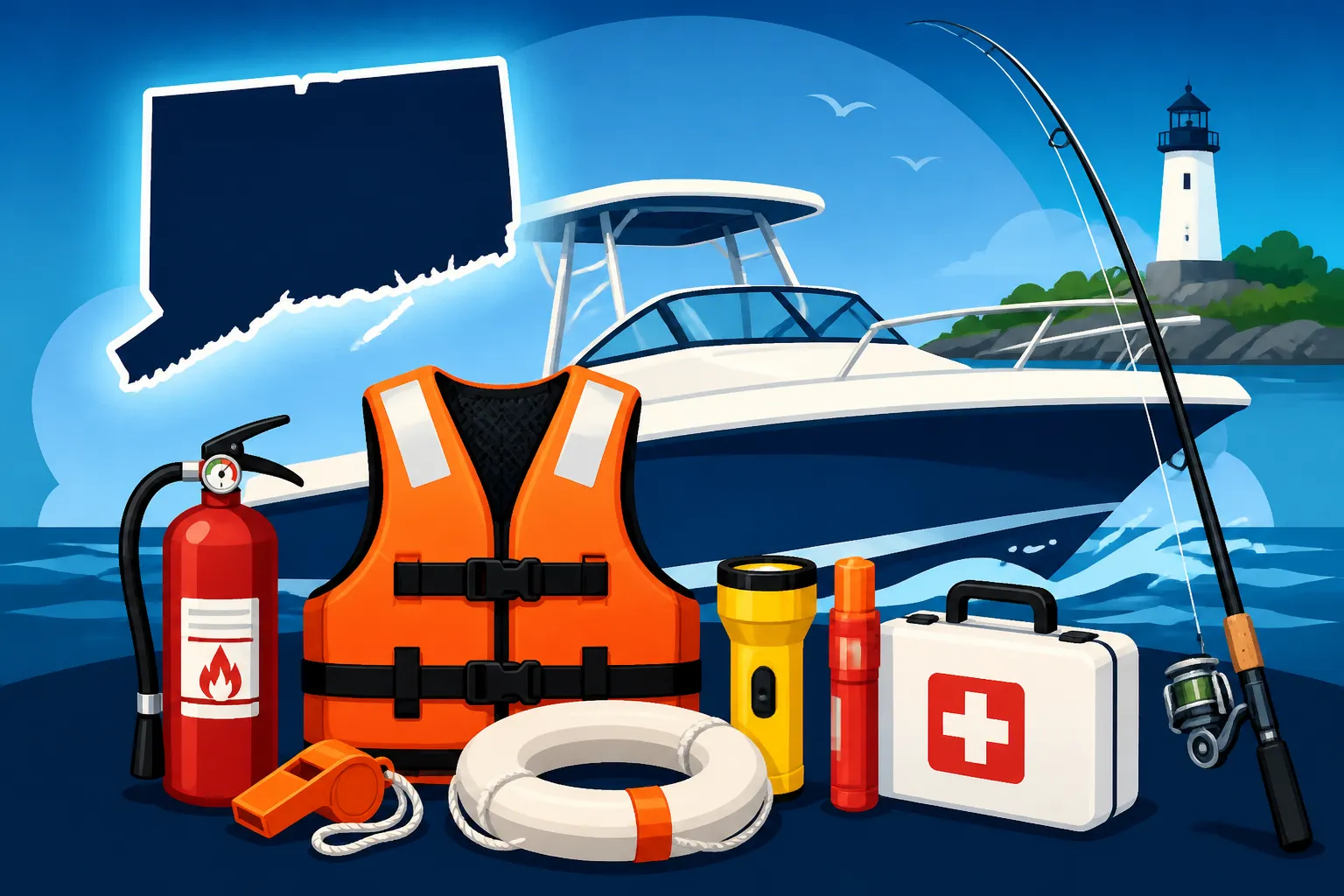
Here's a quick summary of the key required boat safety equipment in Connecticut, remembering that specifics can vary by vessel length and type. Always consult the official CT DEEP regulations for the most up-to-date and precise information.
| Equipment Category | Item | Requirement Details | Notes |
|---|---|---|---|
| Personal Flotation Devices (PFDs) | Wearable Life Jackets | One USCG-approved wearable PFD for each person on board. Children under 13 must wear one while underway unless below deck/in enclosed cabin. | Must be good condition, proper fit, readily accessible. Cold water rules apply Oct-May. |
| Throwable PFD (Type IV) | Required on vessels 16 feet or longer (except canoes and kayaks). | Must be immediately available. | |
| Visual Distress Signals (VDS) | Day & Night VDS | Required on vessels 16 feet or longer operating on coastal waters (Long Island Sound). Vessels under 16 feet only need night VDS for coastal night operations. | Examples: flares (red), orange smoke signals, electric distress lights, orange signal flag. Check expiration dates on pyrotechnics. |
| Sound Producing Devices | Whistle/Horn | All vessels must carry a sound-producing device audible for at least 0.5 mile (e.g., whistle, air horn). | Vessels 40 feet or longer also need a bell. Used for signals and distress. |
| Fire Extinguishers | USCG-Approved Extinguisher (B-I/B-II) | Required on motorized vessels with enclosed engine compartments, permanent fuel tanks, or living spaces (galley/berths). Number/type depends on boat size/engine. | Must be readily accessible, charged, and in good condition. |
| Navigation Lights | Proper Lights | Required between sunset and sunrise and in restricted visibility. Specific configurations vary by vessel type (power, sail) and length. | Ensure all lights are functional; carry spare bulbs if not LED. Paddlecraft need a white light. |
| Vessel Documentation | Registration Certificate | All motorized vessels & sailboats >19.5ft must have a current CT registration certificate on board. | Display registration numbers/decals correctly. Consider Connecticut boat registration cost. |
| Safe Boating Certificate | Required for many operators. | Proof of completion of a state-approved boating safety course. | |
| Other Essential Gear | Oars/Paddles | Required for vessels under 16 feet not equipped with auxiliary propulsion. | Good idea for all boats as an emergency backup. |
| Bailing Device | All vessels must have an efficient means to remove water (e.g., bilge pump, hand bailer). | ||
| Anchor | Highly recommended for all vessels, though not universally mandated by federal law. | Appropriate size/rode for vessel and conditions; crucial for emergencies. |
Disclaimer
The information provided in this guide is for general informational purposes only and does not constitute legal advice. Boating laws and regulations, particularly those regarding safety equipment, can change frequently and may have specific nuances based on vessel type, length, and operating area. Always consult the official Connecticut Department of Energy and Environmental Protection (CT DEEP) website or resources for the most current and accurate regulations before operating any vessel on Connecticut waters. Compliance with all federal, state, and local laws is the sole responsibility of the vessel operator.