What tautog blackfish look like compared to sea bass
It’s a common scenario on Connecticut’s rocky reefs: you pull up a feisty, dark-colored fish, and for a moment, you’re not quite sure if you’ve landed a tautog or a black sea bass. These two popular saltwater species often occupy similar habitats and can, at first glance, look quite alike, leading to understandable confusion among even seasoned anglers. This guide will meticulously break down the distinctive features of both tautog (often called blackfish) and black sea bass, equipping you with the knowledge to confidently identify your catch every single time.
The Perennial Mix-Up: Why Tautog and Sea Bass Get Confused
The waters off Connecticut's coast, especially around rocky structures, wrecks, and mussel beds, are prime territory for both tautog and black sea bass. Their shared preferences for these complex underwater environments mean anglers frequently encounter both species on the same fishing trip, sometimes even on the same drift. This ecological overlap is a primary driver of the identification challenge.
Many anglers target these species using similar bottom-fishing techniques, often employing crab baits for tautog or jigs and bait for sea bass. When a dark, stout fish comes over the rail, especially in the heat of the moment or during a fast bite, the initial visual can be deceiving. Both are robust, powerful fighters, and their general dark coloration can lead to a quick, but incorrect, assumption. It’s not just beginners who get stumped; even experienced hands have been known to pause and double-check, particularly with juvenile fish or those exhibiting unusual coloration for their species.
Shared Habitats and Angling Techniques
Tautog thrive in areas with abundant hard structure – think rock piles, mussel beds, bridge pilings, and shipwrecks. They are master crunchers, using their powerful jaws and teeth to pry crustaceans and shellfish from their moorings. Black sea bass, while also structure-oriented, tend to be a bit more versatile. They can be found over rocky bottoms, artificial reefs, mussel beds, and even certain sandy or muddy areas adjacent to structure. Their diets overlap significantly, both feasting on crabs, shrimp, and various small invertebrates. This convergence in feeding habits and preferred real estate means your carefully presented crab offering for a tautog might just as easily entice a black sea bass, and vice versa.
Consider a typical day fishing off the reefs near New London or Stonington. You drop your rig, laden with green crabs, into 40 feet of water near a sunken barge. The bite is on, and you're hauling up fish consistently. In that flurry of activity, with fish flopping on deck, it’s easy to grab the first dark fish you see and assume it's one or the other. It’s only upon closer inspection, when you might be thinking about the specific slot limits or possession rules, that the subtle differences become glaringly important.
Initial Glance Similarities
Both tautog and black sea bass possess a generally dark, mottled appearance that helps them blend into their rocky surroundings. They both have relatively deep bodies for their length, prominent eyes, and powerful tails built for short bursts of speed and maneuvering around structure. Their firm, flaky flesh also makes them highly prized table fare, further solidifying their status as desirable catches in Connecticut's saltwater fisheries.
From a distance, particularly in murky water or low light, the overall silhouette and dark pigmentation can make them look remarkably similar. Young black sea bass, in particular, can have a blockier, more "tautog-like" profile than their adult counterparts, which can exacerbate the confusion. Without a clear view of their distinct head shapes, fin structures, and specific color patterns, it's easy to mistake one for the other. This is precisely why it's so important to learn the detailed identifying characteristics of each species, which we'll dive into next.
Tautog (Blackfish) Identification: Getting Up Close and Personal
When you've got a tautog in hand, you'll immediately notice its rugged, almost prehistoric appearance. These fish are built like tanks, perfectly adapted for prying shellfish off rocks and living in turbulent, high-energy environments. Their scientific name, Tautoga onitis, sounds as tough as they look, and they are a true icon of the Long Island Sound's rocky bottom. If you're looking for Blackfish (Tautog) Fishing in Connecticut, understanding their appearance is key.
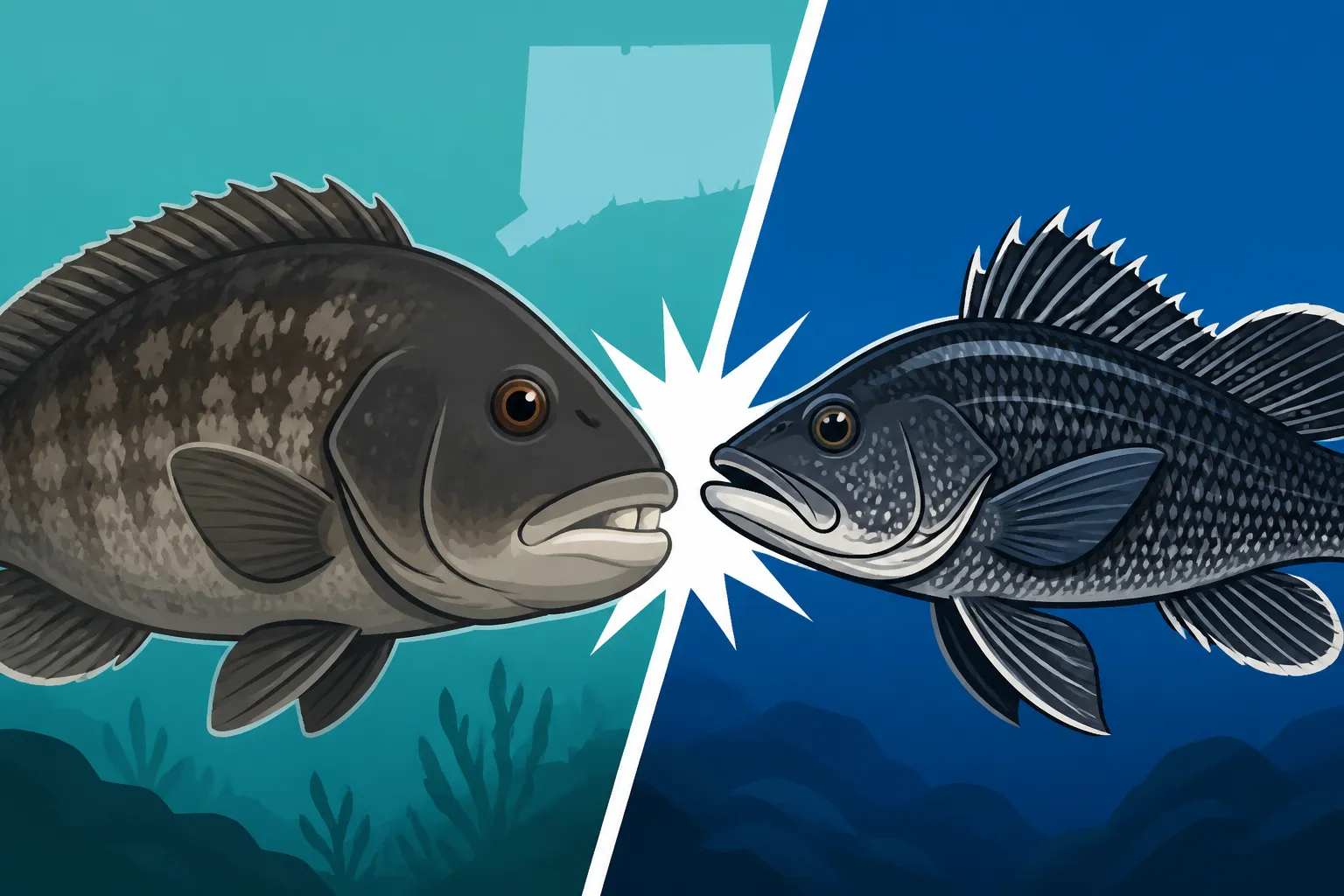
Their body is robust and laterally compressed, meaning it's somewhat flattened from side to side. The coloration is generally a mottled dark gray to black, often with irregular lighter patches or bands, especially on the flanks. This camouflage allows them to disappear against rocky backgrounds. You might notice a paler belly, but the overall impression is one of deep, stony hues. This helps them ambush prey and avoid predators among the crevices.
Distinctive Body Shape and Coloration
Tautog have a very distinctive, stout body shape. They are deep-bodied and somewhat blocky, with a high arching back that gives them a powerful profile. Their dorsal fin, which runs along their back, has a long base and is composed of both spiny and soft rays. The spiny part is quite rigid, and the soft-rayed portion is more rounded. The tail fin, or caudal fin, is notably fan-shaped and strong, perfectly suited for quick bursts of power when escaping into rock piles.
The color can vary depending on the habitat and individual fish, but typically ranges from dark olive green to grayish-brown or even black, often with lighter patches. These patches are not usually as distinct or organized as the stripes you might see on other fish. Larger males, often referred to as "white chins" or "bulldogs," develop a prominent white or pale chin area, which is a very clear identifying marker when present. You can find excellent visual guides or fish identification charts, some of which are available on Amazon, that can further aid in learning these subtle color variations.
Mouth, Teeth, and Lips
This is where tautog truly stand out. Their mouth is small, but incredibly powerful, with thick, fleshy lips. Inside, you'll find a set of impressive, distinct teeth. At the front, they have prominent canines, almost like buck teeth, which are used for prying mollusks and crustaceans off rocks. Further back, they have broad, molar-like grinding teeth designed to crush the shells of their prey. These teeth are a dead giveaway; no other fish you're likely to encounter in similar Connecticut waters has such a unique dental arrangement.
When you carefully open a tautog's mouth (watch those teeth!), the robustness of their dental structure becomes immediately apparent. This specialized dentition is perfectly adapted for their diet, allowing them to crack open mussels, clams, and crabs with ease. These features are a crucial part of Blackfish Habits Around Structure. You won't find anything similar in a black sea bass.
Dorsal Fin and Tail Shape
The dorsal fin of a tautog is long and continuous, starting relatively far forward on its back. It has a tough, spiny front section and then transitions into a softer-rayed, more rounded rear section. The spiny rays are quite thick and rigid, offering protection. The tail fin (caudal fin) is thick, broad, and somewhat rounded or slightly truncate (straight-edged), providing powerful propulsion for navigating tight spaces and current.
The anal fin, located on the underside behind the vent, also follows a similar pattern to the dorsal, with a spiny front and soft-rayed back portion. Pay close attention to the overall robustness of these fins—they are built for durability and strength, characteristic of a fish that spends its life in rocky, abrasive environments.
Size and Growth Patterns
Tautog can grow to impressive sizes, though in Connecticut, most recreational catches are within a moderate range. However, trophy-sized tautog, weighing well into the double digits, are highly sought after. They are relatively slow-growing and long-lived, which makes their conservation particularly important. The state record fish are truly giants, and it takes many years for them to reach such proportions. Anglers often ponder Do Blackfish Get Bigger in Deeper Water? when pursuing these larger specimens.
Understanding the typical size and appearance of different age classes can also help distinguish them. Younger tautog share the same fundamental characteristics but might appear a bit more streamlined. As they age, especially males, they develop that classic "bulldog" appearance with a pronounced forehead and often that iconic white chin.
Black Sea Bass Identification: A Master of the Reef
Black sea bass, Centropristis striata, are another highly sought-after species in Connecticut's marine waters, prized for their delicious white meat and aggressive bites. While they share some general traits with tautog, a closer look reveals a sleek, elegant predator distinct from its stout, bottom-dwelling cousin. If you're interested in Black Sea Bass Fishing in Connecticut, knowing their appearance is paramount.
Their body is more elongated and streamlined than a tautog's, giving them a more "fish-like" appearance in the traditional sense. Their coloration is also typically dark, ranging from dusky brown to black, but they often exhibit distinct patterns and can change shades rapidly depending on their mood, habitat, and activity level. This ability to change color is a key feature, helping them blend into various backgrounds, from dark rock to sandy bottoms.
Sleek Body and Striking Patterns
Black sea bass have a more compressed, ovate body shape compared to the blockier tautog. They are not as deep-bodied and generally appear more "streamlined." Their coloration, while often dark, is frequently adorned with irregular, faint vertical bars or blotches, particularly in younger fish. Adults often display iridescent blue, green, and purple hues, especially on their fins and around their head, which are quite striking when seen fresh out of the water.
A key visual cue is the prominent, single dorsal fin. Unlike the tautog's somewhat rounded soft-rayed portion, the black sea bass's dorsal fin is very distinctive. The first few spiny rays are noticeably elongated, often forming a "sail-like" appearance, especially in larger males. The tail fin is usually trilobed or has a distinctive elongated streamer on the upper lobe, particularly noticeable in males. This can be a very clear identifier, often referred to as the "pennant" or "flag." This visual characteristic is a major difference from the tautog's rounded tail.
Mouth, Eyes, and Head Profile
The mouth of a black sea bass is larger and more protractile (can extend forward) than a tautog's. It's filled with numerous small, sharp, conical teeth arranged in bands, designed for gripping and tearing small fish, shrimp, and crabs. They don't have the heavy, crushing molars or prominent canines that tautog possess. Their eyes are also quite large and prominent, indicating a visually oriented predator.
The head profile of a black sea bass is generally smoother and less "stubby" than that of a tautog. Large male black sea bass, often called "humpbacks" or "knotheads," develop a noticeable fleshy hump on their forehead, particularly during spawning season. This hump is a clear indicator of a mature male and is another distinguishing feature not seen in tautog. You can find detailed images in many fishing guides, like those found on Amazon, that clearly illustrate this sexual dimorphism.
Dorsal Fin and Tail Shape
The dorsal fin of a black sea bass is continuous, with a long spiny section and a shorter soft-rayed section. Crucially, the dorsal spines are often quite rigid and can be sharp, but it's the distinctive elongated filament or streamer on the upper lobe of the tail fin that truly sets it apart. This streamer is particularly pronounced in larger males and is almost always present to some degree in adult fish. The caudal fin itself is typically truncate to slightly rounded, but that upper streamer is a dead giveaway.
The anal fin also has spines and soft rays, but it’s the overall sleeker fin structure and the unique tail streamer that are the most reliable indicators. This streamlined fin structure aids in their quick, darting movements around structure, allowing them to ambush prey efficiently. These unique features contribute to Black Sea Bass Habits in Connecticut Waters.
Size and Sexual Dimorphism
Black sea bass typically caught in Connecticut range from smaller "keepers" up to impressive fish weighing several pounds. They are known for their rapid growth and relatively shorter lifespan compared to tautog. A fascinating aspect of black sea bass biology is their sexual dimorphism and sequential hermaphroditism. Most black sea bass are born female, and many later transition to male, usually when they reach a certain size.
This sex change influences their appearance, as larger, older males often develop the distinctive hump on their head and the elongated dorsal spines and tail streamer. These visual differences are important to note when trying to differentiate between a large black sea bass and a tautog, especially if you're comparing a juvenile of one species to a mature adult of the other.
Side-by-Side Comparison: Tautog vs. Black Sea Bass
To make things a bit clearer, let's put these two species head-to-head with their key identifying features. This table offers a quick reference for those moments when you're on the boat and need to make a quick identification.
| Feature | Tautog (Blackfish) | Black Sea Bass |
|---|---|---|
| Body Shape | Stout, blocky, deep-bodied, laterally compressed. | More elongated, ovate, streamlined. |
| Coloration | Mottled dark gray/black/olive, irregular light patches; large males often have white chin. | Dusky brown to black, often iridescent blue/green/purple hues; faint vertical bars possible; rapidly changeable. |
| Mouth/Teeth | Small, thick lips; prominent canine-like front teeth, molar-like grinding teeth in back. | Larger, protractile mouth; numerous small, sharp, conical teeth in bands. |
| Head Profile | More blunt, "stubby"; older males develop a more pronounced forehead. | Smoother; large males develop a fleshy hump on forehead ("knothead"). |
| Dorsal Fin | Long, continuous; robust, rigid spines; soft-rayed portion is rounded. | Long, continuous; first few spiny rays often elongated; overall sleeker. |
| Tail Fin | Thick, broad, typically rounded or slightly truncate (straight-edged). | Trilobed or rounded, but often with a distinct, elongated streamer on the upper lobe (especially in males). |
| Typical Diet | Primarily shellfish (mussels, clams), crabs, barnacles. | Crabs, shrimp, small fish, worms, squids. |
| Habitat | Heavy structure (rocks, wrecks, mussel beds, pilings). | Rocky bottoms, wrecks, artificial reefs, some sandy areas. |
Practical Identification Tips for Anglers
Alright, you've just hauled a fish over the rail. Here's a quick mental checklist to confirm what you've got:
- Check the Mouth and Teeth FIRST: This is your absolute best bet. If it has prominent "buck teeth" in front and grinding molars in the back, it's a tautog, no question. If it has a larger mouth with many small, sharp, conical teeth, it's a black sea bass. You can sometimes even feel the difference without fully opening the mouth.
- Look at the Tail: Does the upper lobe of the tail fin have a distinct, elongated streamer? If yes, it's a black sea bass. If the tail is broad, thick, and rounded or straight-edged without a streamer, it's a tautog.
- Observe the Overall Body Shape: Is it super chunky, stout, and "blocky"? Tautog. Is it more elongated, sleeker, and more oval-shaped? Black sea bass.
- Consider the Head: Does it have a white chin? Tautog. Does it have a fleshy hump on the forehead? Black sea bass (and likely a mature male).
These four points alone will solve 99% of your identification dilemmas. Remember to always handle the fish carefully, especially if you plan to release it, to minimize stress. Learning these differences will greatly enhance your enjoyment and compliance when fishing. Check out Best Techniques for Blackfish Around Structure or Best Charters for Black Sea Bass in Connecticut to put your new identification skills to the test!
Why Accurate Identification Matters
Knowing the difference between a tautog and a black sea bass isn't just about showing off your fish ID skills at the dock (though that's certainly a bonus!). It's vitally important for several practical and ethical reasons, especially when you're enjoying a day of Connecticut Saltwater Fishing Regulations by Species.
The regulations for these two species often differ significantly. Incorrect identification could lead to keeping an undersized fish, possessing too many fish, or keeping a fish out of season, all of which carry legal consequences. Beyond that, accurate identification plays a crucial role in conservation efforts, allowing anglers to contribute responsibly to the health of our marine ecosystems.
Navigating Connecticut Fishing Regulations
Connecticut has specific regulations for both tautog and black sea bass, covering minimum size limits, daily creel limits (how many you can keep), and open seasons. These rules are put in place by the Connecticut Department of Energy and Environmental Protection (CT DEEP) to manage fish populations sustainably. For instance, Connecticut Blackfish (Tautog) Season Dates and Connecticut Black Sea Bass Regulations for 2026 are subject to change, often annually, based on scientific stock assessments.
Imagine you're out fishing and you catch a fish that’s on the borderline of the minimum size limit. If you mistakenly identify a small black sea bass as a tautog, you might keep a fish that's illegal, or vice versa. The penalties for violating fishing regulations can range from fines to license suspension. It’s simply not worth the risk. Always consult the most current Connecticut fishing guide, available through the CT DEEP website or in print at many tackle shops, to ensure you are fully compliant.
Conservation and Sustainable Practices
Accurate identification directly supports conservation. When anglers properly identify and adhere to species-specific regulations, they contribute to the long-term health and stability of fish populations. Releasing undersized or out-of-season fish of the correct species is a responsible practice that ensures future generations of fish and anglers.
Furthermore, reporting accurate catch data, if required, helps fisheries biologists monitor populations and make informed management decisions. By distinguishing between tautog and black sea bass, we respect the unique biological characteristics and management needs of each species. This commitment to responsible angling helps protect these incredible resources for everyone. If you’re ever in doubt, the best practice is always to err on the side of caution and release the fish, or if possible, consult an experienced angler or a reliable identification resource. This thoughtful approach ensures that the joy of fishing in Connecticut remains vibrant for years to come.
Disclaimer
This article is for general informational purposes only and does not constitute professional advice. Laws, prices and regulations vary by location and change over time. Consult a qualified professional for guidance on your specific situation.