Best trolling speed for umbrella rigs targeting striped bass
It's a familiar scenario for many Connecticut anglers: you've got your boat loaded, the umbrella rigs are deployed, and you're covering water, but the striped bass just aren't hitting. The frustration builds as you wonder, "Am I going too fast? Too slow?" Finding that sweet spot for your trolling speed with umbrella rigs is often the difference between a memorable day of bent rods and a quiet ride home. This comprehensive guide will unravel the mysteries of optimal trolling speeds, helping you connect with more striped bass in our local waters.
Understanding Umbrella Rigs for Striped Bass
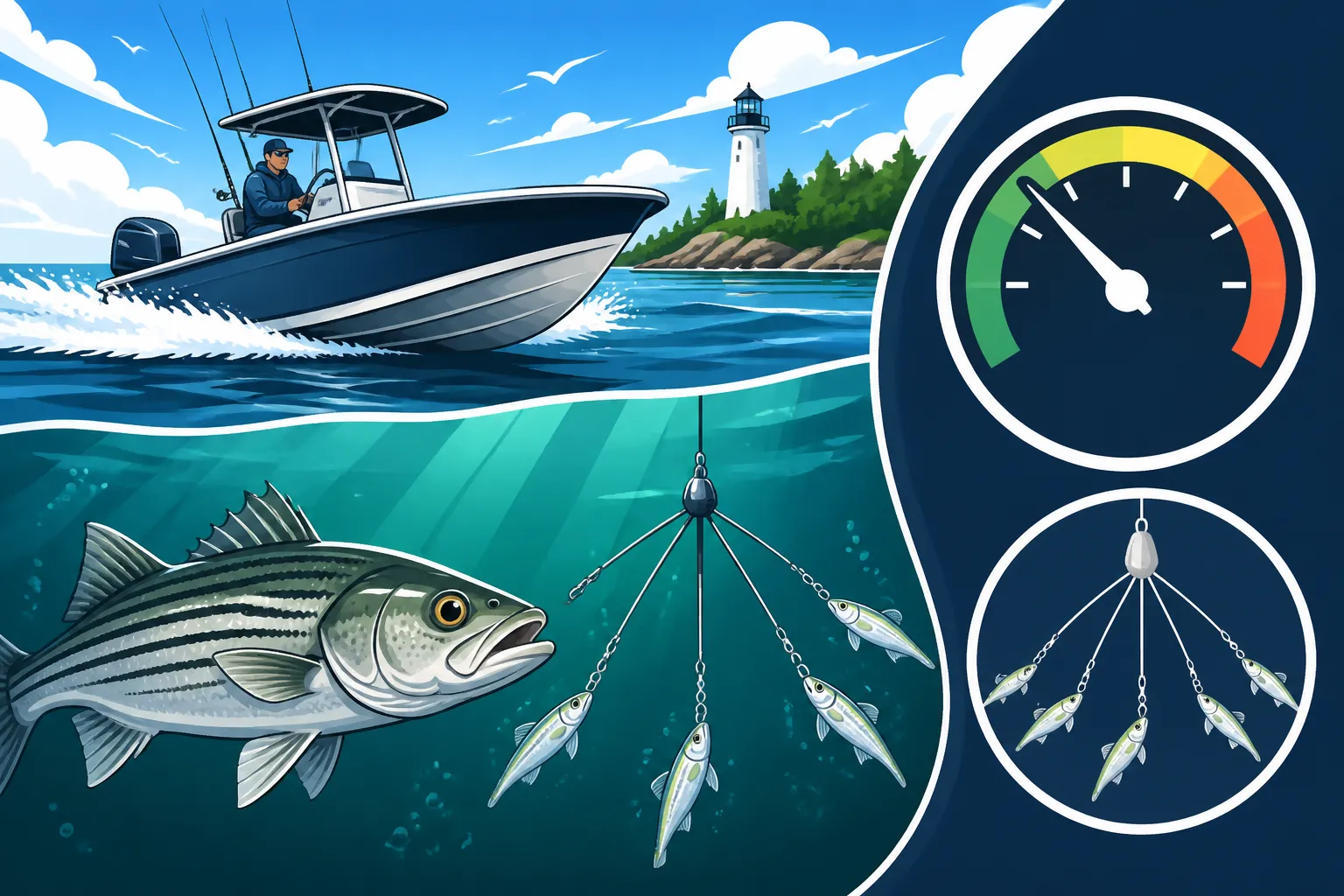
Before we even talk about speed, let's get on the same page about what an umbrella rig is and why it's such a go-to for targeting striped bass. It’s not just a fancy lure; it’s an entire system designed to mimic a school of baitfish. Imagine a large group of bunker, mackerel, or spearing moving through the water – that's what a well-rigged umbrella aims to replicate.
Typically, an umbrella rig consists of a central leader from which several "arms" or spreader bars extend. These arms have teasers attached, often soft plastics, tubes, or small spoons, all designed to look like smaller baitfish. At the end, usually a foot or two behind the entire school, you'll have one or more larger "chase baits" or "stinger baits" that are meant to be the target fish's meal. These can be larger soft plastics, swimming plugs, or even rigged real baitfish like bunker or eels. The effectiveness of an umbrella rig comes from its ability to present multiple baits simultaneously, creating a larger, more enticing profile that aggressive striped bass simply can't resist. When you're fishing for Striped Bass Fishing in Long Island Sound, these rigs are practically indispensable.
The beauty of umbrella rigs lies in their versatility. They can be incredibly effective when striped bass are feeding on large schools of baitfish, as the rig perfectly imitates this natural occurrence. They allow you to cover significant amounts of water efficiently, particularly when fish are scattered or holding at various depths. From schoolie stripers to genuine cow bass, an umbrella rig, when trolled correctly, can entice bites from a wide range of sizes. Different designs and sizes of umbrella rigs are available, from lighter setups for smaller schools of bait to heavy-duty rigs meant to target larger fish deeper in the water column. The weight and design of your particular rig will absolutely play a role in how it behaves at different trolling speeds, which we’ll dive into next.
Factors Influencing Optimal Trolling Speed
There's no single magic number for the "best" trolling speed because Mother Nature, and the striped bass themselves, have a funny way of changing the rules daily. However, understanding the key factors that influence this speed will empower you to make informed adjustments on the water. It’s all about adapting to the conditions and the fish you're pursuing.
Water Conditions: Current, Wind, and Chop
This is perhaps the most significant variable, yet it's often overlooked. Your boat's speed through the water is what matters for lure action, not necessarily your speed over ground (SOG) that your GPS reports.
Imagine trolling directly into a strong outgoing tide in Long Island Sound. Your GPS might say you're doing 2.5 knots (SOG), but the strong current pushing against you means your lures are barely moving through the water. Conversely, if you're trolling with that same current, your SOG might be 2.5 knots, but your lures could be rocketing through the water at 4 or 5 knots (speed through water, STW).
- Current: Always be mindful of the current. If you're going against it, you'll need more engine RPMs to get your lures moving effectively. With the current, you'll need less. It's crucial to use a speed-through-water sensor or, failing that, observe your lines and rig action to gauge actual lure speed. Strong currents can also create eddies and current breaks, which are prime holding spots for striped bass.
- Wind: Wind can push your boat around, making it hard to maintain a straight course or consistent speed. A strong headwind will slow your boat down, while a tailwind will speed it up. Crosswinds are particularly tricky, as they can cause your boat to crab sideways, making your lines sweep in an unnatural arc.
- Chop and Swell: Rougher water means your boat is constantly pitching and rolling. This erratic motion can translate to inconsistent lure speed and action. Sometimes, a little "bounce" can be a good thing, adding a lifelike jigging motion. Other times, it can make your baits look unnatural. Learning to "trim" your boat and steer a steady course in adverse conditions is a skill that comes with practice.
Target Species Behavior: Striped Bass Mood Swings
Just like us, striped bass have good days and bad days, and their mood dictates how they feed. Understanding their behavior is critical for perfecting your trolling speed.
- Aggressive vs. Finicky: When striped bass are in a full-on feeding frenzy, they might smash anything moving at almost any speed. However, when they're lethargic, perhaps due to a Cold Front Fishing Tactics for Connecticut Bass or unusual water temperatures, they'll often prefer a slower, more deliberate presentation. You need to present the rig as an easy meal.
- Depth and Structure: Stripers will hold at different depths depending on water temperature, light conditions, and baitfish location. If they're holding deep over structure, a slower troll might give them more time to react and rise to the bait. If they're actively chasing bait on the surface, a faster troll can mimic that fleeing baitfish action. This is where knowing How deep striped bass go in summer can be a game-changer.
- Time of Day/Tide: Fish behavior changes throughout the day and with different tides. Best Time of Day to Catch Striped Bass often coincides with low light or strong tidal movements. Experiment with speed during these peak times. Sometimes a slightly faster troll during a feeding blitz can stand out, while a slower troll during a slack tide can be more effective.
Baitfish Imitation: Matching the Hatch (or the School)
The whole point of an umbrella rig is to imitate a school of baitfish. The most effective trolling speed is often the one that makes your rig look the most natural.
- Mimicking Natural Movement: Observe the baitfish in the area. Are they darting erratically, or are they lazily cruising? Bunker, for instance, often move at a slower, more deliberate pace, while spearing or silversides might be more frantic. Your umbrella rig should ideally match this natural movement. A faster speed often suggests panicked, fleeing bait, which can trigger a chase response. A slower speed can suggest an unconcerned, easy meal.
- Species of Baitfish: The local forage will influence your presentation. If striped bass are keying in on larger, slower-moving baits like menhaden (bunker), a slower troll might be more productive. If they're after smaller, faster bait like bay anchovies, a quicker pace could be better. Knowing What striped bass eat in Long Island Sound helps immensely here.
- Lure Action: Different teasers and stinger baits are designed to have specific actions at certain speeds. A paddle tail swimbait, for example, might have a great thumping action at 2 knots but just drag lifelessly at 1 knot. Conversely, a tube lure might have a beautiful wiggle at 1.5 knots but spin unnaturally at 3 knots. Pay attention to how your specific rig components behave at various speeds.
Rig Design: Weight, Drag, and Blade Configuration
The physical characteristics of your umbrella rig itself will dictate how it performs in the water.
- Overall Weight and Buoyancy: A heavier rig will naturally want to sink more and require more boat speed to achieve a desired depth or action. Lighter, more buoyant rigs might need less speed to stay off the bottom or maintain their spread.
- Spreader Bar Design: Some spreader bars are designed to create more drag, spreading the teasers wider and giving them a more active movement with less boat speed. Others are more streamlined.
- Blade/Teaser Configuration: Some rigs incorporate spinner blades or highly articulated soft plastics that generate a lot of flash and action at even slow speeds. Others rely on simple tubes or straight plastics that need more speed to achieve their intended movement. Think about what you've put on your rig – a lot of plastic paddles and tails will create more drag than slim tubes. When buying replacement teasers or even new rigs, it's worth checking customer reviews on sites like Amazon for feedback on how they perform at different trolling speeds.
Dialing In Your Speed: Practical Tips and Techniques
Alright, with all those factors in mind, how do you actually find that "best" trolling speed for umbrella rigs on any given day? It’s a process of observation, adjustment, and continuous learning.
Establishing a Baseline Speed
Most anglers targeting striped bass with umbrella rigs will find their sweet spot falls within a general range. For many setups in typical Long Island Sound conditions, a good starting point is 1.5 to 3.0 knots (speed through water).
- Slow Troll (1.0-2.0 knots): This range is often effective when fish are lethargic, holding tight to structure, or when you're using larger, slower-moving bait imitations like bunker. It allows the fish more time to react and inspect the rig. It's also often preferred in colder water, when striped bass might be less willing to chase.
- Medium Troll (2.0-3.0 knots): This is a versatile range that works well in many scenarios. It mimics a cruising school of baitfish and provides enough action for most umbrella rig components. This is often the bread-and-butter speed for general striped bass trolling.
- Fast Troll (3.0-4.0+ knots): Sometimes, a faster troll is exactly what's needed. This can imitate fleeing baitfish, triggering a predatory chase response from aggressive stripers. It's often effective in warmer water, during strong feeding periods, or when fish are scattered over open bottom and you need to cover ground quickly. However, go too fast, and your rig can become unnatural, spin, or blow out of position.
Remember, these are speeds through the water. Your boat's GPS will show "speed over ground" (SOG). To truly gauge your lure speed, consider a dedicated speed-through-water sensor or, more simply, observe your lines.
Reading Your Electronics: GPS and Fish Finder
Modern electronics are invaluable tools for trolling.
- GPS (Speed Over Ground – SOG): Your GPS gives you SOG, which is crucial for navigation and repeatability. If you get a bite at 2.5 knots SOG in a certain area, you want to be able to replicate that speed next time you pass through. However, remember the distinction between SOG and STW.
- Speed Through Water (STW): If your boat has a paddlewheel or other STW sensor, use it! This is the most accurate measure of how fast your lures are moving relative to the water they're in. This is far more important for lure action than SOG.
- Fish Finder (Sonar): Your fish finder helps you locate baitfish schools and striped bass. If you're marking fish at a certain depth, adjust your speed and depth to put your umbrella rig right in front of them. It also helps identify structure where fish might be holding. Sometimes, a very slow troll is necessary to work a tight contour or a rock pile effectively.
Boat Control and Maintaining Consistent Speed
This is harder than it sounds, especially in challenging conditions.
- Autopilot is Your Friend: If you have an autopilot, use it. It will help maintain a consistent course and reduce fatigue, allowing you to focus on your rods and electronics.
- Throttle and Trim: Learn how your boat responds to small throttle adjustments. Sometimes, just a slight increase or decrease in RPMs can make a big difference in lure action. Using your trim tabs can also help keep your bow down and maintain a smoother ride in chop, which translates to more consistent lure action.
- Steering a Straight Course: Erratic steering can cause your umbrella rig to swing wildly, creating unnatural movements or tangles. Try to hold the steadiest course possible. If you need to make a turn, do it slowly and smoothly. Turns can sometimes trigger bites, as the inside rig slows down and the outside rig speeds up, creating a different action that fish might key in on. This is where Trolling Techniques for Long Island Sound Striped Bass becomes an art form.
"Reading the Rods" and the Water
Your fishing rods are your most direct connection to what your umbrella rig is doing in the water.
- Observe Rod Tip Action: A properly trolled umbrella rig will have a consistent, pulsing action at the rod tip. It shouldn't be dead still, nor should it be wildly thrashing. The "thump" or "wiggle" of the rod tip tells you the teasers and stinger baits are working as intended. If your rod tips are dead, you might be going too slow. If they're violently thrashing or bending unnaturally, you might be going too fast, or have weeds on your rig.
- Check for Weeds: Periodically reel in your rigs to check for weeds or debris. A fouled rig won't perform correctly and won't catch fish.
- Watch for Baitfish and Birds: Keep an eye on the surface for signs of baitfish or diving birds. These are often indicators of actively feeding striped bass. Adjust your speed to mimic the distressed baitfish in these areas. You might need to speed up to mimic fleeing bait or slow down to present an easy meal to fish already feasting.
Trial and Error: The Angler's Mantra
Ultimately, finding the best trolling speed is a continuous process of trial and error.
- Start with a Baseline: Begin within the 1.5-3.0 knot range (STW) that feels right for your specific rig and the prevailing conditions.
- Make Small Adjustments: Increase or decrease your speed by 0.2 to 0.5 knots at a time. Pay close attention to how the rod tips react and, more importantly, if you get any bites.
- Note What Works: Keep a log! Note the date, time, tide, location, water temperature, SOG, STW, and what speed produced bites. This information is invaluable for future trips.
- Don't Be Afraid to Change: If you're not getting bites after 20-30 minutes at a certain speed, change it up. Try a slightly faster or slower speed. Sometimes, a subtle shift is all it takes. This is part of the learning curve for How to Catch Striped Bass in Long Island Sound.
Gear and Setup Considerations for Trolling Umbrella Rigs
Using umbrella rigs isn't just about speed; it's also about having the right gear to deploy them effectively and handle the powerful strikes of a striped bass. Proper rigging can greatly enhance your ability to control depth and present your lures optimally.
Rod and Reel Selection: Built for Battle
Trolling with umbrella rigs is serious business, requiring robust tackle. You're pulling a significant amount of weight and drag through the water, and when a large striped bass hits, it hits hard.
- Rods: Look for heavy-action trolling rods, typically 6 to 7 feet long, with a strong backbone and a softer tip. The softer tip helps absorb the shock of the rig's action and the initial strike, while the backbone is essential for fighting big fish. Many anglers opt for composite or fiberglass rods for their durability and forgiving action.
- Reels: You'll need conventional reels with a high line capacity and a smooth, powerful drag system. A level wind feature is a plus for even line retrieval. Reels designed for saltwater trolling or bottom fishing, often in sizes equivalent to a Penn 30-wide or Shimano TLD 20/25, are excellent choices. Make sure your reel is spooled with plenty of line, typically 50 to 80 lb braided line, as you'll be letting out a lot of line for proper depth and spread. You can find many reliable options on Amazon for rods and reels suitable for this heavy-duty trolling.
Line Choice: Braid for Performance, Mono for Stretch
The type of fishing line you use plays a crucial role in how your umbrella rig performs and how you feel the bites.
- Main Line (Braided): Most serious umbrella rig trollers opt for braided line as their main line. Braided line has almost no stretch, which provides superior sensitivity. You'll feel every twitch of the rig and every subtle strike, even with hundreds of feet of line out. Its thin diameter for its breaking strength also helps reduce water resistance, allowing your rig to run deeper with less weight. Use 50 to 80 lb test braid for your main line.
- Leaders: Between your braided main line and the umbrella rig, you'll want to use a heavy monofilament or fluorocarbon leader. This leader provides some shock absorption, which is especially important with no-stretch braid, and helps protect your main line from abrasion against the fish's mouth or prop wash. Leader strengths typically range from 80 to 150 lb test, depending on the size of fish you expect. A good fluorocarbon leader offers invisibility in the water, a subtle edge when fish are finicky.
- Teaser and Stinger Leaders: The leaders connecting your teasers and stinger baits to the umbrella rig arms should also be heavy monofilament or fluorocarbon, often 50-80 lb test. The length and stiffness of these leaders can impact the action of your individual baits.
Umbrella Rig Components: Quality and Customization
The effectiveness of your umbrella rig also hinges on the quality and configuration of its individual parts.
- Spreader Bars: These are the backbone of your rig. Choose high-quality stainless steel or heavy-gauge wire spreader bars that can withstand the stresses of trolling and fighting fish. The length and stiffness of the bars will influence the spread and action of your teasers.
- Teasers: The small lures attached to the spreader bar arms are critical for creating the illusion of a bait school. Soft plastics, tubes, small shad bodies, or even small squids are common. Vary your teaser colors and sizes to match the local baitfish. For example, if you know the stripers are on peanut bunker, use olive-and-white teasers.
- Stinger (Chase) Bait: This is the money bait. It's usually a larger lure, like a 6-9 inch soft plastic shad, a swimming plug, or a rigged natural bait, placed at the end of the main leader behind the teasers. This is the bait that the striped bass are most likely to strike. Ensure it has a lively, enticing action at your chosen trolling speed. You can find a huge variety of teaser and stinger baits on Amazon, allowing for endless customization to match conditions.
- Hooks: Always use sharp, strong hooks that can handle big fish. Replace dull or bent hooks immediately.
Downriggers and Planer Boards: Precision Depth Control
For precise depth control, especially when fish are holding deep or suspended in the water column, downriggers or planer boards are essential.
- Downriggers: These devices allow you to send your umbrella rig down to a specific depth, independent of your trolling speed. By attaching your main line to a release clip on a heavy cannonball weight, you can position your rig precisely where the fish are marked on your sonar. Once a fish strikes, the line releases from the clip, allowing you to fight the fish directly. This is crucial when targeting fish in deeper water, as How deep striped bass go in summer can vary greatly.
- Planer Boards: Planer boards are designed to pull your lines out to the side of the boat, away from the prop wash and turbulence. This allows you to present multiple umbrella rigs simultaneously without tangles, effectively creating a wider trolling spread. Some planer boards also dive to a certain degree, offering additional depth control. Using a Best trolling spread for striped bass with planer boards can dramatically increase your coverage area.
Table: Umbrella Rig Trolling Speed Guide for Striped Bass
Here's a general guideline for trolling speeds when using umbrella rigs for striped bass. Remember, these are starting points – always adjust based on conditions and fish behavior.
| Trolling Speed (Knots STW) | Conditions | Rig Action | Striped Bass Behavior | Recommended Action |
|---|---|---|---|---|
| 1.0 – 1.5 Knots | Cold water, strong currents (against), finicky fish, large bait imitations | Slow, deliberate movement, minimal flash | Lethargic, holding tight to structure, hesitant biters | Increase pause time, "easy meal" presentation |
| 1.5 – 2.5 Knots | Moderate conditions, general search, typical baitfish movement | Natural school appearance, consistent lure action | Actively feeding, cruising, inspecting baits | Standard approach, good starting point |
| 2.5 – 3.5 Knots | Aggressive fish, warmer water, chasing bait, mimicking fleeing bait | Energetic, increased flash and vibration | Aggressive, chasing prey, reacting to speed | Trigger reaction strikes |
| 3.5+ Knots | Very aggressive fish, covering large areas, targeting specific species (bluefish often hit faster) | Fast, sometimes erratic; risk of rig spinning | Highly active chase mode, opportunistic | Use with caution, monitor rig carefully |
STW = Speed Through Water. SOG = Speed Over Ground. Always prioritize STW for lure action.
Ultimately, the best trolling speed for your umbrella rigs when targeting striped bass in Connecticut isn't a fixed number you can set and forget. It's a dynamic range that changes with the conditions, the bait, and the mood of the fish. By understanding the underlying principles, paying close attention to your electronics and rod tips, and being willing to experiment, you'll significantly improve your chances of success. So get out there, observe, adapt, and enjoy the thrill of a big striper hitting your umbrella rig! And always remember to check the Connecticut Saltwater Fishing Regulations by Species before you head out.
Disclaimer
This article is for general informational purposes only and does not constitute professional advice. Laws, prices and regulations vary by location and change over time. Consult a qualified professional for guidance on your specific situation.