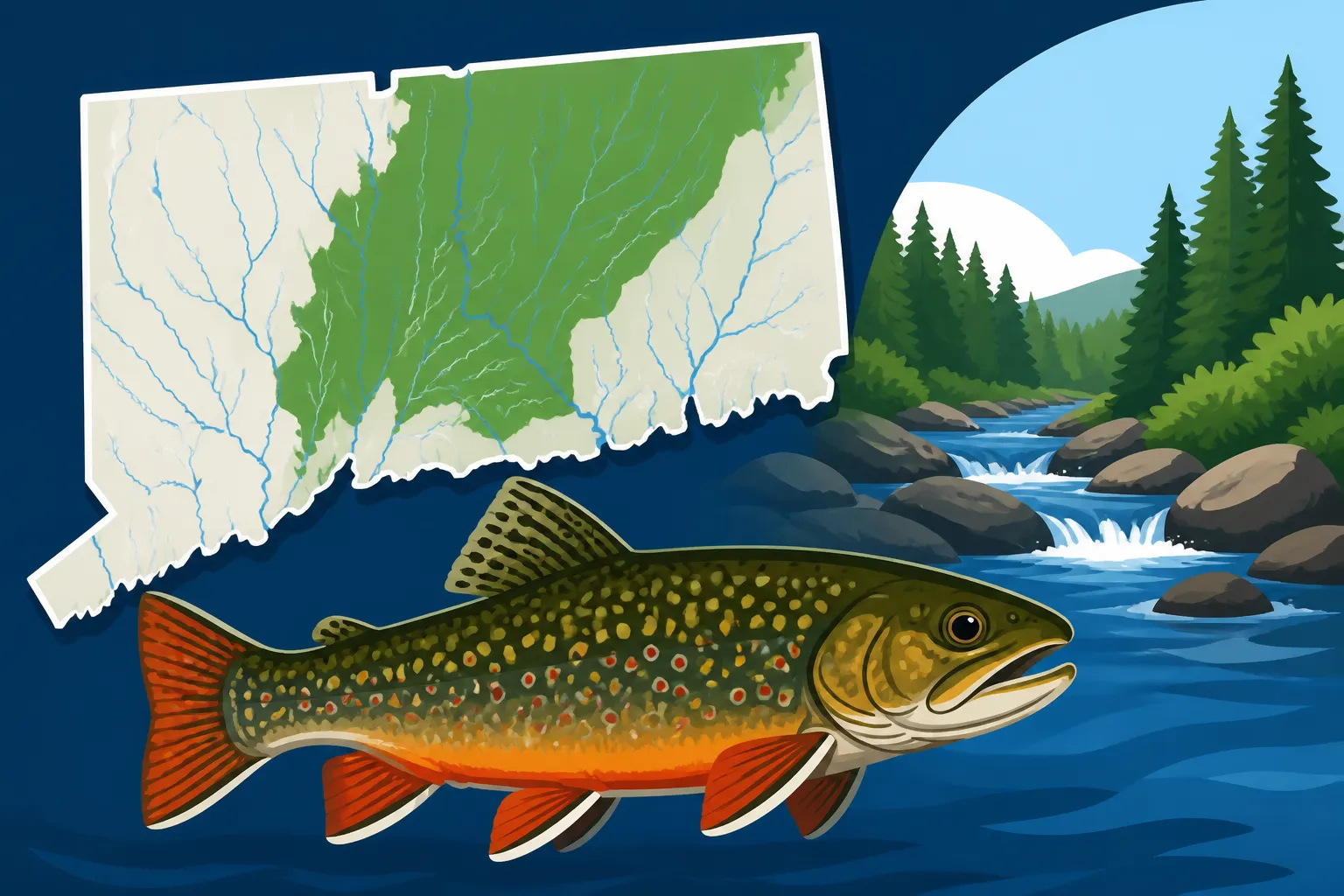
Brook Trout Native Range in Connecticut
It's easy to get caught up in the romance of trout fishing in Connecticut, picturing pristine streams teeming with wild fish. But the reality for many anglers is that the vast majority of trout they encounter are stocked. This can be a bit of a letdown if you're truly seeking a connection with nature and a chase for a fish that has beaten the odds to survive and thrive naturally. This guide is all about helping you understand, appreciate, and even find Connecticut's true native jewel: the brook trout, and where these beautiful fish still genuinely call home.
Understanding Connecticut's Native Brook Trout
There's something truly special about a native brook trout. It’s not just a fish; it's a testament to the health and purity of the water it inhabits. Unlike their stocked cousins, these fish have a wildness, a resilience, and a beauty that's entirely their own, shaped by generations in Connecticut's cold, clear streams.
What Makes a Brook Trout "Native"?
When we talk about a "native" brook trout in Connecticut, we're not just talking about any brook trout. We're specifically referring to populations that have evolved and reproduced naturally within a particular watershed for centuries, long before humans started moving fish around. These aren't fish raised in a hatchery and then released into a stream. Instead, they are the progeny of wild fish, born and bred in the very stream you might be fishing. Their genetic makeup is uniquely adapted to their local environment, making them perfectly suited to the specific challenges and opportunities their home stream presents. It's a subtle but profound difference that speaks to the untouched quality of their habitat.
These fish contribute to the ecological diversity of their streams, playing a vital role in the food web and serving as indicators of water quality. Their presence is a sign that the stream is healthy, cold enough, and free from significant pollution or disturbances that would prevent natural reproduction. Think of it as a living, breathing historical record of Connecticut's wild waterways.
Identifying a True Brookie
Identifying a brook trout isn't usually the challenge; telling a wild native brook trout from a stocked one can be. Native brookies, Salvelinus fontinalis, are stunning fish. They boast a dark, mottled green back, often with worm-like patterns (known as vermiculation), transitioning to lighter sides adorned with vibrant red spots circled by blue halos. Their fins, especially the lower ones, typically have a distinctive white leading edge, often followed by a black stripe, and then orange or red.
The key differences from a stocked fish are usually subtle but telling. Native brook trout often appear leaner, more streamlined, and have less damage to their fins – no clipped fins, no worn-down tails from rubbing against concrete hatchery walls. Their colors also tend to be more intense and vibrant, reflecting their diverse diet and active life in a pristine environment. They rarely grow very large in Connecticut's smaller streams, often topping out at 6-10 inches, but what they lack in size, they make up for in sheer beauty and tenacity. You'll often find anglers discussing specific fly patterns on platforms like Amazon that are particularly effective for these smaller, cautious native fish. You can also explore Trout Species Identification Guide for Connecticut to sharpen your skills.
The Ecological Significance of Native Populations
Native brook trout populations are incredibly important to the overall health of Connecticut's freshwater ecosystems. They are often considered an "indicator species," meaning their presence (or absence) can tell us a lot about the condition of the stream they inhabit. If you find a thriving population of native brook trout, it's a strong sign that the water is exceptionally clean, consistently cold, and boasts a healthy aquatic insect population. These fish are incredibly sensitive to changes in water temperature, oxygen levels, and pollution, so their continued existence in a stream acts as a natural barometer for environmental quality.
Beyond being indicators, native brookies are an integral part of the stream's food web. They feed on aquatic insects, small invertebrates, and even tiny baitfish, while also providing a food source for larger predators like otters, kingfishers, and even larger brown trout in some systems. Protecting these native populations isn't just about preserving a beautiful fish; it's about safeguarding the entire intricate ecosystem that supports them, ensuring biodiversity and the ecological integrity of our precious waterways.
Where Wild Brook Trout Call Home: Ideal Habitat in Connecticut
Finding native brook trout in Connecticut isn't like finding stocked trout; you won't typically find them in heavily fished main stem rivers or large, easily accessible ponds. Instead, you need to think small, wild, and remote. Their survival depends on very specific environmental conditions that are becoming increasingly rare.
The Crucial Role of Cold, Clean Water
This is perhaps the single most critical factor for native brook trout. They are coldwater specialists, thriving in water temperatures that rarely exceed 68°F (20°C) even in the summer, and ideally staying much cooler. This is why you'll find them primarily in headwater streams – the very beginnings of rivers and brooks – that are fed by constant, underground springs. These springs deliver a steady supply of oxygen-rich, cold water year-round, creating thermal refugia even during the hottest days of summer.
A dense canopy of mature trees along the stream banks is equally vital. These trees provide essential shade, preventing the sun from heating the water. They also drop leaves and branches, creating organic matter that fuels the aquatic insect community, which in turn feeds the brook trout. Without this natural overhead cover and spring-fed input, many small streams simply become too warm for brook trout to survive, particularly during extended periods of heat and drought. If you're looking for Connecticut Trout Management Area Regulations you'll see how specific these regulations are around thermal protection.
Rocky Bottoms and Complex Structure
Native brook trout need more than just cold water; they need a complex and diverse physical environment to thrive. Look for streams with a mix of gravel, cobble, and small boulders on the streambed. These rocky bottoms are crucial for several reasons. Firstly, the spaces between the rocks provide excellent hiding spots from predators and strong currents. Secondly, the gravel is essential for spawning. Female brook trout excavate nests, called redds, in clean gravel, where they deposit their eggs. Without suitable spawning habitat, a population cannot reproduce naturally.
Beyond the streambed, complex structure in the water itself is vital. This includes fallen trees (large woody debris), undercut banks, and deep pools formed by natural obstructions. These features create crucial holding lies, ambush points for feeding, and protection during high water events or when water levels drop. A stream that looks "clean" to the untrained eye, without snags or debris, is often a biological desert for native trout.
Remote Headwater Streams and Tributaries
This is where the real adventure begins for the native brook trout enthusiast. You won't find many native brook trout populations in the larger, more developed main stems of rivers like the Housatonic or Farmington, though those certainly hold fantastic stocked trout opportunities. Instead, you'll need to seek out the smaller, often unnamed, first and second-order tributaries that feed into these larger systems. These are the streams that often flow through undeveloped state forests, land trust properties, or other protected natural areas.
The remoteness of these streams is key because it means less human impact. Less development means less impervious surface, which translates to less runoff pollution and more natural groundwater infiltration that feeds springs. Less access means less fishing pressure, allowing these sensitive populations to flourish without being overharvested. These are often small, brushy creeks that might require some bushwhacking to access, offering a genuine sense of wilderness and discovery. Knowing Do Trout Reproduce Naturally in Connecticut Streams? is key to understanding why these remote areas are so important.
Pinpointing Connecticut's Prime Native Brook Trout Waters
While finding exact locations for native brook trout can be a bit of a treasure hunt – and often a closely guarded secret by those who cherish them – understanding the types of areas they inhabit can lead you to your own discoveries. Connecticut's landscape still harbors pockets of these incredible fish, if you know what to look for.
The Northwestern Highlands
When you think of wild, coldwater streams in Connecticut, your mind should immediately turn to the northwestern part of the state, particularly Litchfield County. This region is characterized by its hilly, forested terrain, which helps maintain cooler air temperatures and provides abundant shade. More importantly, it has a geology that often includes significant groundwater aquifers and numerous springs that bubble up into small brooks.
Many of these headwater streams originate in areas like the Housatonic State Forest, Mohawk State Forest, or Macedonia Brook State Park. While specific names are often kept quiet to protect these delicate populations, exploring the smaller, steep-gradient tributaries of larger rivers like the Housatonic River, the Naugatuck River, or even the Shepaug River system can yield incredible results. These are typically fast-flowing, oxygen-rich waters. When planning a trip, consider looking at a topographic map and seeking out blue lines that run through heavily wooded areas with minimal road access. If you're exploring this region, understanding Housatonic River Trout Management Area Fishing is a must, though native brookies will be in smaller, adjacent tributaries.
Northeastern Quiet Zones
While Litchfield County often gets the most attention for its trout waters, the northeastern corner of Connecticut, encompassing parts of Tolland and Windham counties, also holds some hidden gems for native brook trout. This area, too, features significant forested tracts and a geology that supports spring-fed streams.
Streams flowing through lands managed by the state, such as Pachaug State Forest, Nipmuck State Forest, or Natchaug State Forest, can provide the pristine conditions necessary for brook trout. These areas tend to be less populated and developed than some other parts of Connecticut, leading to less habitat degradation and fewer disturbances. Look for streams with good tree cover, clean gravel bottoms, and those that flow away from agricultural run-off or dense residential areas. The smaller tributaries of the Shetucket River or the Willimantic River systems are good places to start your research. Sometimes you'll find specialized gear, like light fly rods or breathable chest waders suitable for small stream environments, reviewed on platforms like Amazon, which can enhance your comfort during your explorations.
Lesser-Known Pockets
Beyond these prime regions, native brook trout exist in countless smaller, more isolated pockets across the state. The trick is knowing what to look for and being willing to explore. Often, these are tiny, unassuming brooks that most anglers would overlook. They might be mere trickles in the summer, but below the surface, they harbor the conditions necessary for a small population to persist.
Key indicators to scout for include:
- Constant cold water: Even on a hot summer day, if you can feel truly cold water emanating from a feeder stream, it's a good sign.
- Heavy canopy cover: Dense, mature trees shading the stream completely.
- No obvious pollution: No visible trash, strange odors, or excessive sediment.
- Lack of easy access: Streams that require a hike, or are overgrown with brush, tend to be less disturbed.
- Absence of other trout species: While you might find brookies alongside brown trout in some systems, truly pristine native brook trout waters often have little to no competition from stocked or even wild brown trout.
It’s about developing an "eye" for what a healthy, self-sustaining stream looks like. These aren't just fishing spots; they're ecological sanctuaries.
| Feature | Native Brook Trout Stream | Stocked Trout Stream (Typical) |
|---|---|---|
| Water Temperature | Consistently cold (spring-fed, heavily shaded) | Varies, can warm significantly in summer |
| Stream Size | Often small, headwater brooks and tributaries | Larger rivers, accessible ponds, main stems |
| Habitat Complexity | High: fallen trees, undercut banks, rocky bottoms | Variable, sometimes channelized or lacking structure |
| Vegetation | Dense riparian buffer (trees, shrubs for shade) | Can be open, less shade in developed areas |
| Fishing Pressure | Low (difficult access, smaller fish) | High (easy access, larger stocked fish) |
| Fish Appearance | Vibrant colors, pristine fins, streamlined, smaller | Variable, sometimes duller, worn fins, hatchery marks |
| Reproduction | Natural, self-sustaining population | Dependent on human stocking for numbers |
| Ecological Role | Indicator species of stream health | Provides recreational fishing opportunity |
Threats to Connecticut's Native Brook Trout
While the idea of discovering a pristine native brook trout stream is exciting, it's important to understand that these populations are incredibly fragile and face numerous threats. Their very existence is a testament to their resilience, but also a stark reminder of the environmental challenges we face.
Habitat Degradation
One of the most pervasive threats to native brook trout in Connecticut, and indeed across their range, is habitat degradation. This comes in many forms. Urban and suburban development often leads to increased impervious surfaces (roads, parking lots, roofs), which prevents rainwater from slowly soaking into the ground and recharging springs. Instead, water rushes off quickly, causing flashier flows that scour stream beds, carry pollutants, and elevate water temperatures. The removal of riparian buffer zones—the trees and vegetation along stream banks—for farming, logging, or construction eliminates crucial shade, leading to warmer water and increased erosion, which fills in essential gravel spawning beds with sediment.
Pollution is another major factor. Runoff from agricultural fields containing pesticides and fertilizers, lawn chemicals from residential areas, and even oil and other contaminants from roads can drastically reduce water quality. These pollutants can directly harm trout and the aquatic insects they feed on, or they can indirectly degrade habitat by promoting algal blooms that reduce oxygen levels. You might even find specialized water filters or ecological guides on Amazon that help understand these issues better.
Competition from Stocked Fish
It might seem counterintuitive, but stocked trout, while providing excellent fishing opportunities, can pose a significant threat to native brook trout populations. Connecticut's rivers are heavily stocked with brown trout and rainbow trout, species that are often larger, more aggressive, and more tolerant of slightly warmer water than native brookies.
When stocked fish are introduced into streams that also hold native populations, they can outcompete the smaller, shyer brook trout for food and prime habitat. Even more concerning is the potential for stocked brook trout (which are genetically distinct from native populations) to interbreed with wild brook trout. This can dilute the unique genetic adaptations that native populations have developed over centuries, making them less resilient to environmental changes. This is why many dedicated native brook trout anglers advocate for keeping stocked fish separate from sensitive wild brook trout waters. Knowing the Difference between wild and stocked trout in Connecticut is crucial for appreciating this challenge.
Climate Change Impacts
Perhaps the most insidious and overarching threat to native brook trout is climate change. As global temperatures rise, so do local air and water temperatures. For a species that absolutely relies on cold water, this is devastating. Streams that once held thriving brook trout populations may now experience summer water temperatures that are simply too warm for their survival.
Increased frequency and intensity of droughts, also linked to climate change, further exacerbate this issue. Lower water levels during dry periods concentrate fish, making them more vulnerable to predators and warm temperatures. Additionally, reduced stream flows mean less oxygen in the water, which is detrimental to trout. Conversely, more intense rainfall events can lead to flash flooding and increased erosion, further damaging stream habitat. This cycle of extreme weather makes life incredibly difficult for a species already at the edge of its thermal tolerance.
Conservation Efforts and Angler Responsibility
Given the fragility of Connecticut's native brook trout populations, their protection is a shared responsibility. Anglers, conservationists, and state agencies all play a vital role in ensuring these beautiful fish continue to grace our coldwater streams.
Connecticut DEEP's Role in Protection
The Connecticut Department of Energy and Environmental Protection (DEEP) is a key player in brook trout conservation. While they manage extensive stocking programs for recreational fishing, they also recognize the importance of native populations. DEEP actively identifies, monitors, and manages streams that support wild, native brook trout. This often involves specific regulations designed to protect these sensitive populations, such as special management areas, catch-and-release only sections, or restrictions on bait.
DEEP also undertakes habitat restoration projects, working to improve stream health by planting riparian buffers, stabilizing eroding banks, and removing impediments to fish passage. They also conduct scientific studies to better understand brook trout genetics, population dynamics, and the impact of environmental changes. Familiarizing yourself with the Connecticut Fishing Regulations Explained and especially the rules for Connecticut Catch and Release Fly Fishing Only Waters can help you understand and comply with these protective measures.
Catch and Release Practices for Native Trout
For anglers lucky enough to encounter a native brook trout, catch-and-release fishing is paramount. These fish are not only beautiful but also incredibly important for the genetic health and resilience of their populations. A native brook trout that is harvested is a loss that can take years, if not decades, for a small, isolated population to recover from.
Practicing responsible catch and release involves several key steps:
- Use appropriate tackle: Light rods and lines minimize stress on the fish. Barbless hooks are ideal, making removal much easier and quicker. If your hooks have barbs, simply crimp them down with pliers. Many specialty items, like barbless hooks or specific types of nets, are readily available on Amazon.
- Minimize handling: Keep the fish in the water as much as possible. Avoid squeezing or laying the fish on dry surfaces. If you must handle it, do so with wet hands.
- Quick release: Unhook the fish quickly and gently. If the fish is lethargic, hold it upright in a calm current until it swims away under its own power.
- Avoid prolonged fights: Bring the fish in as quickly as possible to reduce exhaustion.
The goal is to ensure the fish swims away healthy and can continue its vital role in the ecosystem.
How Anglers Can Help
Beyond practicing catch and release, anglers have a powerful voice and a significant role to play in native brook trout conservation.
- Education: Learn more about brook trout and their habitat. Share your knowledge responsibly with other anglers, fostering a culture of conservation. The more people who understand the value of these fish, the better.
- Advocacy: Support organizations like Trout Unlimited (TU) or local watershed associations that are actively working to protect and restore coldwater habitats in Connecticut. Participate in local cleanups or habitat restoration events.
- Mindful Gear Choices: When buying gear, whether from a local fly shop or online on Amazon, consider environmentally friendly options. Look for products that minimize your footprint on the environment.
- Report Concerns: If you observe pollution, habitat destruction, or illegal fishing activity in a sensitive brook trout stream, report it to CT DEEP. Your vigilance can make a real difference.
- Support Land Conservation: Lands protected by state parks, state forests, or land trusts are often critical for maintaining the headwater streams that brook trout depend on. Support these efforts through donations or volunteering.
By taking these steps, you're not just fishing; you're becoming a steward of Connecticut's most precious aquatic resource, ensuring that the magic of native brook trout continues for generations to come. To further your understanding of these species and their habits, consider reading Brook Trout: Connecticut's Native Trout or Trout Fishing in Connecticut.
Disclaimer
This article is for general informational purposes only and does not constitute professional advice. Laws, prices and regulations vary by location and change over time. Consult a qualified professional for guidance on your specific situation.