Connecticut fishing license reciprocity on the Housatonic River with New York
It's a common headache for anglers who live near state lines: you're eager to hit the water, but then the nagging question pops up – "Do I need a separate license for this, or does my current one cover it?" This can be especially frustrating when fishing popular, interstate watersheds like the Housatonic, leading to confusion about where one state's jurisdiction ends and another's begins. This guide is here to clear up any misunderstandings about fishing license reciprocity between Connecticut and New York specifically concerning the Housatonic River, ensuring you stay on the right side of the law and enjoy your time on the water.
Understanding Interstate Fishing Challenges on Shared Waters
Fishing near state borders can feel like navigating a legal minefield, even for seasoned anglers. The excitement of finding a new honey hole quickly gives way to anxiety when you realize that invisible lines on a map can dictate whether your cherished fishing license is even valid. It’s a situation many of us have faced, and it’s completely understandable why anglers seek clarity on these often-complex regulations.
The Confusion of Border Waters
Imagine this: you've spent hours planning a trip to a beautiful stretch of the Housatonic River, maybe an area you heard was fantastic for smallmouth bass or a scenic spot for a quiet afternoon of fly fishing. You pull out your trusty Connecticut fishing license, ready to go. But then you remember a friend mentioning that the river gets pretty close to the New York border in some spots, or perhaps you're thinking about one of the larger lakes in western Connecticut, like Candlewood Lake, which draws a significant number of anglers from New York due to its proximity. Suddenly, you're second-guessing everything. Is there an unspoken agreement? Does your Connecticut license magically cover you if you cast into a pool that might be on the "other side," even if it’s technically the same river? The answer, unfortunately, isn't always as simple as we'd like it to be. The issue often arises because state boundaries can be less clear on water than they are on land, leading to genuine confusion rather than intentional wrongdoing.
Why Reciprocity Matters
Reciprocity in fishing licenses is, at its heart, about convenience and common sense. When two states share a body of water, like a major river forming their border, it makes things incredibly difficult for anglers if they have to carry two licenses or constantly worry about inadvertently drifting into the wrong jurisdiction. Take the Connecticut River, for instance, which forms a border with Massachusetts for a stretch; for certain sections of that river, specific reciprocal agreements are in place to make fishing easier. These agreements save anglers money by not requiring multiple licenses for the same shared water, and more importantly, they prevent honest mistakes from turning into expensive fines. Without clear reciprocity, fishing across a border becomes a bureaucratic nightmare, which can deter people from exploring new waters or even enjoying their local spots if they happen to straddle a state line. Knowing the rules means you can focus on the tug on your line, not the potential legal repercussions.
Connecticut and New York's Approach to Housatonic River Fishing Licenses
Now, let's get to the nitty-gritty of the Housatonic River and the New York border. This is where a common misconception often surfaces, and it's important to clarify it right upfront to avoid any issues down the line.
No Direct Reciprocity on the Housatonic River Main Stem
Here's the crucial point: The main stem of the Housatonic River, as it flows through Connecticut, does not form a direct state boundary with New York. The Housatonic River originates in Massachusetts, flows south through western Massachusetts, and then continues its journey through western Connecticut before emptying into Long Island Sound. While parts of its watershed and some of Connecticut's westernmost towns are indeed very close to the New York border, the river itself does not mark the line between the two states.
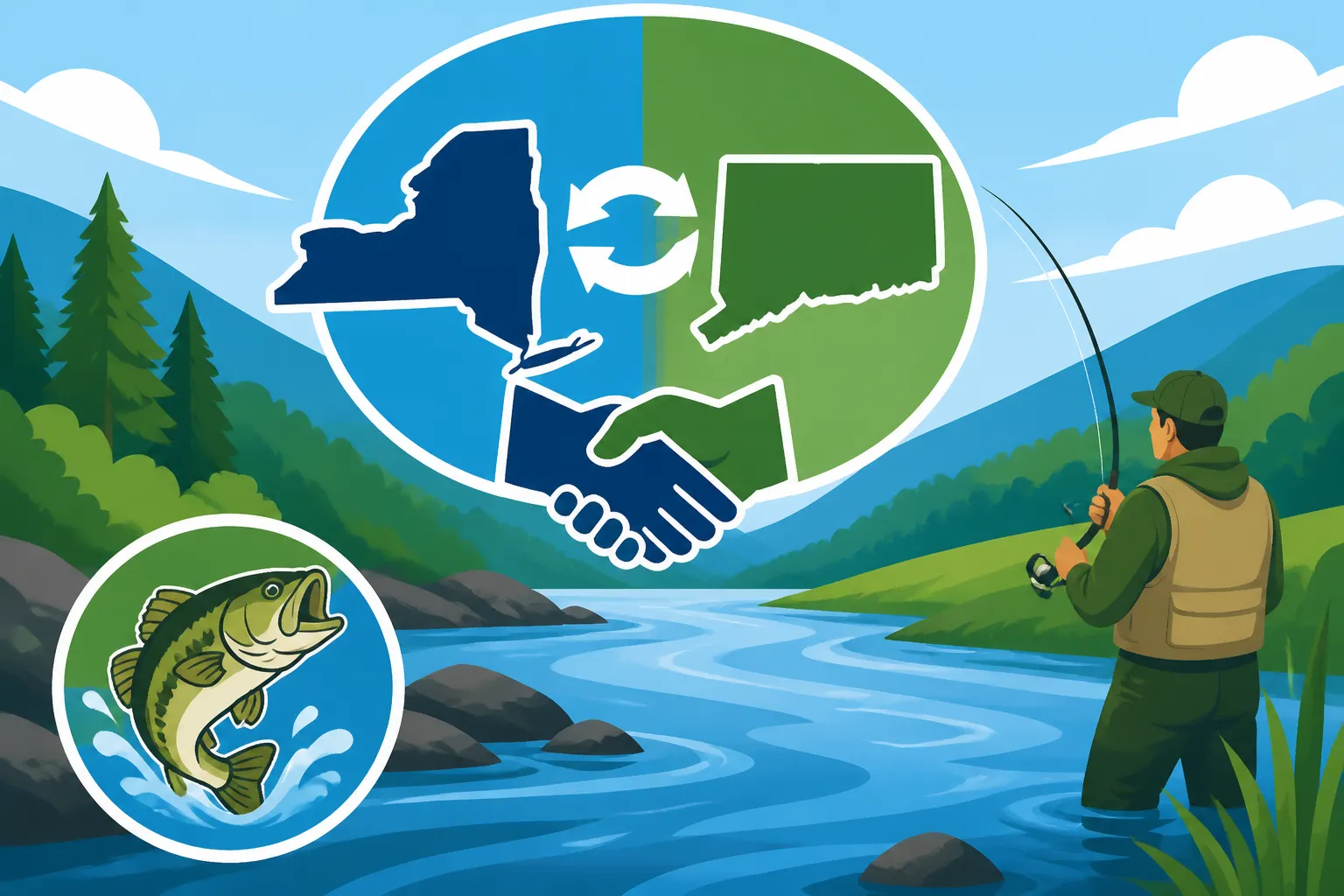
What does this mean for your fishing license? It means there is no specific, formal fishing license reciprocity agreement between Connecticut and New York that applies to the main channel of the Housatonic River itself. If you are fishing anywhere on the Housatonic River within the geographical boundaries of Connecticut, you are required to possess a valid Connecticut Fishing License Guide for 2026. This applies whether you're a lifelong Connecticut resident or a visitor from New York or any other state. The state where you are physically fishing dictates the license you need. You can find detailed information on costs in our guide, How Much Does a Connecticut Fishing License Cost.
So, if you're a New York resident planning a trip to fish the famous Housatonic for trout or smallmouth, you'll need to purchase a non-resident Connecticut fishing license. Your New York license, no matter how comprehensive, will not cover you for fishing in Connecticut waters. This is a common point of confusion, and one that anglers often assume works like other border waters. Always remember: if your feet are on Connecticut soil, or your boat is in Connecticut water, a Connecticut license is your ticket to legally fish.
Special Cases: Border Lakes and Reservoirs
While the Housatonic River itself doesn't share a direct border with New York, its broader watershed in western Connecticut is dotted with lakes and reservoirs that are popular among anglers from both states due to their close proximity to the New York line. For instance, large bodies of water like Candlewood Lake, while entirely within Connecticut, see significant fishing pressure from New York residents. Other smaller ponds and lakes in towns like Danbury, Sherman, and New Fairfield are right up against the border.
In these situations, the rule remains consistent: if the entire body of water (or the section you are fishing) is within Connecticut's state lines, you must have a Connecticut fishing license. There are very few, if any, truly shared bodies of water that straddle the Connecticut-New York land border where specific reciprocity agreements for fishing licenses would apply. Unlike some other states where a lake might literally be bisected by a state line, in western Connecticut, most fishing waters are definitively within one state or the other.
So, for any lake or reservoir in western Connecticut, even if you can practically see New York from the shoreline, a valid Connecticut fishing license is necessary. This includes the major impoundments and the numerous smaller ponds that are popular for panfish, bass, and sometimes stocked trout. Always check a detailed map to be absolutely certain of your location, especially in more remote areas.
What a Connecticut Angler Needs to Fish the Housatonic in Connecticut
Alright, so if you're fishing the Housatonic in Connecticut, whether you're a resident or a non-resident, you absolutely need a Connecticut fishing license. Let's break down exactly what that entails.
The Essentials: Your Connecticut Fishing License
For most freshwater fishing on the Housatonic River, you'll need an Inland Fishing License. However, if you plan to venture further downstream into the tidal sections of the river, closer to Long Island Sound, you might consider an All-Waters license, which covers both inland and marine waters. Our guide, Connecticut Inland vs Marine vs All-Waters License, Explained, dives deep into these distinctions.
The basic requirements are pretty straightforward. If you're 16 years of age or older, you need a license. Children under 16 can fish without one, which is a fantastic opportunity for young anglers to get hooked on the sport! For those who love to chase trout or salmon, you'll also need to purchase a Connecticut Trout and Salmon Stamp, Explained in addition to your fishing license. This stamp supports the state's extensive trout stocking programs and is mandatory for anyone taking or attempting to take these species.
Getting your license is easier than ever. You can purchase one online through the Connecticut Department of Energy and Environmental Protection (DEEP) website, which is incredibly convenient. We’ve put together a step-by-step guide on How to Buy a Fishing License Online in Connecticut. Alternatively, you can visit one of the many authorized vendors across the state, such as bait and tackle shops, town clerks, or sporting goods stores. Always make sure your license is current; Connecticut annual fishing license expiration date is typically at the end of the calendar year, December 31st, regardless of when you purchased it.
Additional Considerations for Housatonic Anglers
Beyond just the license, the Housatonic River is a special place with its own set of rules and nuances that every angler should be aware of. For example, certain sections of the Housatonic are designated as Trout Management Areas (TMAs) or other special regulation waters, which may have specific gear restrictions (like fly-fishing-only sections), catch-and-release rules, or seasonal closures. Our comprehensive guide, Connecticut Trout Management Area Regulations, is an excellent resource for understanding these unique rules.
A critical regulation to be aware of, particularly if you're targeting trout, is the Connecticut Housatonic River Seasonal Closure Explained. Portions of the Housatonic River, especially below Falls Village, close to fishing during certain summer months to protect the river's wild trout population from warm water stress. Fishing during these closures, even with a valid license, can result in penalties. Always check the latest Reading the Connecticut Fishing Guide to ensure you're compliant with all local rules before heading out. This guide, published annually by CT DEEP, is your ultimate authority on all state fishing regulations.
Navigating Fishing Regulations Beyond the License
Having the right fishing license is just the first step. Connecticut, like all states, has a comprehensive set of regulations designed to manage fish populations, protect habitats, and ensure sustainable fishing for everyone. It's not enough to simply have your license; you also need to understand the rules that govern how and what you can fish.
Species-Specific Rules
Every fish species you might encounter in the Housatonic River, from the plentiful trout to robust smallmouth bass and even striped bass in its lower tidal reaches, has its own set of rules regarding size limits, daily creel limits (how many you can keep), and sometimes even specific seasons or gear requirements. For instance, if you're targeting smallmouth bass in the river, there will be a minimum length limit and a daily creel limit that differs from, say, trout. Our guides like Connecticut Trout Limit and Possession Rules or Connecticut Striped Bass Slot Limit and Season go into great detail on these.
It's crucial to check these regulations every year, as they can change based on scientific assessments of fish populations and management goals. The best place to find the most up-to-date information is the official Connecticut Fishing Guide, which is available both online and in print where licenses are sold. Relying on outdated information or hearsay could easily lead to a citation, even if your intentions are good.
Understanding Special Management Areas
The Housatonic River is home to several special regulation areas, often established to protect specific fisheries or enhance particular angling experiences. Trout Management Areas (TMAs) are a prime example, often featuring catch-and-release rules or restrictions on tackle (like artificial lures and flies only) to ensure a healthy wild or holdover trout population. For instance, the Housatonic River TMA from the confluence of the Still River to the Route 1 bridge in Cornwall is a popular spot for fly anglers and has unique rules that differ from general statewide trout regulations.
These special regulations are typically posted clearly at access points, but it's always wise to consult the official fishing guide beforehand. Ignoring these specific rules, even unintentionally, can result in significant penalties. These areas are designed for a reason – to create exceptional fishing opportunities and protect fragile ecosystems – so respecting them is paramount for both your legal standing and the health of the fishery. Understanding these localized rules is just as important as knowing the general statewide guidelines.
Practical Advice for Anglers Near the Border
Fishing near state lines requires a bit more diligence, but it’s definitely manageable. By taking a few proactive steps, you can ensure your fishing trip is worry-free and enjoyable, regardless of where the imaginary border might be.
Always Verify Your Location
In this day and age, there's really no excuse for not knowing precisely where you are. Modern GPS units and mapping applications on your smartphone (like Google Maps, Gaia GPS, or fishing-specific apps like Navionics for marine areas) can pinpoint your exact location down to a few feet. Before you even head out, take a moment to look at your planned fishing spot on a detailed map. Understand where the Connecticut state line truly lies, especially if you're exploring tributaries or smaller ponds in the western part of the state, such as those around Salisbury or Sharon, which are very close to the New York border.
It's a small effort that can save you a huge headache. Imagine getting a fine for Fishing Without a License in Connecticut: Penalties simply because you unknowingly drifted a hundred yards into New York waters without a New York license. Ignorance of the law is never a valid defense, and enforcement officers are typically quite knowledgeable about their jurisdiction's boundaries, especially on popular fishing waters. A quick check of your position on a map can provide instant peace of mind and allow you to focus on the joy of fishing.
Don't Risk It: Get the Right License
While the idea of buying a second state fishing license might seem like an unnecessary expense, consider it an investment in hassle-free fishing. The cost of a non-resident Connecticut fishing license is far, far less than the potential fine, court costs, and embarrassment that comes with being caught without one. For those who frequently fish close to the border, or who might even split their time between residences in Connecticut and New York, purchasing both licenses is simply the smartest option. You can research the Resident vs Nonresident Fishing License Costs in Connecticut to understand the pricing differences.
If you're only making a short trip, a Connecticut 3-Day Nonresident Fishing License Cost might be a more economical option for visitors from New York who want to fish the Housatonic without committing to an annual license. Ultimately, making sure you have the proper credentials for the waters you intend to fish is paramount. It’s about being responsible and ensuring that your love for fishing doesn’t land you in a difficult situation.
Fishing License Requirements for Housatonic River in Connecticut
Here's a straightforward comparison to help clarify the license requirements for fishing the Housatonic River when it's entirely within Connecticut's borders. Remember, there's no specific reciprocity for the Housatonic with New York, so a Connecticut license is always required.
| Angler Residency | Required License for Housatonic River (CT) | Additional Stamps (if targeting specific species) | Key Consideration |
|---|---|---|---|
| Connecticut Resident | Annual Inland Fishing License (or All-Waters if also marine fishing) | Connecticut Trout & Salmon Stamp (if targeting trout/salmon) | Your home state license covers all CT waters. |
| New York Resident | Annual Nonresident Inland Fishing License (or All-Waters) | Connecticut Trout & Salmon Stamp (if targeting trout/salmon) | No reciprocity; your NY license is not valid. A CT Nonresident license is required. |
| Other State Resident | Annual Nonresident Inland Fishing License (or All-Waters) | Connecticut Trout & Salmon Stamp (if targeting trout/salmon) | No reciprocity; a CT Nonresident license is required. |
Disclaimer
The information provided in this guide is intended for general informational purposes only and is subject to change. While we strive to offer accurate and up-to-date content, fishing regulations, license requirements, and reciprocal agreements can be amended by state authorities without prior notice. Always consult the official Connecticut Department of Energy and Environmental Protection (CT DEEP) website or the current annual Connecticut Angler's Guide for the most precise and legally binding information before engaging in any fishing activities.