Wading Techniques for Connecticut Trout Streams
The allure of a pristine Connecticut trout stream, with its shimmering runs and mysterious pools, is undeniable for any angler. But let's be honest, getting to those prime spots isn't always a walk in the park. Slippery rocks, swift currents, and the constant concern of taking an unexpected dip can make wading feel more like a perilous adventure than a peaceful pursuit. This comprehensive guide is here to demystify the art of wading, providing you with the techniques and insights you need to navigate Connecticut's beautiful trout waters safely and confidently.
Essential Wading Gear for Connecticut Streams
Before you even think about stepping into the moving water, having the right gear is non-negotiable. This isn't just about comfort; it's fundamentally about your safety and effectiveness as an angler. Cutting corners here can lead to a miserable, or even dangerous, experience.
Waders and Wading Boots
Your waders are your primary line of defense against the cold water, and their quality and fit directly impact your comfort and mobility. For most of Connecticut's trout seasons, especially during the cooler months, breathable waders are the go-to choice. These allow perspiration to escape, preventing that clammy, cold feeling. Look for models made with Gore-Tex or similar proprietary materials. During the dead of winter, or when ice fishing, you might consider neoprene waders for their superior insulation, but they can be cumbersome for active wading in moving water. Ensuring your waders fit well – not too tight, not too baggy – is crucial. You need enough room to layer underneath, but not so much that they create excess drag in the current or become a tripping hazard.
Then there are the boots, and this is where many anglers make their first mistake. Your wading boots are perhaps the single most important piece of safety equipment you own when wading. They provide the grip that keeps you upright on slick, moss-covered rocks and uneven riverbeds. You'll typically choose between felt soles and rubber soles, or a hybrid. Felt soles offer incredible grip on wet, slimy rocks, making them a favorite for many traditional trout anglers. However, they can perform poorly on mud, snow, or dry ground, and there's the ongoing concern about transmitting invasive species (some states and even specific waters have banned felt altogether, so always check local regulations). Rubber soles are more versatile, performing better on varied terrain and for hiking to access points. For maximum grip, especially in challenging conditions, many anglers opt for rubber soles equipped with screw-in studs or cleats. You can find a great selection of high-quality wading boots, including models with options for studding, on platforms like Amazon.
The interplay between your waders and boots is also critical. Your waders should have neoprene booties that fit snugly but comfortably inside your wading boots. Too small, and your feet will be cramped and cold; too large, and they'll bunch up, causing blisters and instability. Take the time to try on waders and boots together, ideally with the socks you'd actually wear while fishing, to ensure a perfect match. Ill-fitting gear doesn't just reduce comfort; it significantly compromises your stability and safety in the current.
The Indispensable Wading Staff
If you take one piece of advice from this guide, let it be this: a wading staff is not optional; it is a lifeline. Period. Many experienced anglers will tell you that a wading staff is the single most important item for safe wading, often more so than the waders themselves. It provides a crucial third point of contact with the riverbed, transforming your balance from a precarious two-legged stance to a stable tripod. This additional stability can be the difference between maintaining your footing and taking an unexpected, and potentially dangerous, tumble into swift, cold water. Think of it as an extension of your body, constantly probing the riverbed for depth, stability, and unseen obstacles.
Wading staffs come in various forms, from fixed-length models to collapsible designs that fold up neatly and store on your wading belt. While fixed staffs offer robust stability, many anglers prefer the portability of a folding staff, often made from durable aluminum or carbon fiber. Most good wading staffs will come with a coiled lanyard or retention cord that clips to your wading belt or vest, ensuring it doesn't float away if you lose your grip. This is especially important when you need both hands free for casting or handling a fish. When choosing a staff, ensure it's long enough to provide support when extended, typically reaching to about chest height when deployed.
Proper usage of a wading staff involves using it to probe the water ahead of you, feeling for drop-offs, slippery rocks, or unstable bottom conditions before you commit your weight. It also acts as a brace, allowing you to lean into the current and break its force, reducing the pressure on your legs. When moving, the staff should be deployed as part of your "tripod" technique, providing a stable point of contact while you shift your feet. Never push off your staff; use it for support and balance, allowing it to take some of the force of the current.
Critical Safety Accessories
Beyond waders, boots, and a staff, a few other accessories can greatly enhance your safety on Connecticut's diverse trout streams. First and foremost is a properly fitted wading belt. This isn't just for keeping your waders up; it's a critical safety device that cinches your waders tightly around your waist. In the event of a fall, a snug wading belt significantly reduces the amount of water that can rush into your waders, preventing them from filling up and becoming an anchor. This is a crucial step in preventing a life-threatening situation, as water-filled waders can quickly pull you downstream and make it incredibly difficult to regain your footing or swim.
For anyone planning to wade in deeper or swifter waters, especially during the colder months, a personal flotation device (PFD) is highly recommended. While not always common among fly anglers, a low-profile, inflatable PFD can be a game-changer for peace of mind. Remember, the Connecticut Cold Water Life Jacket Rule (October to May) mandates PFD usage in many situations, even for boats, highlighting the danger of cold water immersion. Having a sharp wading knife or line cutter easily accessible can be vital for cutting yourself free from entangled fishing line or other hazards. A small, waterproof first-aid kit containing essentials for minor cuts, scrapes, and blisters is also a smart addition to your pack. Finally, always carry a communication device, such as a cell phone in a waterproof case, especially if you're fishing alone or in remote areas.
Layering your clothing underneath your waders is another often-overlooked aspect of safety and comfort. Avoid cotton, which loses its insulating properties when wet. Instead, opt for moisture-wicking synthetics or wool base layers, followed by insulating mid-layers. This strategy allows you to adjust your clothing based on changing temperatures and activity levels, preventing overheating or chilling. Quick-drying materials are key, so if you do get wet, you can dry out faster and stay warmer.
Understanding Water Dynamics and Reading the River
Stepping blindly into a river is an invitation to trouble. A confident wader isn't just physically capable; they are observant, able to "read" the water and anticipate its challenges. Before you even get your feet wet, take a moment to scan the river and understand its dynamics.
Current Speed, Depth, and Substrate
The speed of the current is perhaps the most immediate indicator of wading difficulty. Slow, meandering stretches are generally easier to navigate, while fast-moving riffles and rapids present significant challenges. Look for visual cues: calm, glassy surfaces often indicate deeper, slower water (or perhaps a dangerously deep pool), while broken, turbulent water over rocks usually means shallower, faster flows. However, what looks like a benign riffle from shore can often be surprisingly swift and powerful once you're in it.
Estimating depth accurately from the bank is a skill that comes with experience. Your wading staff is your best tool here, allowing you to probe the bottom before committing your weight. A good rule of thumb is to avoid wading water that is much deeper than mid-thigh, especially in strong currents. Any deeper, and the water pressure becomes immense, making it incredibly difficult to maintain balance and move safely. Remember, even seemingly shallow water can have hidden depressions or slick spots. The goal is to always know the depth before you put your foot down.
Equally important is understanding the riverbed's substrate. Connecticut's trout streams, like the renowned Farmington River West Branch Trout Fishing or the productive Housatonic River Trout Management Area Fishing, can feature a variety of bottom compositions. Rocky bottoms, particularly those covered in a slick film of algae or moss, are notorious for being treacherous. Gravel beds offer decent footing but can be unstable, especially if the gravel shifts underfoot. Sandy or silty bottoms, while appearing less challenging, can sometimes be surprisingly soft and prone to quicksand-like conditions in certain areas. Observing the banks can often give clues about the riverbed composition. If the banks are gravely, chances are the riverbed will be too.
Identifying Safe Wading Paths
The art of observation before entry is crucial. Don't just pick a spot and plunge in. Instead, mentally map out your route. Look for shallower sections where the current appears to be less aggressive. Often, these paths might not be straight across but might angle upstream or downstream, utilizing natural breaks in the current. Eddies, those calmer pockets of water behind larger rocks or logs, can provide temporary havens and easier points for crossing. Similarly, areas where the current flows over a series of smaller rocks or gravel bars, creating a "V" pattern with the point facing upstream, can sometimes indicate a shallower, more wadeable route.
Always try to plan your entry and exit points carefully. Look for gradual slopes and stable ground where you can comfortably step into and out of the water. Avoid steep, undercut banks or areas with dense, thorny vegetation that could snag your gear or cause a fall before you even get started. It's not just about getting to the fishing spot; it's about getting there and back safely. Sometimes, the safest wading path isn't the most direct, or it might require a short walk along the bank to bypass a particularly nasty section of fast, deep water.
Factors Influencing Water Conditions
River conditions are dynamic and can change rapidly, often necessitating a shift in your wading strategy. Recent rainfall or snowmelt are major players. Even a moderate rain shower can significantly increase water levels and current speed, turning a normally wadeable stretch into a dangerous torrent. Always check local weather forecasts and river gauges before heading out. The Connecticut DEEP's website often provides real-time flow data for major rivers, which can be invaluable.
Dam releases, particularly on regulated rivers like sections of the Farmington River, can dramatically alter water levels and flows with little warning. Anglers need to be acutely aware of dam release schedules and respect warning signs. A river that was perfectly safe to wade in the morning can become dangerously high and fast hours later due to a release. Pay attention to sudden changes in water color or debris in the water, which can indicate increasing flows.
Seasonal changes also play a significant role. Spring run-off from melting snow often means higher, colder, and swifter water, making wading more challenging. Summer can bring lower, warmer flows, which are generally easier to wade, but can also expose more slippery, algae-covered rocks. Understanding these seasonal patterns is key to choosing appropriate gear and adjusting your expectations for Spring Trout Fishing Techniques for Connecticut Streams.
Foundational Wading Techniques for Stability
Once you've assessed the water and chosen your path, it's time to put technique into practice. Good wading is about deliberate, controlled movements, always prioritizing stability over speed.
The "Shuffle Step" and Its Importance
The most fundamental technique for safe wading is the "shuffle step." This isn't just about moving slowly; it's about maintaining constant contact with the riverbed. Instead of lifting your feet high, you slide or "shuffle" them along the bottom, keeping your weight distributed and your balance secure. Why is this so crucial? Because the riverbed is often uneven, riddled with unseen rocks, slick spots, and sudden drop-offs. By shuffling, you can feel these hazards before committing your full weight, giving you time to adjust.
This method emphasizes slow, deliberate movements. Rushing through the water is a recipe for disaster. Each step should be a conscious effort, feeling for stable footing before transferring your weight. Avoid sudden shifts in your center of gravity. Think of yourself as a low-slung crab, moving sideways or slightly angled, always feeling your way. Keeping your center of gravity low by bending your knees slightly and leaning gently into the current also provides greater stability against the water's force. The current wants to push you over; leaning into it helps you brace.
The shuffle step also helps minimize disturbance to the stream. Lifting your feet and crashing them down creates noise and vibrations that can spook fish, particularly wary trout. By shuffling, you move more quietly, allowing for a stealthier approach to those prime fishing lies.
The Tripod Stance for Stability
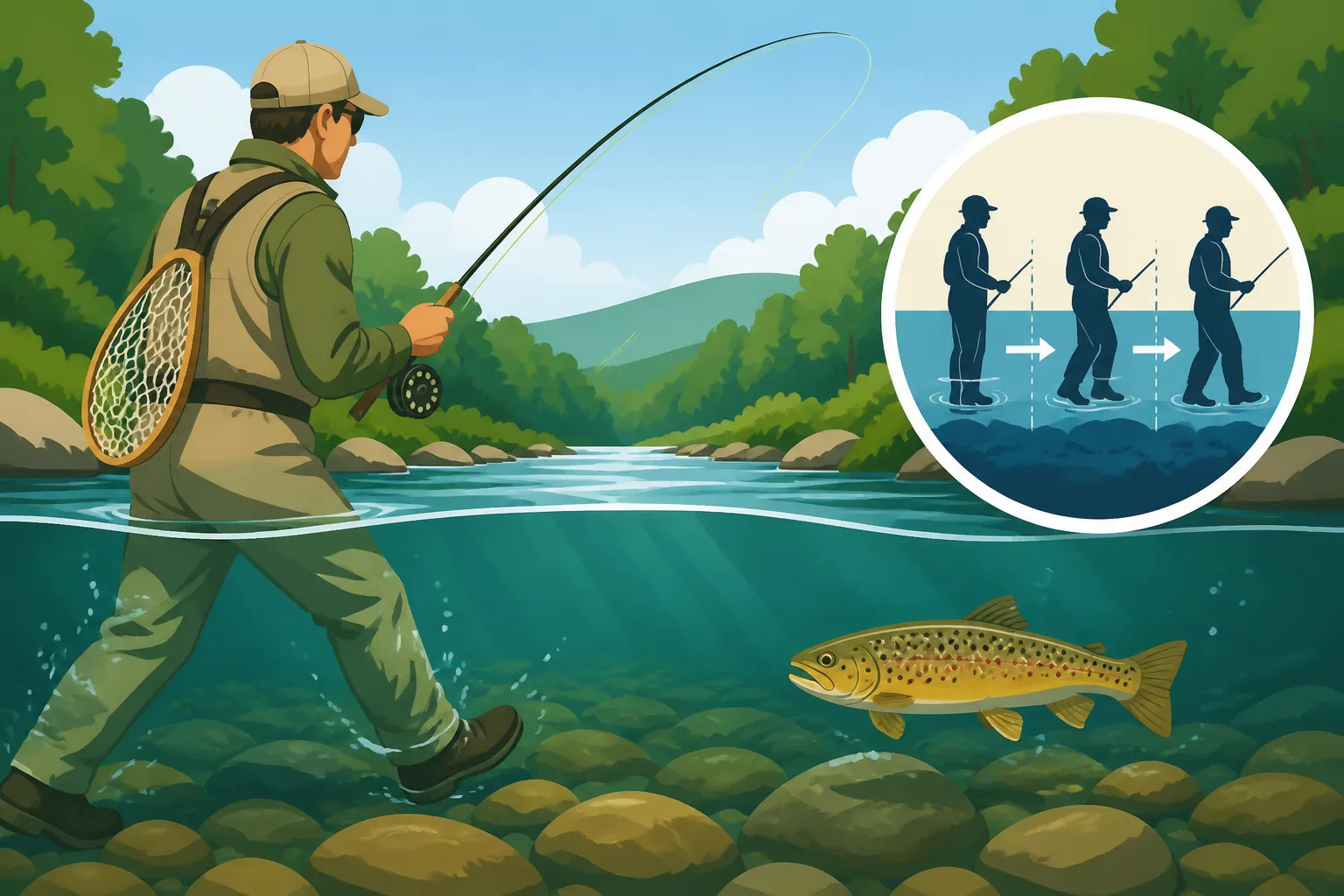
As mentioned, your wading staff is your third leg, and integrating it into a "tripod stance" is how you achieve maximum stability. When you stand or move in the current, you effectively have two points of contact: your feet. Adding the staff creates a third point, forming a stable triangle. This dramatically increases your balance, especially when traversing uneven ground or strong currents.
To practice the tripod, envision your movement:
- Staff Forward: Extend your wading staff slightly ahead of you and plant it firmly on the riverbed.
- First Foot: Move one foot forward, placing it securely on the bottom, always maintaining contact with the staff and your other foot.
- Second Foot: Bring your second foot forward, once again establishing firm contact, while the staff and your first foot provide stability.
Repeat this rhythm, always ensuring two points of contact (staff and one foot, or both feet) are firmly planted before the third point moves. This deliberate, three-point contact system ensures that you are always braced and supported, even when the current is pushing hard.
The tripod stance isn't just for moving; it's essential when stopping to cast, tie on a new fly, or net a fish. By planting your staff firmly, you can focus on your task without constantly fighting the current to maintain balance. This allows for safer, more precise casting and handling of your catch.
Crossing Currents Effectively
When faced with a strong current that must be crossed, there's a specific technique that will keep you upright. Instead of facing directly into the current, angle your body slightly downstream. This allows the current to push against your upstream side, helping to brace you rather than sweeping you off your feet. It's almost like "crabbing" your way across the river. Your wading staff should also be deployed on your upstream side, planted firmly to help break the current's force and provide a stable pivot point.
In wider or particularly swift sections, the buddy system is highly recommended. If you're fishing with a partner, cross together, with the stronger wader positioned upstream to break the current for the other. Hold onto each other's wading belts or shoulders for mutual support. This shared stability can make an otherwise impossible crossing manageable. However, it's crucial to acknowledge when a current is simply too strong. No fish is worth risking your life. If the water is above your mid-thigh in a strong current, or if you feel unstable even with a staff, it's best to find an alternate route, wade a different section, or simply sit that crossing out. Learning to say "no" to a crossing is a sign of a truly experienced and wise angler. The Connecticut Fishing Regulations Explained include safety guidelines that subtly reinforce this wisdom.
Advanced Wading Strategies and Overcoming Challenges
Once you've mastered the fundamentals, you can begin to incorporate more nuanced strategies that will open up new fishing opportunities and help you navigate trickier situations.
Downstream and Upstream Wading
How you approach a section of river – wading upstream or downstream – can significantly impact your success and safety.
Wading Upstream: This is often the preferred method for trout anglers. As trout typically face upstream into the current, wading upstream allows for a stealthier approach from behind them. Fish are less likely to see you, and any disturbance you create tends to flow behind you, minimizing its impact on the fish ahead. This method is also generally safer as you are moving against the current, making it easier to brace yourself and less likely to be swept off your feet. However, it requires more physical effort, especially in strong currents, as you're constantly pushing against the flow. For more specific tactics, consider looking into How to Fish a River for Smallmouth Bass, which often involves similar upstream strategies.
Wading Downstream: While generally less common for stealthy trout fishing, wading downstream has its advantages. It's often easier on the knees and less physically demanding, as the current assists your movement. It can be useful when covering long stretches of water where stealth isn't the primary concern, or when moving quickly between known fishing spots. The main disadvantage is that you are often approaching fish from their line of sight, increasing the chance of spooking them. Additionally, in very swift currents, wading downstream can be less safe, as a fall can quickly sweep you away. You also need to be constantly aware of your footing, as obstacles can appear suddenly from behind your upstream-facing view.
The best strategy often involves a combination of both. You might wade upstream to approach a productive run, fish it thoroughly, then carefully wade downstream to the next promising spot, or exit the river. Always consider the river's characteristics, the fish you're targeting, and the presence of other anglers.
Navigating Obstacles and Deeper Water
Connecticut trout streams are rarely uniform. You'll encounter submerged rocks, fallen trees, beaver dams, and sudden drop-offs. Learning to navigate these obstacles safely is part of becoming an adept wader.
When encountering submerged rocks or logs, use your wading staff to probe around them. Look for gaps or channels where the water might be shallower or slower. Sometimes, a slight detour around the obstacle, even if it means wading closer to the bank or briefly stepping onto it, is safer than attempting to directly cross a turbulent, unknown area. If you must step over a small log or rock, always maintain your tripod stance, planting your staff firmly before lifting a foot.
Entering and exiting deeper pools requires extra care. If possible, avoid entering pools from steep, undercut banks. Look for gradual entries where you can ease into the deeper water, using your staff to gauge depth. When exiting, identify a stable, gently sloping bank. In deeper water, the current's force is greater, and your mobility is reduced. Maintain a low center of gravity and use your staff to maintain balance as you transition from deep to shallower water or solid ground.
Wading in Cold Water Conditions
Connecticut's trout season often spans through very cold months, from early spring to late fall, and even into winter for some species and special regulation areas. Wading in cold water presents unique challenges and significant risks. The primary danger is hypothermia, a condition where your body loses heat faster than it can produce it. Even a brief immersion in cold water can quickly lead to hypothermia, impairing your judgment and physical abilities. This is precisely why the Connecticut Cold Water Life Jacket Rule (October to May) is in place, reminding us of the serious dangers.
Proper layering is paramount in cold water. Start with a good quality base layer made of merino wool or synthetic materials, which wick moisture away from your skin and retain warmth even when damp. Follow with insulating mid-layers, such as fleece pants or puffy down/synthetic pants specifically designed for wearing under waders. Neoprene waders offer superior insulation compared to breathable waders, making them a better choice for truly frigid conditions. However, if using breathable waders, ensure your layering is sufficient.
Recognizing your limits in cold water is crucial. Shivering, clumsiness, confusion, and slurred speech are all signs of hypothermia. If you experience these, or see them in a fishing partner, get out of the water immediately, change into dry clothes, and seek warmth. It's far better to cut a trip short than to risk severe health consequences. Always let someone know where you're going and when you expect to return, especially during cold weather outings.
Wading Etiquette and Environmental Stewardship
Being a responsible angler extends beyond just catching fish; it encompasses how we interact with the environment and with other people on the water. Good wading etiquette and environmental stewardship ensure that Connecticut's trout streams remain beautiful and productive for everyone.
Minimizing Stream Disturbance
Every step you take in a trout stream has the potential to disturb the delicate aquatic ecosystem. Careless wading can dislodge eggs, crush aquatic insects (the primary food source for trout), and erode the stream bed. To minimize your impact, practice the shuffle step diligently, moving slowly and deliberately. Avoid kicking up excessive silt or gravel, which can obscure visibility for both fish and other anglers downstream.
Be particularly mindful of disturbing active spawning beds, often visible as cleaner, lighter-colored patches of gravel called "redds." During spawning seasons, stepping on these areas can destroy trout eggs and decimate future generations. While Connecticut has specific regulations regarding Connecticut Trout Season and Stocking Rules, understanding fish behavior helps preserve natural reproduction. Staying aware of your surroundings and avoiding unnecessary movement will not only make you a more ethical angler but often a more successful one, as it reduces the chance of spooking fish.
Respecting Other Anglers
Connecticut's trout streams are popular, and you'll often encounter other anglers. Maintaining adequate distance is a fundamental courtesy. A general rule of thumb is to give other anglers at least 50-100 feet of space, or more if the river allows, to ensure you don't crowd their fishing spot or wade through water they intend to fish. If you need to pass someone, do so by walking on the bank, well behind them, or if absolutely necessary, wade widely around them, offering a polite "excuse me" or "mind if I pass?" as you go.
Never "wade through" another angler's active fishing water, especially if they are casting or working a specific run. This is one of the quickest ways to earn dirty looks and understandable frustration. Communication is key; a friendly wave or a verbal check-in can often diffuse potential issues and even lead to shared insights about the fishing conditions. We are all out there to enjoy the peace of the river, and mutual respect ensures that experience for everyone.
Protecting Stream Banks and Riparian Zones
The vegetation along river banks, known as the riparian zone, plays a vital role in stream health. It stabilizes the soil, prevents erosion, filters runoff, and provides shade and habitat for wildlife. When wading, try to stay in the water as much as possible, or use designated access points and well-worn trails. Repeatedly trampling vegetation on stream banks can destroy this crucial habitat, leading to erosion and degradation of water quality.
Always adhere to Leave No Trace principles: pack out everything you pack in, and leave the stream as clean or cleaner than you found it. This includes fishing line, bait containers, and any other trash. Familiarize yourself with the Reading the Connecticut Fishing Guide to understand specific regulations and recommended practices for protecting Connecticut's natural resources. Our collective actions directly impact the health and beauty of these precious trout streams for years to come.
| Sole Type | Best Use Case | Pros | Cons |
|---|---|---|---|
| Felt | Very slick, mossy rocks | Superior grip on wet, slimy surfaces | Poor grip on mud/snow/dry ground; can transfer invasive species (often banned); wears quickly on abrasive surfaces |
| Rubber | Varied terrain, mud, gravel, hiking | Good all-around grip; better for hiking; won't transfer invasives | Can be slippery on extremely slick, moss-covered rocks; less initial "stick" than felt |
| Rubber with Studs/Cleats | Extremely challenging, slick, algae-covered terrain, strong currents | Unmatched grip, penetrates moss/slime, excellent stability | Can damage soft stream beds; noisy; studs wear down on pavement; can scratch boat finishes |
Disclaimer
The information provided in this guide is for general informational purposes only and does not constitute professional advice. Wading in rivers carries inherent risks, and conditions can change rapidly. Always exercise extreme caution, use appropriate safety gear, and assess conditions before entering the water. Your safety is your responsibility.