How to catch blackfish around rocky structure
Landing a feisty blackfish (also known as tautog) around Connecticut's abundant rocky structure is one of the most rewarding, yet incredibly frustrating, experiences for any angler. You know the drill: you feel that tell-tale tap, set the hook, and suddenly you're locked in a tug-of-war with a powerful fish determined to wrap your line around every barnacle-encrusted rock and submerged wreck. It's a game of inches, a true test of tackle and skill, and losing a big one to a snag can feel like a punch to the gut. This guide is here to equip you with the knowledge and tactics to consistently pull those stubborn 'tog out of their treacherous rocky homes in Connecticut waters.
Understanding Blackfish and Their Rocky Lair in Connecticut
Blackfish are true gladiators of the inshore saltwater scene, and their preference for hard, craggy bottom is both their greatest defense and your biggest challenge. To consistently catch them, you first need to understand why they love these areas and how to identify their prime real estate.
Blackfish Habits Around Structure
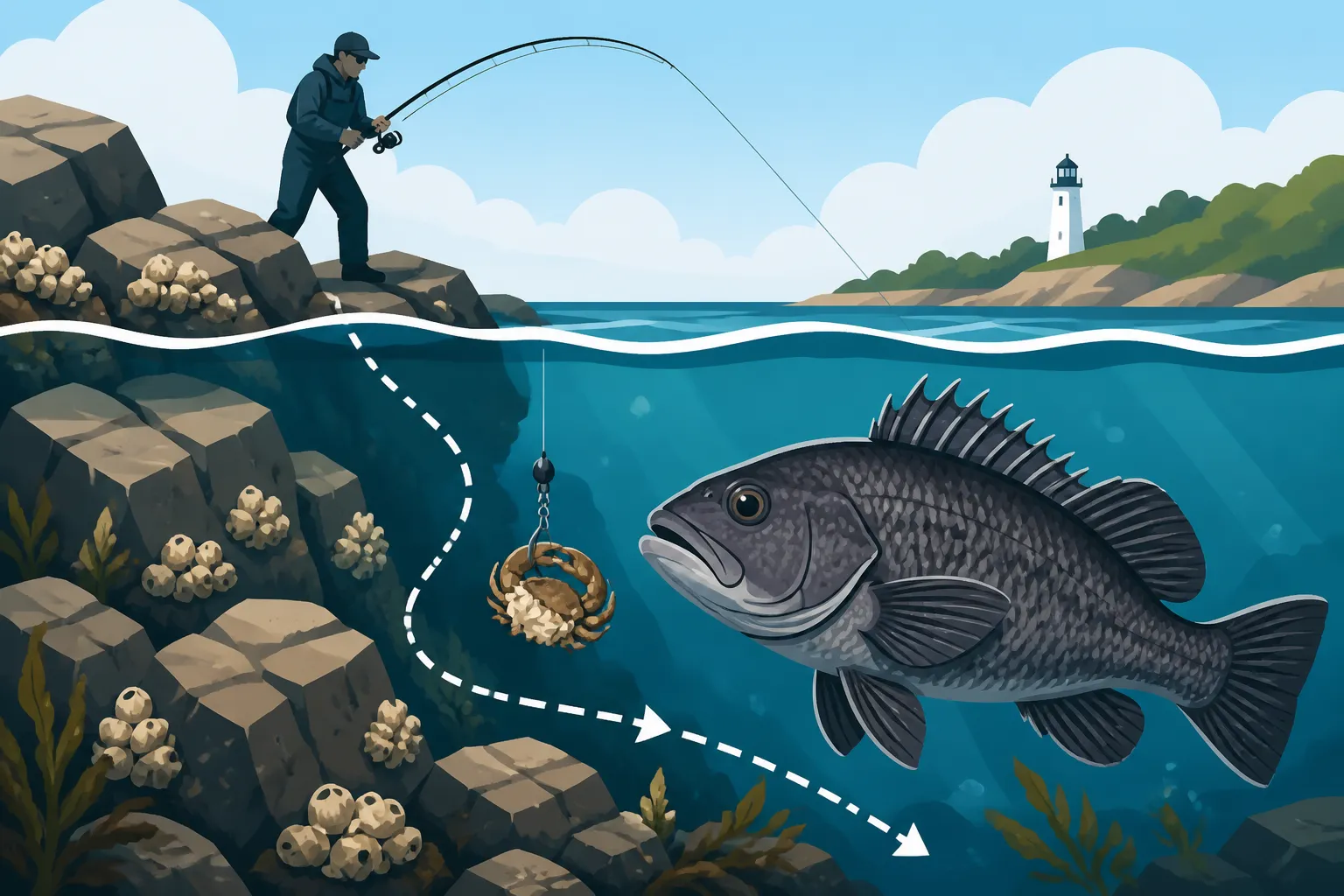
Think of a blackfish as the ultimate marine bouncer, patrolling their rocky turf. Their diet largely consists of shellfish, crabs, and other crustaceans, which naturally cling to or hide within rocky environments. With their powerful, crushing jaws and prominent teeth, they're perfectly adapted to prying mussels off rocks, cracking crab shells, and generally foraging in these hard-bottomed areas. They don't just hang out near structure; they live in it. Crevices, overhangs, and small caves offer them protection from predators and strong currents, and a convenient pantry of food. This habit is exactly why targeting them is so challenging – they're just a short dart away from safety once hooked. Understanding What blackfish eat around structure is key to bait selection.
These fish are also pretty territorial, often returning to the same rock piles or wrecks season after season. They're cold-blooded creatures, so their activity levels are influenced by water temperature. In the colder months, they might move to deeper, more stable structures, while in warmer periods, you'll find them more active in shallower, accessible rocky zones. Knowing these habits helps you predict not only where they'll be but also how aggressively they might feed.
Identifying Prime Rocky Structure
Connecticut's coastline, particularly in Long Island Sound, is absolutely littered with fantastic blackfish habitat. Identifying these prime spots is half the battle. You're looking for anything that offers hard bottom, shelter, and food sources.
- Natural Reefs and Rock Piles: These are the classic spots. Think about areas like the Thimble Islands off Branford, where countless rocky outcroppings and submerged ledges create an intricate network of tog heaven. These can be relatively shallow or extend into deeper waters.
- Jetties and Breakwaters: Man-made structures like the jetties in Old Saybrook, Clinton, or the breakwaters around New Haven Harbor are magnets for blackfish. They offer vertical relief, plenty of cracks for crabs, and barnacle growth that tog love to graze on. These spots are often accessible to shore anglers as well.
- Bridge Pilings: The pilings of bridges spanning tidal rivers or estuaries (like sections of the Connecticut River leading to the Sound) can also hold blackfish, especially if there's rock riprap around their bases.
- Submerged Wrecks and Debris: Old boats, barges, and even discarded construction materials on the seafloor become artificial reefs over time. These can be absolute goldmines, but they're also notorious for snags. Many fishing charts and electronic mapping systems will mark known wrecks.
- Boulder Fields and Rocky Bottom on Flats: Even seemingly featureless bottom might have patches of large boulders or extensive rocky terrain that aren't immediately obvious on a basic chart. A good fish finder is invaluable here for marking these subtle variations.
When scouting, look for sudden changes in depth, areas where strong currents funnel baitfish, and listen to local reports. Many seasoned anglers keep precise GPS marks of productive rock piles. Remember, blackfish don't like soft, muddy bottom; they need something solid to call home. This focus on structure is a cornerstone of Blackfish (Tautog) Fishing in Connecticut.
Essential Gear for Taming Tautog in the Rocks
You can't go into a blackfish battle with flimsy gear. These fish are powerful, and their environment is unforgiving. Equipping yourself properly is crucial to success and minimizing lost tackle.
Rod, Reel, and Line Selection
The right setup isn't just about catching the fish; it's about extracting them from their rocky fortress.
- Rod: You need a rod with serious backbone. Forget about light trout rods or even medium-action bass rods. A 7 to 8-foot fast-action conventional or heavy spinning rod, rated for 20-50 lb braid, is ideal. The fast action gives you sensitivity to feel those subtle tog bites, while the stiff backbone is necessary to turn a fish's head the moment it bites and prevent it from diving back into the rocks. Some anglers prefer shorter rods (6-6.5 feet) for quicker leverage when fishing extremely tight structure. Look for quality rods with durable guides and reel seats.
- Reel: A conventional reel (like a Penn Squall or a Shimano Torium) in a 15-20 size is a popular choice for boat anglers. It offers excellent cranking power and a powerful drag system, which is paramount when fighting a fish that's pulling for a snag. For shore-based anglers or those who prefer spinning gear, a heavy-duty spinning reel in the 5000-6000 series (like a Daiwa BG or a durable Penn Spinfisher) with a robust drag is also perfectly acceptable. The key is a smooth, strong drag that won't give out under pressure.
- Line: Braided line is almost universally preferred for blackfishing, and for good reason. Its nearly zero stretch provides incredible sensitivity, allowing you to detect the faintest "taps" that signal a tog bite. Use 30-50 lb test braided line. The thinner diameter also helps cut through the current, allowing you to use lighter sinkers. Because braid has no abrasion resistance, you must use a leader. A 3-4 foot section of 30-50 lb fluorocarbon leader is essential. Fluorocarbon is less visible underwater and, more importantly, much more abrasion-resistant than mono, helping protect your main line from sharp rocks and oyster beds. You can find quality braided line and fluorocarbon leaders on platforms like Amazon, offering a wide selection to match your preferences.
Rigging for Success in Rocky Environments
This is where many anglers either succeed or fail. The goal is to present your bait naturally while minimizing snags.
- Tog Jigs: In recent years, tog jigs have become incredibly popular, especially for boat fishing. These are basically lead-head jigs with a stout hook, often painted in dark or natural colors. Their advantage is a more direct connection to the fish, a natural presentation, and often fewer snags than traditional rigs because the sinker and hook are one unit. You can simply thread a half crab onto the jig hook. Weights typically range from 1/2 oz to 2 oz, but you might need heavier ones in strong currents.
- Sinker Rigs (Traditional Tog Rigs): The classic "tog rig" is a variation of a Carolina rig or a high-low rig, specifically designed for bottom fishing.
- Components: You'll need an egg sinker or bank sinker (often 3-10 oz, but sometimes up to 12 oz in strong currents or deeper water), a heavy barrel swivel, a section of fluorocarbon leader, and a strong, sharp hook.
- Construction: A common setup involves tying your main line (braid) to one end of a barrel swivel. To the other end of the swivel, tie about 12-18 inches of fluorocarbon leader. Then, tie your hook to the end of that leader. Above the swivel, slide your egg or bank sinker directly onto your main line. Some anglers add a small bead between the sinker and the swivel to protect the knot. This allows the fish to pick up the bait without immediately feeling the weight of the sinker.
- Alternative (Snag-Resistant): Another popular rig is to tie a small surgeon's loop or dropper loop about 6-8 inches above your sinker knot on a short leader. Your hook attaches to this loop. Then, tie a lighter monofilament "breakaway" line (e.g., 15 lb test mono) to your sinker, with the sinker at the very end. This way, if your sinker gets snagged, you only lose the sinker, not the entire rig and fish.
- Hooks: Absolutely crucial. Blackfish have incredibly tough mouths. You need strong, sharp, wide-gap hooks that won't bend out or dull easily. Octopus-style hooks or stout J-hooks in sizes 2/0 to 4/0 are standard. Brands like Gamakatsu or Owner are often favored for their sharpness and strength. Invest in good hooks; it's a small expense that makes a huge difference.
The Best Baits and How to Present Them
You can have the best gear in the world, but if you're not offering the tog what they want to eat, you're just fishing. Blackfish are predominantly crab and shellfish eaters, so your bait selection should reflect that.
Top Blackfish Baits
When it comes to blackfish, crabs are king. There's no way around it; they are their favorite meal.
- Green Crabs: These are the undisputed champions of blackfish bait. Readily available at most tackle shops in coastal Connecticut during the season. To rig them, you can break off the legs (which releases scent) and either thread a whole small crab onto the hook or, for larger crabs, break them in half. Hook them through one of the leg sockets or through the "point" on the side of their carapace, making sure the hook point is exposed. You can find excellent instructional videos on YouTube showing various rigging techniques.
- Asian Shore Crabs: These smaller, darker crabs have become increasingly prevalent along the Connecticut shoreline. They're often found hiding under rocks and seaweed in the intertidal zone. While smaller than green crabs, they are incredibly effective, especially for "finicky" tog or when trying to match the local forage. Many anglers collect their own.
- Fiddler Crabs: Excellent bait, especially in areas where they are naturally present. They are smaller than green crabs, so you might use multiple fiddlers per hook for a more enticing offering.
- Hermit Crabs: These tough, shelled crabs are also a fantastic option. They're harder to find and prepare (you need to crack their shells), but their meat is a tog delicacy, often attracting larger fish.
- Clams and Mussels: While not as durable or universally effective as crabs, fresh clams or mussels can work, especially if they are abundant in the area you are fishing. They break down quickly, so you'll need to re-bait frequently. Some anglers combine a piece of clam with a small crab for added scent.
Don't be afraid to experiment! Sometimes, what the tog are keying on changes by location or even by the day. Having a variety of baits on hand can make a big difference. You can even find specialized tackle and bait buckets, like those on Amazon, to help keep your crabs fresh and lively on the boat.
Mastering the Drop and the Bite
This is the art and science of blackfishing. It's not just about dropping a bait to the bottom; it's about precision, feel, and quick reflexes.
- Precise Placement: Blackfish live in the structure, so your bait needs to be in the strike zone. If you're fishing from a boat, use your electronics (fish finder, GPS) to pinpoint rock piles, wrecks, or contours. Once you've marked a spot, try to drop your rig directly onto or very close to the structure. This might mean adjusting your boat's position with an anchor, a Minn Kota electric trolling motor with spot-lock, or by carefully drifting. For shore anglers, this means accurately casting into pockets or alongside jetty rocks.
- Feeling the Bite: This is the most infamous aspect of blackfishing. Blackfish are known for their incredibly subtle, yet distinct, bite. It's rarely a slam-bang strike. More often, you'll feel a series of light "taps" or "picks." They're not biting the hook; they're sampling the bait, often crushing the shell, before deciding to commit. This is why braided line is so critical—you need that sensitivity. Don't immediately set the hook on the first tap. Wait for a solid, sustained pull, or a sequence of increasingly aggressive taps that indicate the fish has taken the bait into its mouth. Sometimes it feels like your sinker is just bouncing on the bottom, but it's actually a tog mouthing your crab!
- Setting the Hook: The moment you feel that solid pull, or the rod tip loads up, set the hook hard. This isn't a gentle wrist flick; it's a powerful, sweeping motion, often two or three times to ensure the hook penetrates their bony jaw. If you hesitate, even for a second, the tog will either spit the bait or, worse, wedge itself back into a rock crevice.
- Fighting the Fish: Once hooked, the fight is on. Blackfish are incredibly strong for their size and will immediately try to dive back into the structure. You need to keep constant, heavy pressure on them. Pump and reel, don't just crank. Don't give them an inch of line, especially in the initial stages of the fight. If they get back into the rocks, it's usually game over. You might be able to free a snagged fish by giving slack and waiting, but more often than not, it's a lost rig. Many anglers recommend using an anchor ball for easier anchor retrieval, which can really save your back and prevent anchor loss when fishing gnarly bottom.
Advanced Strategies and Safety for Rocky Blackfishing
Beyond the basics, there are some nuanced strategies and vital safety considerations that can elevate your blackfishing game, especially around Connecticut's diverse rocky habitats.
Utilizing Tides and Current
Tides and current play a huge role in blackfish activity and how you fish for them. Blackfish are opportunistic feeders, and moving water brings food to them.
- Moving Tides: Often, the most productive times are during the moving tides, particularly the last few hours of the incoming tide and the first few hours of the outgoing. This is when crabs, mussels, and other prey are dislodged or become more active, making them easier targets for hungry tog. During a strong current, blackfish will typically position themselves on the leeward side of the structure, out of the direct flow, waiting for food to drift past. This is where you want your bait to land.
- Slack Tide: While blackfish can still be caught on a slack tide, their activity often slows down. However, slack tide can also offer a window to fish particularly gnarly, snag-prone spots that are impossible to fish during heavy current. The lack of current allows for lighter sinkers and a more precise bait presentation. It's a trade-off: potentially less active fish, but easier fishing in challenging spots. Pay attention to Connecticut Fishing Season Dates and Closures and Connecticut Blackfish (Tautog) Season Dates as seasonal changes can impact how tog respond to tides.
Boat Positioning and Anchoring
If you're fishing from a boat, your ability to position yourself precisely over or alongside structure is paramount.
- Precise Anchoring: This is an art form. You need to account for current, wind, and depth to drop your anchor upstream (or up-current) of your target structure so that your boat settles directly over the spot. An anchor ball can be a lifesaver, allowing you to quickly pop your anchor free if it gets snagged on the bottom. Practice makes perfect here. If you're chartering, a good captain will have this down to a science. Consider contacting Best Blackfish Charters in Connecticut for expert guidance.
- Electric Trolling Motors: Modern electric trolling motors with GPS spot-lock capabilities have revolutionized blackfishing. Instead of anchoring, you can simply press a button, and the motor will hold your boat in place over the exact spot, even in current. This allows for incredible precision and easy adjustments to target different parts of a rock pile.
- Multiple Drops: Don't just anchor once and stay there. Make a few drifts or anchor adjustments to explore different angles and depths of the structure. Sometimes moving just 20 feet can put you directly on a school of feeding tog.
Shore-Based Blackfishing from Jetties and Piers
Not everyone has a boat, and Connecticut offers some fantastic opportunities for shore-based blackfishing, especially from jetties and piers along Best Shore Fishing Spots in Connecticut.
- Challenges: The primary challenges are casting accuracy, the need for heavier tackle to battle fish from a height, and navigating slippery, barnacle-covered rocks. You'll often need longer rods to help guide the fish over the rocks and prevent immediate snags.
- Techniques: Look for areas where the jetty drops off into deeper water or where there are obvious rock piles at the base of the structure. Cast your rig as close to the rocks as possible without getting immediately snagged. Be prepared for a very strong, immediate fight once hooked, and try to guide the fish away from the structure as quickly as possible.
- Safety: Always wear appropriate footwear with good grip when walking on jetties. Rocks can be extremely slippery, especially when wet from waves or rain. Be mindful of incoming waves and changing tides.
Safety First on the Water
Fishing around rocky structure, especially in cold water or from a boat, carries inherent risks. Your safety should always be the top priority.
- Life Jackets: Always wear a life jacket. It's not just a recommendation; it's often a legal requirement in Connecticut, particularly during colder months. Check the Life Jacket Requirements for Connecticut Boaters and be aware of the Connecticut Cold Water Life Jacket Rule (October to May), which mandates wearing a life jacket from October 1 to May 31 for anyone on a small vessel. Drowning can happen in seconds, even for strong swimmers, especially if you fall into cold water or are knocked unconscious.
- Weather Awareness: Keep a close eye on weather forecasts and sea conditions. Long Island Sound can get rough quickly. High winds, heavy seas, or approaching thunderstorms are reasons to stay ashore or head back to port.
- Sharp Objects: Blackfish have sharp teeth, and hooks are, by nature, sharp. Bring a good pair of pliers or a dehooker to safely remove hooks. A cutting tool (like heavy-duty clippers or a knife) is also essential for quickly cutting snagged lines.
- Cold Water Gear: If you're fishing in the cooler months, dress in layers and wear waterproof outer gear. Hypothermia is a serious risk if you get wet.
- First Aid Kit: Always have a well-stocked first aid kit on board for minor cuts, scrapes, or other injuries.
By understanding the blackfish's habits, selecting the right gear, mastering presentation, and prioritizing safety, you'll significantly increase your chances of success in landing these hard-fighting fish from Connecticut's challenging rocky structures.
Blackfish Bait Comparison Table
| Bait Type | Pros | Cons | Best Use Case | Rigging Tips |
|---|---|---|---|---|
| Green Crabs | Very effective, widely available | Can be expensive, shells can be tough to rig | All-around best bait for most situations | Whole (small), halved (medium/large). Hook through leg socket or side point. |
| Asian Shore Crabs | Highly effective, natural forage | Smaller size, harder to purchase | When fish are picky, or matching local diet | Several small crabs per hook, or single large one. Hook through carapace. |
| Fiddler Crabs | Excellent attraction, natural | Small size, less durable, harder to purchase | Finesse fishing, light tackle, or when available locally | Multiple fiddlers per hook for better presentation. Hook through carapace. |
| Hermit Crabs | Attracts larger fish, tough bait | Hard to find, requires shell cracking | Targeting trophy-sized blackfish | Crack shell, expose meat, thread onto hook. |
| Clams/Mussels | Strong scent, can be abundant | Very soft, easily picked off, less durable | As a secondary attractant, or when crabs are scarce | Use a clam bag or secure with bait elastic. |
Disclaimer
Fishing regulations, including seasons, size limits, and possession limits, are subject to change. Always consult the latest official Connecticut Department of Energy and Environmental Protection (DEEP) fishing guide or website before heading out to ensure compliance with all current rules. This guide is for informational purposes only and does not supersede official regulations.