Best technique for fishing a plunge pool
Plunge pools, those deep, often mysterious pockets of water found beneath waterfalls, rapids, or significant obstructions in a river or stream, can be some of the most frustrating yet rewarding places to fish in Connecticut. Many anglers walk right past them, intimidated by the turbulent water or dense overhead cover, or they simply cast through them too quickly, missing out on the prime lies where some of the biggest, most aggressive fish often hold. It's a common challenge: how do you effectively present a bait or lure in such a dynamic, often compact, and sometimes snag-filled environment? This comprehensive guide will arm you with the best techniques to unlock the secrets of these hidden gems, helping you consistently catch fish where others only see a swirling challenge.
Understanding the Anatomy of a Plunge Pool
Before you even think about casting, truly understanding what makes a plunge pool a fish magnet is crucial. It’s not just a deep spot; it’s a dynamic ecosystem within the river that provides specific advantages to the fish living there. Ignoring these nuances means you're just casting blindly into a hole.
The Fish's Perspective: Why Plunge Pools Are Prime Real Estate
Think of a plunge pool from a fish's point of view. It’s a natural cafeteria with a built-in current delivery system. The crashing water above acts like a conveyor belt, dislodging insects, worms, and even smaller baitfish from upstream and depositing them right into the pool. This constant influx of food means fish don't have to expend much energy to feed; they can simply hold in strategic positions and let the groceries come to them. Beyond the food, these pools offer significant protection. The depth provides cover from overhead predators like ospreys and herons, while the turbulent surface water often masks their presence from anglers. Furthermore, the deeper water can offer thermal refuge, staying cooler in summer and warmer in winter, making them comfortable havens year-round. They are also often key holding areas for larger, more dominant fish that have claimed the best feeding and resting spots.
The structure around a plunge pool is equally important. Large boulders, submerged logs, undercut banks, and ledges create current breaks and ambush points. Fish will tuck themselves behind these structures, expending minimal energy while waiting for food to drift past. This also gives them a sense of security. Knowing where these hidden structures are, even if you can't see them, will dictate your casting angles and presentation. This is especially true in the cold, clear waters often found in Connecticut's trout streams or the larger rivers holding smallmouth bass. Mastering the approach to these challenging lies will significantly improve your chances.
Identifying Key Holding Lies and Current Seams
Every plunge pool, despite its chaotic appearance, has an underlying structure of currents and calmer water that fish exploit. Your job is to read these subtle cues. The most obvious feature is the main current flow entering the pool, which is usually the most turbulent. However, directly adjacent to this, or along the edges, you'll find "current seams." These are lines where fast water meets slower water, creating a conveyor belt effect where food concentrates. Fish will often sit right in or along these seams, darting out to grab morsels as they pass.
Beyond the seams, look for eddies – areas where the current circles back on itself, often behind a large rock or in a corner of the pool. These are prime resting spots where fish can conserve energy while still having access to food that gets caught in the swirling water. The very bottom of the plunge pool, particularly if it's rocky or has submerged logs, provides deep cover. Larger, more wary fish often hug the bottom, especially when the water is clear or the sun is high. Understanding the different sections of a plunge pool is your first step to strategic fishing. You're not just casting into a pond; you're deciphering a complex aquatic puzzle where every ripple and swirl tells a story. When you're fishing for species like trout in the Farmington River or trying to hook a feisty smallmouth in the Housatonic River Fishing Guide, understanding these micro-currents is paramount.
Essential Gear for Plunge Pool Domination
Successfully fishing plunge pools often requires a slightly different approach to gear than simply fishing open stretches of river. The tight quarters, swift currents, and need for precise presentation demand specific rod, reel, line, and lure choices.
Rods and Reels for Tight Spaces and Heavy Lifts
For plunge pools, think short and powerful. A shorter rod, typically in the 5 to 7-foot range, offers significant advantages. It allows for easier casting under overhanging branches that often line these pools and provides better maneuverability in tight spots. A medium-light to medium power rod with a fast action tip is ideal. The fast action gives you the sensitivity to feel subtle bites in turbulent water, while the medium power provides enough backbone to fight a strong fish out of heavy current and away from snags. Paired with a spinning reel in the 1000 to 2500 size range, spooled with 6-10 pound test braided line and a fluorocarbon leader, you'll have a formidable setup. Braided line offers superior sensitivity and strength for its diameter, which is crucial for detecting strikes and preventing break-offs around structure. The fluorocarbon leader, being nearly invisible underwater and abrasion-resistant, adds a stealthy connection to your lure. Many anglers find durable, quality options for these setups available on Amazon, especially when looking for specific lengths or actions that might not be available at every local shop.
For fly anglers, a shorter rod, perhaps a 7 to 8.5-foot, 3 to 5-weight rod, is often preferred for similar reasons, aiding in roll casts and tight-loop presentations under canopy. A weight-forward floating line or a short sinking tip line, depending on depth and current, coupled with a sturdy leader, will serve you well. Fly Patterns for Connecticut Trout Streams will often dictate the need for precise placement.
Lures and Baits: Matching the Hatch (or the Drop)
The key to lure and bait selection in plunge pools is often about getting down quickly and staying in the strike zone.
For spinning and baitcasting setups, small jigs (1/16 to 1/8 ounce) tipped with soft plastics (grubs, tubes, small creature baits) are incredibly effective. Their compact profile sinks fast and they offer a lifelike action. Small inline spinners or spoons can also be deadly, especially when fish are actively feeding on baitfish. Think about something like a Panther Martin or a small Kastmaster. Another excellent choice, particularly for smallmouth bass, are small crankbaits or jerkbaits that can be worked precisely through the pool, bumping off rocks. For trout, natural baits like worms, mealworms, or corn are always reliable, fished on a small hook with just enough weight (split shot) to get it to the bottom without snagging. Having a diverse selection of these in your tackle box, easily replenished through online retailers like Amazon, will prepare you for varying conditions and fish preferences.
For fly anglers, weighted nymphs are your bread and butter. Patterns like Hare's Ear, Pheasant Tail, Prince Nymph, and Squirmy Wormies, often fished under an indicator with a split shot or two, are excellent for getting deep. Streamers like Woolly Buggers (black, olive, or brown) are fantastic for mimicking baitfish and can provoke aggressive strikes from larger trout or smallmouth. Dry flies are less common in the turbulent heart of a plunge pool but can be effective in the calmer eddies or along the current seams where insects might collect. If you’re getting into Euro Nymphing Connecticut Trout Streams, these pools are prime territory for that technique, allowing you to maintain deep contact with your flies.
Mastering the Cast and Presentation
Getting your lure or bait into the heart of a plunge pool and presenting it naturally is where the true skill comes into play. It's often not about distance, but accuracy and control.
Precision Casting and Roll Casting Techniques
In many plunge pool scenarios, overhead casting is simply not an option due to dense tree cover or steep banks. This is where precision casting and alternative techniques become invaluable. A short, accurate pitch or flip cast is essential. Instead of a big wind-up, use the rod tip to lob your lure with a pendulum motion, aiming for those narrow openings in the canopy or specific seams. Practice this in your backyard, trying to land a small weight in a coffee cup from various angles.
For fly anglers, the roll cast is your best friend. With minimal backcasting room, a roll cast uses the water tension to load the rod, propelling the line forward. Mastering variations of the roll cast will allow you to present nymphs and streamers in even the most claustrophobic environments. Similarly, a spey cast variation can be incredibly effective on larger rivers, allowing you to cover water without a traditional backcast. Remember, the goal is to land your offering softly and accurately, minimizing disturbance. If the fish are spooky, a noisy splash can send them scattering.
Controlling the Drift: Getting Down and Staying in the Zone
Once your bait or lure is in the water, controlling its drift is paramount. This is where many anglers fail, letting the strong current sweep their offering out of the strike zone too quickly.
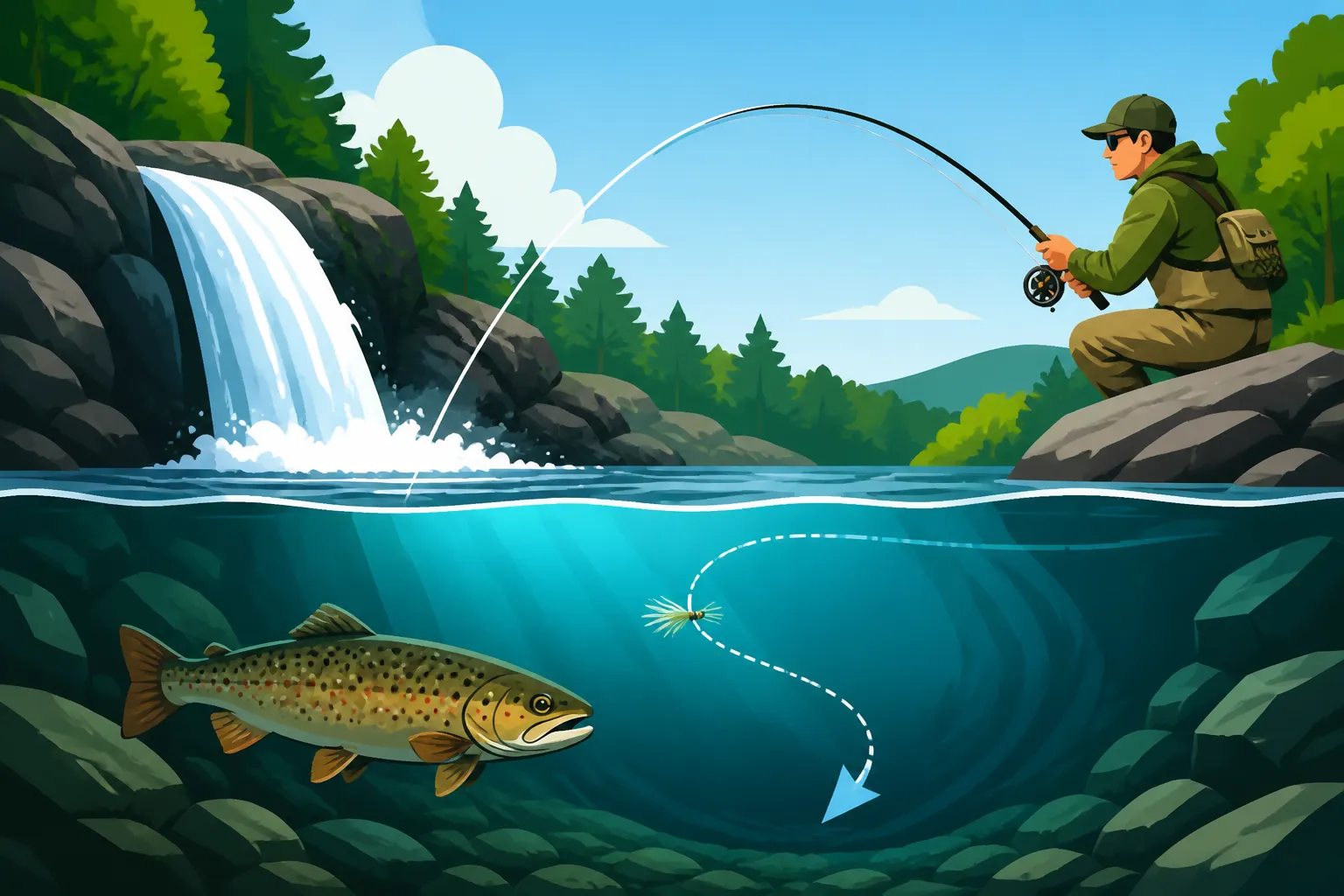
For spin fishing, immediately after your cast, close your bail and begin a controlled retrieve, or "swing." You want your lure to sink rapidly and then drift naturally with the current, tumbling along the bottom. If you're using a jig, let it bounce off the bottom, mimicking an injured baitfish or dislodged insect. Use just enough weight to get down, but not so much that you're constantly snagging. "High-sticking," which involves holding your rod tip high to keep as much line as possible off the water, helps reduce drag from the current, allowing for a more natural drift. Keep a watchful eye on your line; any unnatural hesitation or quick movement can signal a bite.
For fly fishing, this is often called a "dead drift" or "slack line nymphing." The goal is to make your fly drift at the same speed as the natural current, completely drag-free. This requires careful line management, often involving a combination of mending (throwing upstream curves in your line) and high-sticking to keep your fly line out of the main current's influence. As your fly drifts into the plunge pool, watch your indicator or the end of your fly line intently. Any twitch, stop, or unnatural movement could be a take. Sometimes, fish will only grab the fly for a split second, so a quick, decisive hook set is necessary. Learning to read your indicator's subtle movements is a skill that takes time to hone, but it's essential for consistent success in these dynamic environments. Many resources, including guides for Wading Techniques for Connecticut Trout Streams, emphasize similar presentation concepts.
Reading the Water and Adapting Your Approach
Plunge pools are rarely static. Water levels, clarity, and even fish behavior can change rapidly. Being able to adapt your techniques on the fly is what separates good anglers from truly great ones.
High Water vs. Low Water Strategies
The water conditions profoundly impact how fish use a plunge pool and how you should fish it.
- High Water/Turbid Conditions: After a heavy rain, rivers can swell, and plunge pools can become a raging torrent of muddy water. While intimidating, this can be an excellent time to fish. The increased flow dislodges more food, and the murkier water provides excellent cover for fish. In these conditions, fish will often move out of the strongest currents and tuck into the calmer eddies or along the very edges of the pool, where they can still intercept food without fighting the main flow.
- Tactics: Use heavier lures or more weight to get your offering down quickly through the fast water. Brightly colored lures (chartreuse, orange, hot pink) or those that create strong vibrations (spinnerbaits, lipless crankbaits) are effective in stained water because they rely more on flash and feel than sight. Scented baits or powerbait can also be particularly effective since fish will be relying on their lateral line and sense of smell. Cast upstream of the suspected lie and let the current carry your bait into the zone. Patience is key; it might take several drifts to find the sweet spot. When you're dealing with such conditions, having a variety of jig heads and soft plastics, easily ordered from Amazon, can be a game-changer.
- Low Water/Clear Conditions: During dry spells, river levels drop, and the water becomes crystal clear. Fish in plunge pools become incredibly wary. They'll hug the bottom and dart into cover at the slightest disturbance.
- Tactics: Stealth is paramount. Approach cautiously, staying low and out of sight. Use lighter lines (e.g., a lighter fluorocarbon leader) and smaller, more natural-colored baits and lures. Presentations must be perfect and drag-free. Small nymphs, tiny jigs, or even micro-spoons are ideal. Focus on longer, more precise casts that land well upstream of the fish, allowing your offering to drift naturally into the strike zone. Sometimes, a subtle twitch or slow retrieve is all it takes to entice a strike from a wary fish. Consider approaching from downstream, if possible, to avoid spooking fish that might be facing upstream. For trout in particular, understanding Spring Trout Fishing Techniques for Connecticut Streams will involve adapting to these fluctuating water conditions.
Adapting to Fish Behavior and Feedback
Fish aren't always in the same mood or in the same spot. Being observant and willing to change your approach is critical.
-
No Bites? Change Something: If you're not getting any action, don't keep doing the same thing. Change your lure color, size, or type. Switch from a jig to a spinner, or from a nymph to a streamer. Adjust your retrieve speed or your weight. Try fishing different depths within the pool – sometimes fish are suspended, other times they're glued to the bottom. Move to a different part of the pool, perhaps a calmer eddy you initially ignored, or the very lip where the water spills out. Think about different angles of approach too. Sometimes a cast from directly upstream, letting the current do the work, is better, while other times a quartering cast allows for better control.
-
Light Bites or Follows: If you're feeling light taps but no hookups, or seeing fish follow your lure without committing, it's a clear sign you're close but not quite right. This might mean the fish are "short striking" – only nipping at the tail of your lure.
- Tactics: Try a smaller lure or bait to match their cautious mood. Slow down your retrieve or drift even more. If using soft plastics, try trimming them slightly to present a smaller profile. For fly fishing, a different nymph size or subtle change in retrieve can make all the difference. Sometimes, a brief pause or a sudden darting motion can trigger an aggressive reaction strike.
- Example Scenario: You're fishing a deep plunge pool on the Salmon River, targeting trout. You've been drifting a size 12 Pheasant Tail nymph with moderate success, but the bites are very subtle. You notice a few small midges hatching. This is your cue! You switch to a smaller, perhaps size 18, midge pattern or even a tiny attractor nymph. Immediately, your hookup ratio improves as the fish are keying in on those smaller offerings. This kind of real-time adaptation, informed by observation and feedback from the fish, is the hallmark of a successful plunge pool angler. For more on specific species, check out guides like Trout Fishing in Connecticut or How to Catch Smallmouth Bass in Connecticut Rivers.
Safety and Environmental Considerations
Fishing plunge pools often means navigating rugged terrain and powerful currents. Being prepared and respectful of the environment is just as important as your fishing technique.
Wading Safety and Gear
The turbulent nature of plunge pools means wading can be treacherous. Always prioritize safety.
- Waders and Boots: Chest waders with studded or felt-soled boots provide the best traction on slippery rocks. Avoid walking poles with rubber tips; a metal-tipped wading staff offers much better grip and stability, especially in fast currents.
- Wading Staff: A sturdy wading staff is non-negotiable. It provides a third point of contact, helping you maintain balance and probing the depth and stability of the bottom before you step.
- Life Jacket: If you're wading in particularly deep or swift plunge pools, especially after heavy rains, consider wearing a lightweight personal flotation device (PFD). A quick slip could put you in a dangerous situation.
- Never Wade Alone: If possible, fish with a buddy. If you do go solo, always let someone know where you're going and when you expect to return.
- Know Your Limits: Don't attempt to wade water that is too deep or too fast for your comfort level. There's always another fishing spot.
The nature of these pools often means you're away from easy access. Make sure your gear is suitable for the environment; a good pair of waterproof boots for approaching the riverbank, and perhaps a small, compact tackle bag or vest that you can carry comfortably, like those often found on Amazon, are essential. Remember that Connecticut Boating Laws for Anglers also emphasize safety, even if you are just wading.
Leave No Trace Principles
Plunge pools are often found in beautiful, natural settings. It's our responsibility as anglers to protect these areas.
- Pack It In, Pack It Out: Everything you bring with you, take it back out. This includes fishing line scraps, bait containers, and food wrappers.
- Respect Wildlife: Observe wildlife from a distance and avoid disturbing nesting areas or sensitive habitats.
- Minimize Bank Erosion: Be mindful of where you walk along the banks. Avoid creating new paths or disturbing vegetation, which helps prevent erosion.
- Catch and Release Best Practices: Many of the larger fish in plunge pools are older, wilder specimens. If you plan to release fish, handle them gently, keep them in the water as much as possible, and revive them fully before letting them go. Wet your hands before touching the fish to protect their slime coat. Knowing about specific regulations, like those covered in Connecticut Trout Limit and Possession Rules, will help ensure you're compliant.
- Know the Regulations: Always check the current Connecticut Fishing Regulations Explained or Reading the Connecticut Fishing Guide before you head out. Some plunge pools or river sections might have special regulations, such as catch-and-release only or specific lure restrictions. For instance, some of the Connecticut Catch and Release Fly Fishing Only Waters might include plunge pools.
Plunge Pool Lure & Bait Guide
| Lure/Bait Type | Ideal Water Conditions | Target Species (Common CT Examples) | Best Presentation | Notes |
|---|---|---|---|---|
| Weighted Nymphs | Clear, varied currents | Trout, Smallmouth Bass | Dead drift with indicator/high-sticking | Essential for trout; imitate aquatic insects. |
| Small Jigs (1/16-1/8 oz) | Varied, clear to turbid | Trout, Smallmouth Bass, Panfish | Bounce along bottom, subtle jigging | Versatile; can be tipped with soft plastics or natural bait. |
| Inline Spinners | Clear to lightly stained | Trout, Smallmouth Bass | Cast upstream, retrieve slowly with current | Flash and vibration can trigger aggressive strikes. |
| Small Streamers (Woolly Bugger) | Clear to stained, active fish | Trout, Smallmouth Bass | Swing with current, short strips, retrieve | Imitates baitfish; effective for larger, predatory fish. |
| Worms/Mealworms | All conditions | Trout, Panfish, Smallmouth Bass | Fished on small hook with minimal weight, dead drift | Natural, scent-based; a classic for a reason. |
| Small Crankbaits/Jerkbaits | Clear to lightly stained | Smallmouth Bass | Erratic retrieve, twitch, pause | Great for covering water, bumping off structure. |
Local Plunge Pool Hotspots to Explore
Connecticut is blessed with numerous rivers and streams that feature fantastic plunge pools. While I won't give away anyone's secret spots, here are some general areas where you can start your exploration, keeping in mind that specific access points may vary and require local knowledge or public land maps.
- Farmington River: Especially the West Branch. This river is renowned for its trout fishing, and numerous stretches feature significant drops and boulders that create excellent plunge pools. Access points often involve some hiking, so be prepared. The Farmington River Trophy Trout Stream Rules apply in some sections, so always double-check.
- Housatonic River: Particularly in the upper sections where it flows through more rugged terrain. Here, you'll find plunge pools that hold both trophy trout and robust smallmouth bass, depending on the section and time of year. Knowing Where to fly fish the Housatonic River often leads to some of its best plunge pool systems.
- Salmon River: This beautiful river in eastern Connecticut offers excellent opportunities for trout, including some spectacular plunge pools that can be found by exploring its various branches.
- Smaller Feeder Streams: Don't overlook the myriad of smaller, less-known feeder streams that flow into Connecticut's larger rivers and lakes. Often, these streams have smaller, more intimate plunge pools created by natural obstructions or old mill dams, and they can hold surprising numbers of native brook trout or eager panfish. These are often perfect places to practice your precise casting techniques without too much pressure.
Remember, finding these hidden gems often requires a bit of hiking and exploration, which is part of the adventure! Use resources like the Connecticut Interactive Trout Stocking Map, Explained to help locate stocked waters where fish will naturally gravitate to these deeper, protected areas.
Disclaimer
This article is for general informational purposes only and does not constitute professional advice. Laws, prices and regulations vary by location and change over time. Consult a qualified professional for guidance on your specific situation.